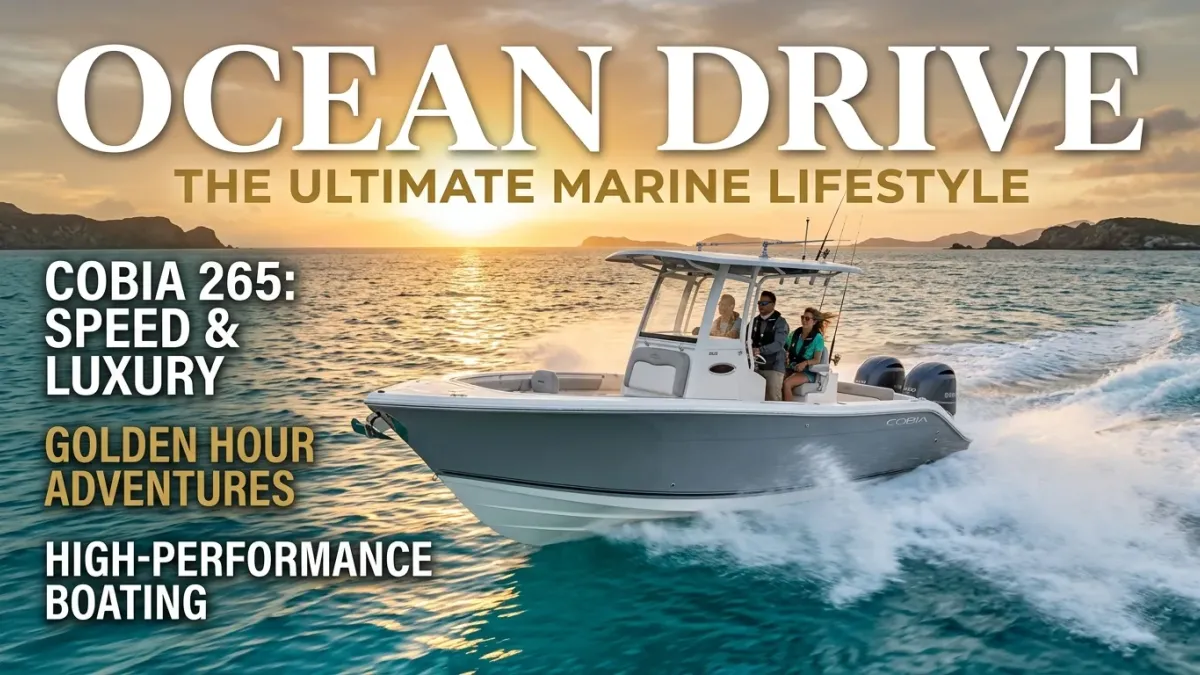
The Cobia 265 CC remains a standout in the mid-size offshore center console market, balancing serious tournament-grade fishing features with comfortable family seating. Engineered for anglers who regularly tackle tough inlet conditions and long offshore runs, this hull bridged the gap between smaller inshore craft and heavy-duty 30-footers. Whether cruising to the canyon or pulling up to a sandbar, the vessel's deep-V design and substantial beam offer a dry, forgiving ride that has kept it in high demand among second-hand boat buyers.
Quick answer: The Cobia 265 CC is a 26-foot 1-inch offshore center console featuring a 21.5-degree deadrise deep-V hull, dual Yamaha outboard power options (typically twin F150s or F200s), and a 162-gallon fuel capacity. It delivers an ideal mix of a 45+ knot top speed, exceptional chop handling, and family-friendly comforts like a step-down head compartment.
Detailed Cobia 265 Specs and Hull Dimensions
Built with solid GRP construction and a hand-laid fiberglass matrix system, the Cobia 265 CC is built to absorb structural pounding. Its hull features a aggressive 21.5-degree transom deadrise paired with wide reverse chine rails. This combination cuts cleanly through head seas while deflecting spray down and away from the cockpit, preventing the drenching ride common on flatter-bottom hulls. Measuring 26 feet 1 inch length overall (LOA) with a beam of 8 feet 10 inches, the hull provides ample deck area without exceeding standard state highway trailering limits without special permits.
Draft sits at a manageable 19 inches with the outboards tilted up, allowing boaters to navigate shallow coastal bay approaches or tuck behind islands during sudden weather shifts. Fully loaded with fuel, water, gear, and twin outboards, displacement sits around 5,700 lbs. That weight provides the solid momentum needed to slice through tight chop rather than riding up and slamming down. For anglers interested in comparing hull types for shallow versus deep-water versatility, understanding how deep-V hulls track in heavy swell is crucial for choosing the right rig.
The interior arrangement makes full use of the boat's beam. A flush forward deck leads back to a deep cockpit featuring coaming bolsters, insulated in-deck fish boxes with macerator pumps, and an integrated transom livewell. Fuel capacity stands at a generous 162 gallons (613 liters), housed in an aluminum tank positioned low along the centerline to keep the center of gravity stable during aggressive maneuvering.
| Specification | Measurement / Detail |
|---|---|
| Length Overall (LOA) | 26 ft 1 in (7.95 m) |
| Beam | 8 ft 10 in (2.69 m) |
| Draft (Motors Up) | 19 in (0.48 m) |
| Deadrise at Transom | 21.5 degrees |
| Dry Weight (approx., w/ twin F150s) | 5,350 lbs (2,426 kg) |
| Fuel Capacity | 162 gal (613 L) |
| Freshwater Capacity | 10 gal (38 L) |
| Max Horsepower Rating | 400 hp (298 kW) |
Engine Options, Real-World Fuel Economy & Performance Data
Most Cobia 265 CC hulls on the market were rigged at the factory with twin Yamaha outboards. The most popular pairing is twin Yamaha F150 four-stroke engines, though performance enthusiasts often opt for twin F200 inline-four or V6 configurations. Dual outboards provide essential redundancy when traveling 30 to 50 miles offshore, along with superior low-speed maneuverability around docks compared to a single large engine setup.
With twin Yamaha F150s spinning stainless steel 3-blade props, the Cobia 265 planes around 3,200 RPM. cruising speed sits comfortably at 28 to 31 knots (32-36 MPH) while turning 4,000 RPM, consuming roughly 13.5 to 14.8 gallons per hour (GPH). This yields an impressive fuel economy figure of approximately 2.1 to 2.3 statute miles per gallon (MPG). At full throttle (WOT), twin 150s push the 265 CC to top speeds between 42 and 45 knots, depending on bottom paint, load, and sea state. Upgrading to twin F200s bumps cruising speed to 34 knots and top-end performance past the 50-knot mark.
On-the-water tip: When running the Cobia 265 CC in a steep 3-foot beam sea, avoid relying solely on the outboard trim. Use small, incremental adjustments on your trim tabs to drop the windward bow bow slightly into the waves. This engages the sharper entry section of the hull, flattening out the ride completely while keeping spray well clear of the helm windshield.
Proper engine installation and prop selection are critical for keeping fuel economy high during long offshore runs. Check out our detailed guide on outboard engine maintenance and propeller sizing to ensure your setup is delivering maximum burn efficiency.
On-Water Handling: Rough Seas, Docking, and Offshore Stability
Offshore performance is where the Cobia 265 CC truly shines. The entry cuts cleanly into tight 2-to-4-foot chop without transferring harsh vibrations into the T-top or helm station. When drift fishing over deep wrecks or trolling along current lines, the wide chines provide solid initial stability, minimizing the snappy roll motion often found on narrower 24-degree deadrise hulls.
During tight maneuvering at the marina, the widely spaced twin outboards offer pinpoint control. By leaving the steering wheel centered and working the mechanical or digital throttles individually, skipper can spin the boat within its own length. Even in strong crosswinds, the substantial displacement prevents the bow from blowing off target quickly, allowing for stress-free docking even in crowded slips.
Safety equipment layout is equally well-thought-out. The high interior freeboard (28 inches in the aft cockpit) keeps young family members secure and provides firm leg support for anglers fighting big pelagics. Self-bailing cockpit scuppers drain deck water rapidly through large transom outlets, satisfying rigorous USCG safety standards for coastal and offshore vessels carrying full safety gear, including PFDs, flares, and an EPIRB.
Fishing Features vs Family Amenities
Cobia engineered the 265 CC to prevent compromise between hard-core angling setups and family comfort. For the fisherman, the stern features a 28-gallon insulated livewell with an acrylic lid, a high-volume raw water washdown pump, and under-gunwale rod storage for up to six offshore outfits. Four heavy-duty stainless steel gunwale rod holders come standard, alongside dual in-deck 45-gallon fish boxes equipped with dedicated overboard discharge pumps.
For family outings, the forward bow section features deep, cushioned seating with removable backrests, converting the bow into an open-air lounge. The front of the console houses a molded seat with an integrated cooler beneath. Inside the console, a lockable step-down head compartment offers a porta-potti or marine head system, a small sink, and convenient wiring access for the helm electronics array.
If you are exploring alternative hull sizes or deciding between dedicated offshore center consoles and dual-console models, read our guide on center console vs dual console layouts to pick the right platform for your lifestyle.
Buying Guide: Cobia 265 CC for Sale, Inspection Points & Value
Finding a well-maintained Cobia 265 CC on the pre-owned market requires examining specific wear areas common to high-use offshore craft. Look closely at the transom core and engine mounting bolts for stress cracks, and check the condition of the fuel sender hatches on the deck. Because these boats frequently run offshore, verifying that the bilge pumps, macerators, and high-water alarms are functioning properly is essential during any pre-purchase survey.
engine service records should be prioritized. Verify that the 100-hour and annual services were logged, paying close attention to water pump impellers, internal engine sacrificial anodes, and lower unit pressure tests. Expect resale values to reflect current engine hours, electronic upgrades (such as dual 12-inch MFDs and radar units), and trailer condition.
Boaters deciding between the Cobia 265 CC and smaller models like the Cobia 240 or older 262 will find that the 265 offers notably higher freeboard, a wider beam, and significantly more range due to its larger fuel tank. It delivers true offshore reach without requiring the diesel tow vehicle required by 30-plus foot center consoles.
Final Recommendation
If you need a proven, dry-riding 26-foot center console capable of running 40 miles offshore to fish the reefs one day and pulling water tubes at the lake the next, the Cobia 265 CC is an ideal match. Look for pre-owned models powered by twin Yamaha F150 or F200 outboards with complete service records. Schedule a professional marine survey and sea trial as your first step toward ownership.
Frequently Asked Questions
What is the fuel burn on a Cobia 265 CC with twin 150s?
At a comfortable cruise of 28 to 31 knots (around 4,000 RPM), twin Yamaha F150s burn roughly 13.5 to 14.8 GPH total. This yields a fuel economy rating of approximately 2.1 to 2.3 MPG, giving the boat a safe cruising range of over 300 nautical miles on its 162-gallon fuel tank.
Can the Cobia 265 CC be legally towed without a wide-load permit?
Yes. The Cobia 265 CC features a beam of 8 feet 10 inches. In most US states, standard non-permitted trailering limits are 8 feet 6 inches to 9 feet, making the 265 easy to trailer behind a standard 3/4-ton tow vehicle.
Is the Cobia 265 CC suitable for offshore trolling?
Absolutely. The 21.5-degree deadrise hull tracks extremely straight at slow trolling speeds (5 to 9 knots) without constant helm correction. Its wide chines provide stability while drift fishing, and the deep cockpit freeboard keeps anglers secure in rolling offshore seas.
Sources
- Cobia Boats Official Website
- Yamaha Outboard Performance Tests & Specifications
- Boat Owners Association of The United States (BoatUS)
- American Boat & Yacht Council (ABYC) Standards
| Model | Length | Engines | Best For |
|---|---|---|---|
| Cobia 262 | ~26 ft | Twin outboards | Compact offshore & family boating |
| Cobia 265 | ~26.5 ft | Twin outboards | Balanced fishing & cruising |
| Cobia 265 CC Open | ~26.5 ft | Twin outboards | Maximum fishing space |
| Cobia 350 | ~35 ft | Triple outboards | Extended offshore trips & luxury |