Disclosure: As an Amazon Associate, we earn from qualifying purchases.
Stepping onto the dock with your family on a sunny Saturday morning, cool water sloshing against the pilings, brings a unique sense of anticipation. Selecting the right vessel to captain for these weekend getaways usually comes down to two dominant contenders in the trailerable runabout world: the bowrider and the deck boat. Both offer exceptional platforms for coastal cruising, sandbar hopping, and towing tubers, yet their underlying naval architecture dictates vastly different experiences on the water.Quick answer: Choose a bowrider if your priority is sharp, sportscar-like handling, traditional sleek styling, and dedicated watersports performance in choppy water. Opt for a deck boat if you prioritize maximum seating capacity, easy boarding, extra deck space for entertaining large groups, and maximum stability at rest.
Naval Architecture and Hull Dynamics Compared
Understanding how these two vessel types perform requires looking beneath the waterline. A classic bowrider utilizes a traditional V-hull design, usually featuring a deep-V or modified-V entry ranging from 19 to 21 degrees of transom deadrise. This sharp entry cuts through lake chop and coastal waves smoothly, tracking predictably through high-speed turns. The hull tapers cleanly toward the stem, creating that iconic, sleek profile loved by traditionalists.
Deck boats, by contrast, carry their beam (width) much farther forward toward the bow. To support this expanded forward structure without creating extreme hydrodynamic drag, marine engineers utilize modified sponsons, cathedral hulls, or "pickle-fork" bow shapes. Models like the Hurricane SunDeck 2400 or Sea Ray SDX 250 feature a flared bow section with deadrise angles typically flatter at the stern—often around 16 to 18 degrees. This flared design maximizes interior volume and provides tremendous initial stability, though it can pound somewhat harder when tackling aggressive, short-period chop at higher speeds.
Engine configuration also plays a major role in how these hulls interact with the water. While sterndrive propulsion (such as MerCruiser 4.5L V6 or Volvo Penta V8 setups) was once the absolute standard for both categories, modern single-outboard setups (like a Mercury Verado 250 hp or Yamaha F200/F250) have largely taken over. Outboards reduce overall boat displacement, simplify winterization maintenance, and free up massive amounts of internal floor space for storage lockers and oversized cooler cutouts.
On-the-water tip: When taking a deck boat through heavy boat wakes or steep bay chop, trim the engine down slightly and angle your approach to 45 degrees rather than taking waves straight on the blunt bow. This prevents spray from coming over the bow rail and keeps your passengers in the forward lounge completely dry.
Interior Layouts, Usable Space, and Passenger Capacity
The defining visual difference between these designs becomes immediately obvious once you step aboard the gunwales. A 22-foot bowrider typically offers cozy bow seating contoured for two adults or three kids, arranged in a V-shape. The helm and companion bucket seats lead back to an aft bench seat and a sunpad covering the engine compartment or sterndrive box. This layout creates an intimate, secure cockpit feel that keeps passengers tucked safely inside while running at 40 knots.
Certified Family Protection: O'Neill Superlite USCG Approved Life Vest

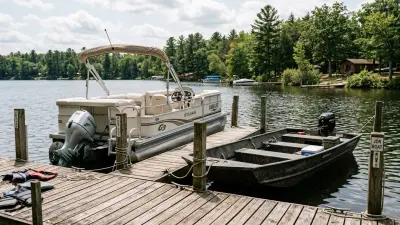
In contrast, a 22-foot deck boat carries a full 8-foot 6-inch beam almost all the way to the bow cleat. This creates a rectangular bow lounge that comfortably seats four adults facing each other, often featuring a removable pedestal table for lunchtime dockside picnics. The walk-through transition from the bow to the main cockpit is wider, eliminating foot-traffic bottlenecks when anchoring off a crowded beach or rigging water skis.
Storage capacity on a deck boat generally outpaces a similar-length bowrider. Expanded deck footprints allow boatbuilders to install deeper under-seat storage compartments, massive in-floor wakeboard lockers, and dedicated trash receptacle nooks. Additionally, deck boats almost universally include a fully enclosed head compartment built into the portside console—a mandatory amenity for long days on the water with young children or older family members.
Performance, Watersports, and Real-World Specifications
When towing a wakeboarder or pulling a triple tube, throttle response, plane speed, and wake shape become critical factors. Bowriders excel in carving tight turns and holding an edge, making them natural tow boats for slalom skiers and wakeboarders who demand a clean, well-defined wake. Deck boats deliver plenty of low-end torque for pulling tubers, but their wider bow profiles generate slightly more wind resistance and a flatter, wider wake spread.
To help visualize how these two designs compare in key technical specifications, the table below outlines typical metrics for a 22-foot model in each category.
| Specification / Feature | 22-Foot Bowrider (e.g., Sea Ray SPX 210) | 22-Foot Deck Boat (e.g., Chaparral SunCoast 216) |
|---|---|---|
| Length Overall (LOA) | 21 ft 6 in (6.55 m) | 21 ft 10 in (6.65 m) |
| Beam (Width) | 8 ft 6 in (2.59 m) | 8 ft 6 in (2.59 m) |
| Draft (Drive Down) | 36 in (0.91 m) | 32 in (0.81 m) |
| Approximate Dry Weight | 3,400 lbs (1,542 kg) | 3,850 lbs (1,746 kg) |
| Deadrise at Transom | 19 - 21 degrees | 16 - 18 degrees |
| Maximum Horsepower | 250 HP (Outboard / Sterndrive) | 250 HP (Outboard) |
| USCG Passenger Capacity | 10 Persons / 1,450 lbs | 12 Persons / 1,800 lbs |
| Fuel Tank Capacity | 40 gal (151 L) | 50 gal (189 L) |
Notice how the deck boat carries an expanded passenger weight threshold despite sharing similar dimensions. This increased capacity stems from the added buoyancy built into the forward hull sections, which prevents bow immersion when several adults congregate near the anchor locker.
Balanced Towing Precision: Airhead Tow Demon Harness

Safety Requirements, Ownership Costs, and Maintenance
Safety equipment requirements set by the U.S. Coast Guard apply equally to both vessel styles under 26 feet. Captains must carry correctly fitted PFDs (Personal Flotation Devices) for every soul aboard, throwable Type IV cushions, USCG-approved fire extinguishers, visual distress flares, and a functional sound-producing device like an air horn. However, deck boats offer an added practical safety feature: dedicated bow boarding ladders. These telescopic stainless-steel ladders allow passengers to step safely onto sandy beaches or docks directly from the front of the vessel, staying well away from stern propellers.
Annual operating costs for both classes closely parallel each other, but key maintenance items vary based on engine selection rather than hull shape alone:
- Outboard engine service: Annual 100-hour service for Yamaha or Mercury outboards involves gear lube changes, engine oil/filter replacement, fuel filter changes, and spark plug checks, typically costing $400–$700 annually.
- Sterndrive Maintenance: Sterndrives require additional inspection of rubber drive bellows, gimbal bearings, and sacrificial anodes, along with winterization drain procedures that can push annual maintenance to $800–$1,200.
- Canvas and Upholstery Care: Deck boats feature significantly more marine vinyl seating area exposed to UV rays, requiring frequent marine-grade vinyl protectant applications to prevent seam splitting and mildew formation.
- Trailering Considerations: Because deck boats carry their weight farther forward, tow vehicles need adequate tongue-weight capacity. A dual-axle aluminum trailer equipped with surge or electric-over-hydraulic brakes is strongly recommended for both styles over 20 feet.
Making the Final Decision for Your Family
If your primary boating destinations involve rough coastal bays, open sound water, high-speed watersports towing, and classic styling lines, a mid-to-large bowrider equipped with a deep-V hull will serve your performance needs best. Conversely, if your summer itineraries focus on sandbar gatherings, hosting large family outings, effortless beach docking, and maximizing lounging space, a modern outboard-powered deck boat provides the ultimate platform for effortless fun on the water.
Frequently Asked Questions
Can a deck boat handle rough water as safely as a bowrider?
Showroom Vinyl Protection: Star brite Ultimate Vinyl Clean & Protectant

Yes, modern deck boats built by top manufacturers meet strict marine safety standards and navigate chop securely. However, because of their flatter bow deadrise and wider forward deck, deck boats tend to ride slightly rougher and spray more water in heavy chop compared to a deep-V bowrider of the same length.
Is an outboard engine better than a sterndrive for a family day boat?
outboard engines have become overwhelmingly popular because they weigh less, are easier to maintain, offer complete tilt-out capabilities for shallow beaching, and open up vast interior storage space under the aft sunpad. Sterndrives remain popular for owners who prefer an unobstructed, full-width swim platform free of an engine cowling.
What tow vehicle do I need to haul a 22-foot deck boat or bowrider?
A typical 22-foot bowrider or deck boat on a dual-axle trailer has a combined tow weight (boat, engine, trailer, fuel, and gear) of roughly 4,800 to 5,800 pounds. A mid-size or full-size truck or SUV with a towing rating of at least 6,500 to 7,000 pounds is required to tow safely on highways and pull the boat up wet slippery boat ramps.