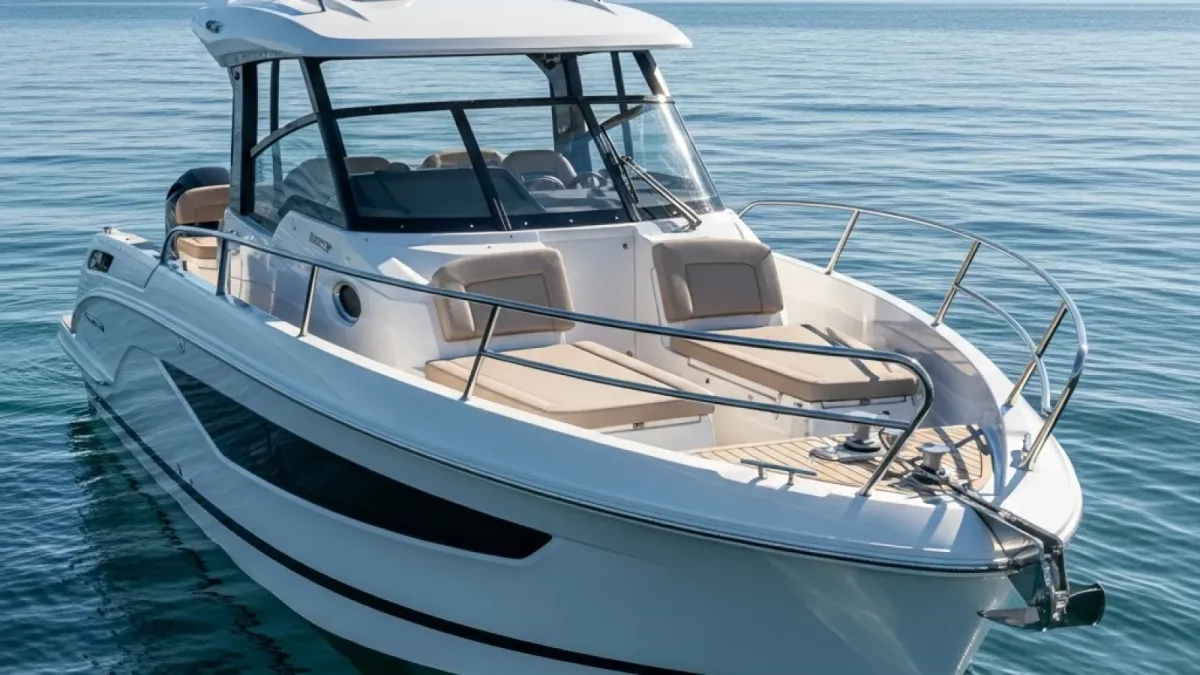
Quick answer: The Quicksilver 855 Activ Weekend stands out as a top family cruiser because it offers two separate double berths, an enclosed private head, and a convertible dinette within a sub-30-foot hull powered by reliable twin outboards. Its intelligent layout combines asymmetric side-decks for safe bow access with an enclosed, all-weather wheelhouse, giving families true four-season cruising capability without requiring a massive maintenance budget.
Design and Architecture: How Space is Maximized
When analyzing the architecture of modern powerboats, hull volume management is everything. The Quicksilver 855 features an overall length (LOA) of 8.91 meters (29 feet 3 inches) and a beam of 2.98 meters (9 feet 9 inches), dimensions that place it right on the edge of easy trailering with specialized transport while offering maximum internal volume for its class. Utilizing a vacuum-infused fiberglass (GRP) layup, the boat achieves a displacement of roughly 2,713 kilograms (5,981 lbs) dry, without engines. This modern composite construction guarantees structural rigidity in choppy coastal waters while keeping the draft down to just 0.58 meters (1 foot 11 inches), allowing owners to safely navigate shallow bays, tidal rivers, and secluded anchorages that deeper keelboats cannot access.
One of the most impressive design traits engineered into this platform is the asymmetric deck arrangement. By shifting the wheelhouse slightly to port, Quicksilver created a wide, deep starboard side-deck with high freeboard and solid stainless steel handrails. Children and older guests can move safely from the cockpit to the forward sun pad without squeezing around narrow gunwales. Furthermore, a sliding side-door at the helm allows the skipper to step directly onto the starboard deck, making single-handed docking or handing off lines to deckhands completely stress-free. The aft cockpit itself features an L-shaped lounge on a sliding track system; push the seat forward to raise the outboard engines completely out of salt water, or slide it aft when anchored to maximize cockpit floor space for alfresco dining.
Over decades of surveying and handling market options in power boats, few structural choices prove as practical for young families as the fully enclosed main saloon. Rather than relying on leaky canvas enclosures that deteriorate after three seasons in the sun, the 855 provides safety and climate control behind standard tempered glass sliding doors. Sunlight floods the main interior through a large glass skylight and 360-degree panoramic windows, giving guests an uninterrupted view of the horizon, which significantly reduces the likelihood of motion sickness among sensitive passengers.
Interior Layout and Accommodation Capabilities
Step inside the main cabin, and the interior layout reveals why this model remains a strong competitor against traditional European pocket cruisers from builders like Beneteau or Jeanneau. To port, a four-person dinette features two facing benches; the forward bench sports a clever hinged backrest that flips effortlessly, transforming it into a double co-navigator seat facing forward while underway. At night, this entire dinette drops down to convert into an auxiliary double bed, bringing the potential sleeping capacity to six passengers. Directly opposite to starboard, behind the helm seat, sits a fully integrated galley equipped with a stainless steel sink, a single-burner LPG stove, a 12-volt refrigerator, and dedicated hardwood storage drawers for utensils and provisions.
| Model | Approximate Price Range |
|---|---|
| Quicksilver 620 | Entry-level, budget-friendly |
| Quicksilver 805 | Mid-range pricing |
| Quicksilver 855 | Higher-end cruiser |
| Quicksilver Pilothouse | Varies by size and equipment |
| Quicksilver Activ | Wide range depending on model |
Below deck, the accommodation space makes clever use of the deep-V bow section to deliver two distinct, private sleeping zones without compromising headroom. The master cabin forward features an offset island double berth with custom foam mattresses, reading lights, and under-bed storage lockers capable of housing life jackets, duffel bags, and extra gear. Hull-side portlights bring in natural sea light, while an opening overhead deck hatch ensures proper cross-ventilation during warm summer nights at anchor.
- Forward Master Cabin: Double island berth, generous under-bed locker space, reading lamps, and opening deck hatch.
- Mid-Ships Guest Cabin: Generous transverse double berth, standing dressing area, hull window, and dedicated hanging locker.
- Enclosed Marine Head: Molded fiberglass interior for easy washdown, electric sea toilet, sink with pull-out shower rose, and opening portlight.
- Saloon Dinette: Seating for four adult passengers, converts quickly into an additional 2-person emergency berth.
On-the-water tip: When setting up the mid-ships cabin for extended cruising, always double-check the operation of the automatic bilge pump float switch located under the berth access panel. Newer owners often pack excess duffel bags tightly into this bilge space, unintentionally pinning the mechanical float switch in the "off" position or jamming the manual manual pump linkage.
Engine Options, Specs, and Real-World Performance
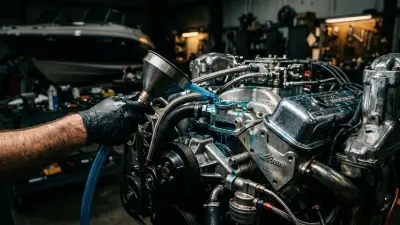
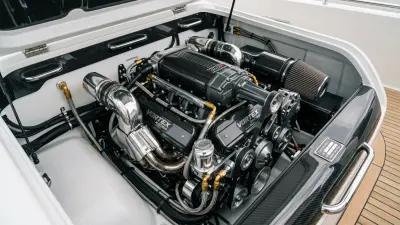
Selecting the right propulsion package for a 3-ton cruiser is critical for fuel economy, planing efficiency, and long-term resale value. The Quicksilver 855 is designed specifically around outboard power, engineered to carry either a single heavy-duty outboard up to 400 horsepower or a twin outboard setup generating up to 350 combined horsepower. Popular configurations feature either a single Mercury Verado 300 hp V8 or twin Mercury 150 or 200 hp FourStroke outboards. Outboard propulsion not only dramatically frees up internal hull space for the mid-cabin, but also reduces routine maintenance costs compared to complex sterndrive or inboard shaft setups.
| Specification Parameter | Mercury Verado 300 HP (Single) | Twin Mercury 150 HP (Twin Setup) | Twin Mercury 200 HP V6 (Twin Setup) |
|---|---|---|---|
| Top Speed (Knots) | 30 - 32 knots | 33 - 35 knots | 37 - 39 knots |
| Cruising Speed (Knots) | 20 - 22 knots | 22 - 24 knots | 24 - 26 knots |
| Fuel Consumption @ Cruise | ~48 L/hr (12.6 GPH) | ~54 L/hr (14.2 GPH) | ~58 L/hr (15.3 GPH) |
| Optimum Range (400L Tank) | ~150 - 160 nautical miles | ~140 - 150 nautical miles | ~135 - 145 nautical miles |
| Docking Control | Standard Bow Thruster | Standard Bow Thruster | Optional Joystick Piloting |
Underway, the stepped hull design delivers smooth efficiency by reducing wetted surface drag as the boat climbs onto plane. Pushing the throttles forward with twin 150 hp outboards brings the boat on plane in under six seconds, with minimal bow rise that maintains good forward visibility from the helm. Cruising comfortably at 23 knots around 4,200 RPM, the boat consumes roughly 54 liters of fuel per hour, providing a safe operating range of over 140 nautical miles from its standard 400-liter (105-gallon) aluminum fuel tank. For families who plan to cross open bays or coastal stretches subject to sudden chop, the twin-engine arrangement offers built-in redundancy, ensuring you can safely return to port even if one engine experiences fuel line issues or mechanical faults.
Seakeeping Ability and Essential Safety Gear
Certified under CE Category B (Offshore) for up to 6 people or Category C (Inshore) for up to 10 passengers, the 855 is built to handle coastal conditions with up to Force 8 winds and 4-meter significant wave heights. The sharp entry bow cuts smoothly through chop, while wide reverse chine rails redirect spray downward, keeping the glass windshield dry. When handling crosswinds while docking, the deep topsides act as a sail, making the optional factory-installed electric bow thruster an almost mandatory upgrade for stress-free maneuvering around tight marina slips.
Ensuring family safety requires stocking appropriate, high-quality marine equipment before departing the fuel dock. Aside from standard Coast Guard requirements—such as Type I or Type II PFDs for every passenger on board, a throwable cushion, and marine fire extinguishers—extended family coastal cruising warrants investing in proper electronic safety gear. An EPIRB (Emergency Position Indicating Radio Beacon) mounted near the helm station, a waterproof handheld VHF radio with built-in GPS/DSC capabilities, and visual LED flares provide crucial peace of mind when venturing offshore with children.
For those researching market alternatives and weighing purchasing options across different manufacturer lines, reviewing detailed specs on boating equipment and hull designs helps clarify how various layouts impact onboard living space. Proper weight distribution is essential on out-driven hulls; keep heavy equipment, spare water jugs, and anchor chains stowed low in the bow lockers to optimize your running trim angle without over-relying on trim tabs.
Clear Recommendation for Buyers
If you are looking for a turn-key family cruiser that avoids the high maintenance fees and complicated mechanics of inboard shaft diesel systems, target a gently used or new Quicksilver 855 configured with twin Mercury outboards and a factory bow thruster. This setup offers the best balance of safety, redundancy, and low-speed docking control. Plan your purchase ahead of the spring season so you can complete engine servicing, apply fresh anti-fouling paint, and conduct sea trials in calm waters before taking your family out on their first overnight coastal weekend.
Frequently Asked Questions
Is the Quicksilver 855 easy to dock for a beginner captain?
Yes, especially models fitted with twin outboards and the optional bow thruster. The high helm position provides clear line-of-sight visibility to both aft corners, and the sliding helm door allows the captain to quickly step out onto the starboard side deck to cleat off lines directly.
What is the difference between the Quicksilver 855 Activ and 855 Weekend?
The names are often used interchangeably in different regional markets. The "Activ Weekend" refers to the fully appointed cruiser trim package featuring the enclosed wheelhouse, permanent double cabins, galley facilities, and shore power electrical systems designed specifically for overnight family stays.
Can the Quicksilver 855 be trailered legally?
With an overall beam of 2.98 meters (9 feet 9 inches) and a dry package weight around 3.5 metric tons including engines and fuel, it exceeds standard wide-load limits in many regions. While trailering is possible with appropriate heavy-duty tow vehicles and wide-load road permits, most owners prefer keeping the boat in a marina slip, stack-deck storage, or on a yard trailer during the off-season.