Disclosure: As an Amazon Associate, we earn from qualifying purchases.
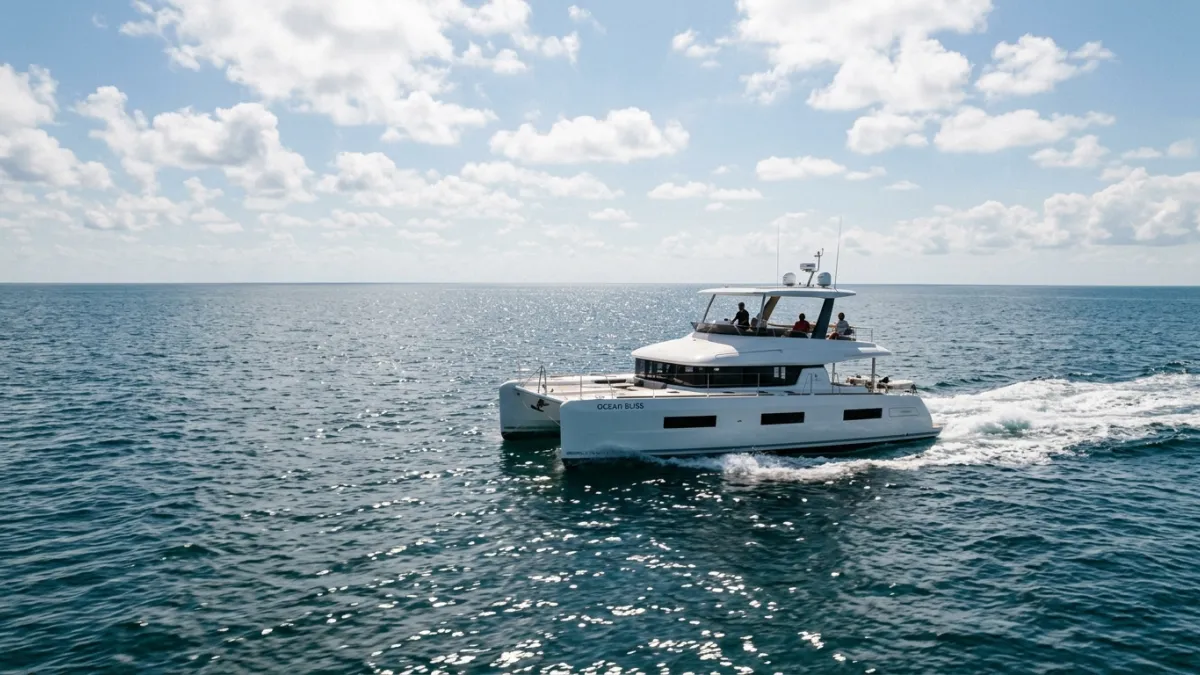
A rigorous power catamaran test evaluates three core criteria: fuel efficiency across displacement and planing speeds, bridge deck clearance under dynamic sea conditions, and close-quarters dock maneuverability. Unlike traditional monohull yachts, modern power catamaran yachts achieve 30% to 40% lower fuel consumption at mid-range cruise speeds (typically 14 to 18 knots) due to slender hull forms and reduced hydrodynamic drag. Conducting a complete sea trial review requires observing engine noise levels, hull tunnel slamming in head seas, fuel burn curves, and high-speed turning stability.
Key Metrics to Evaluate During a Power Catamaran Review
When conducting a thorough power catamaran review, off-the-shelf specs on a dealer brochure rarely tell the whole story. You must observe real-world performance under realistic load conditions (50% fuel and water tanks plus full cruising gear). Key metrics to log during your sea trial include:
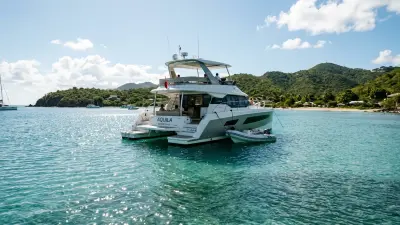
- Fuel Burn vs. Speed Curves: Test displacement cruising speeds (around 7–9 knots) alongside fast cruising speeds (15–18 knots). High-efficiency cruising power catamarans like the Leopard 40 PC or Aquila 44 burn roughly 2.5 to 3 gallons per hour (GPH) per engine at 8 knots, jumping to 15–20 GPH per engine when running on plane at 18 knots.
- Bridge Deck Clearance & Clearance under Load: Low bridge deck clearance (the distance between the water line and the underside of the central salon deck) causes harsh pounding and structural vibration in steep head seas. Ensure at least 25–30 inches of static clearance on 40-to-50-foot models.
- Close-Quarters Docking: Because the twin shafts or pod drives are positioned far apart on opposite hulls, a cruising power catamaran can rotate 360 degrees in its own length using split engine throttles without touching the steering wheel or bow thrusters.
- Leaning in Turns: Unlike monohulls that heel inward during sharp turns, catamarans either stay completely flat or lean slightly outward due to centrifugal forces. Test hard-over steering at 15+ knots to confirm predictable helm response.
Power Catamaran vs. Monohull Performance Comparison
Understanding how a cruising power catamaran compares to an equivalent-length motor yacht highlights why twin-hull configurations are dominating the modern luxury cruiser market. The table below breaks down benchmark performance data from actual sea trials.
Maretron Fuel Flow Monitor, NMEA 2000, New Condition, FFM100-01

| Performance Metric | 40-45ft Power Catamaran | 40-45ft Flybridge Monohull |
|---|---|---|
| Eco Cruise Speed / Fuel Burn | 8.0 knots @ 3.0 GPH total | 8.0 knots @ 5.5 GPH total |
| Fast Cruise Speed / Fuel Burn | 17.5 knots @ 22.0 GPH total | 18.0 knots @ 34.0 GPH total |
| Max Theoretical Range (350 gal tank) | ~800–900 nm @ 8 knots | ~450–550 nm @ 8 knots |
| Beam / Saloon Space | 21–22 ft beam / Expansive | 13–14 ft beam / Moderate |
| Roll at Anchor | Minimal (High Form Stability) | Moderate to Severe (Requires Gyro) |
How to Conduct a Step-by-Step Sea Trial Test
Testing a powercat requires a structured, multi-step process to reveal both its strengths and operational limitations. Follow these actionable steps during your sea trial:
- Static Pre-Departure Inspection: Check engine room access in both hulls. Look for accessible raw-water strainers, fuel filters, dipsticks, and battery banks. Verify structural bulkheads, crash box integrity in the bow sections, and bilges.
- Low-Speed Docking Test: Practice maneuvering out of the slip using throttle controls only. Disengage bow thrusters to test true engine-spacing leverage.
- Noise and Vibration Sweep: Record decibel readings at the lower helm station and main deck salon at idle, 1,500 RPM, 2,800 RPM, and Wide Open Throttle (WOT). Sound levels in the main salon should ideally remain under 72 dB at cruise.
- Head Sea & Quartering Sea Run: Steer directly into 3-to-4-foot choppy waves at fast cruising speeds (15–18 knots). Listen for hull bridge deck pounding ("slapping"). Turn 45 degrees to test quartering sea tracking and helm correction needs.
- Single-Engine Operation: Shut down one engine completely while at sea to confirm emergency speed and steering control under single-shaft propulsion.
Pros and Cons of Power Catamarans
Pros
SKYRC GNSS Performance Analyzer RC GPS+GLONASS Speedometer, Bluetooth Enabled Race Data Logger and Speed Tracker for RC Cars and Planes. GSM020 SK-500023

- Unrivaled Onboard Space: Massive main deck salons and flybridge entertainment zones spanning full beam.
- Anchor Stability: Exceptional resistance to rolling at anchor without needing expensive gyro stabilizers.
- Shallow Draft Access: Drafts as shallow as 3.2 to 3.8 feet allow easy entry to shallow coastal anchorages.
- System Redundancy: Independent engines, fuel lines, and drive shafts in separate hulls provide high safety reserves.
Cons
- Higher Slip Fees: Double-wide beams often mean paying 1.5x to 2x for marina dockage or haul-outs.
- Bridge Pounding in Heavy Seas: Low-clearance models slam when tackling steep, short-period chop.
- Dual Engine Maintenance: Two mechanical rooms mean double the oil changes, zinc replacements, and filter service.
Frequently Asked Questions
What is the ideal cruising speed for a power catamaran?
Most production powercats feature two sweet spots: an economical displacement cruise speed between 7 and 9 knots for long-range offshore passages, and a fast planing/semi-displacement cruise speed between 15 and 18 knots for quick coastal hops.
ZW2011239 Distribution Unit S with 4M Power Cable

Do power catamarans slam in rough chop?
Slamming occurs when waves strike the underside of the bridge deck connecting the two hulls. Higher clearance and air-cushioned tunnel designs minimize pounding, but driving into short-period waves at high speed will cause occasional slapping on most recreational models.
Are power catamarans harder to dock than monohulls?
No, they are usually easier. Because the twin engines are set twice as far apart as on a monohull, differential engine thrust gives the helm operator superior leverage to rotate or pivot the boat without using a rudder or bow thruster.