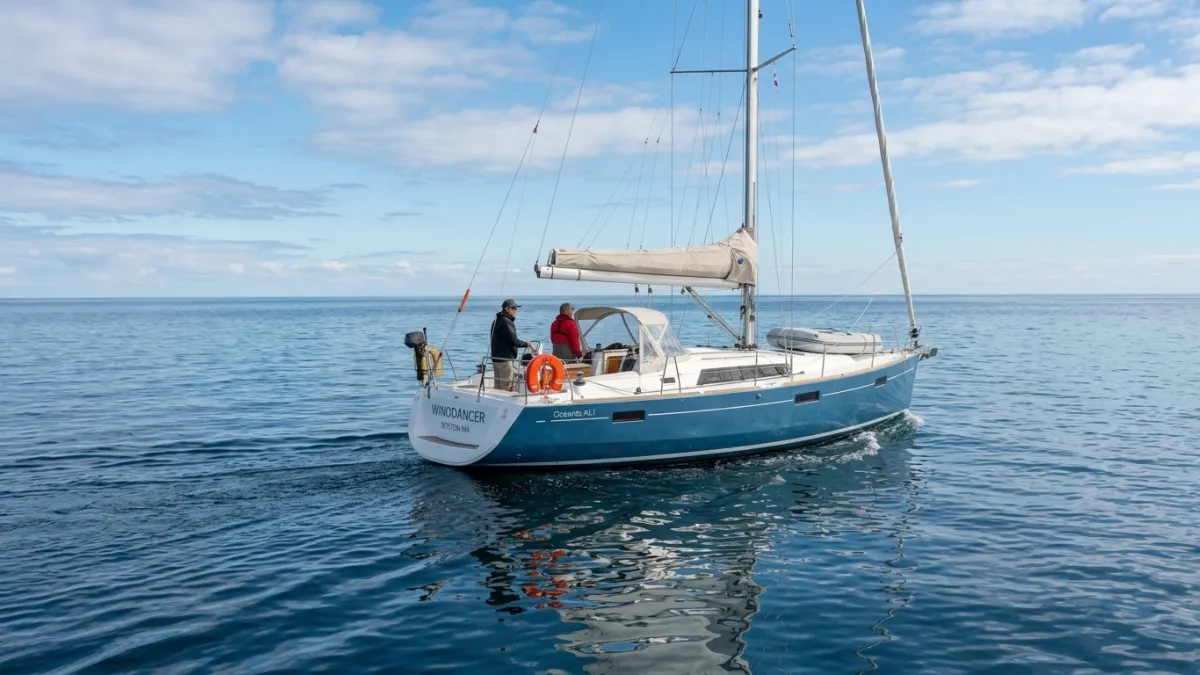
A power sailboat—traditionally known as a motorsailer—combines a full displacement hull and a working sail rig with an oversized diesel engine (typically 50 to 150 HP) capable of maintaining hull speed under engine power alone. Modern cruising enthusiasts frequently compare these vessels to power catamaran yachts, which eliminate sails entirely to utilize dual powerplants (often 150 to 440 HP per engine), delivering cruising speeds of 15 to 24 knots alongside draft depths as low as 3.5 feet and broad 20-plus-foot beams. Both vessel designs solve the trade-off between fuel efficiency, underway stability, and interior living volume, though each serves distinct cruising requirements.
Monohull Motorsailers vs. Power Catamaran Yachts
Understanding the architectural distinction between a traditional power sailboat and a twin-hull powerboat is essential for selecting the right vessel for long-range cruising or coastal island hopping. Monohull motorsailers rely on heavy ballasted keels to provide righting moment, drawing between 5.5 and 7.5 feet of water. Their hull forms are predominantly full-displacement, capping maximum speed to their calculated theoretical hull speed (roughly calculated as 1.34 times the square root of the waterline length in feet).
Conversely, power catamaran yachts achieve transverse stability through their wide beam spacing across twin pontoon hulls rather than heavy lead ballast. Because they lack a deep ballasted keel, power catamarans carry significantly lower displacement-to-length ratios. This allows semi-displacement or full-planing hull forms to lift out of the water, exceeding conventional hull speed limits without requiring massive fuel consumption. Additionally, removing the sail rig eliminates mast air draft restrictions, allowing powercats to navigate bridges with clearances under 20 feet.
Performance and Technical Comparison
When analyzing operational capabilities, key metrics include fuel burn rates at cruise, draft requirements, usable deck area, and underway motion characteristics in choppy seas. Below is a direct specifications comparison for typical 40-to-45-foot cruising configurations:
| Specification Feature | Monohull Power Sailboat (Motorsailer) | Power Catamaran Yacht |
|---|---|---|
| Average Cruising Speed | 6.5 – 8.5 knots | 15 – 24 knots |
| Draft Range | 5.5 – 7.5 feet | 3.0 – 4.0 feet |
| Beam Width (40-45ft length) | 12 – 14 feet | 20 – 23 feet |
| Fuel Capacity | 150 – 300 gallons | 300 – 600 gallons |
| Primary Powerplant | Single 50 – 150 HP diesel | Twin 150 – 440 HP diesels |
| Underway Motion Profile | Heeling under sail; deep rolling in swells | Flat posture; rapid, damp roll period |
Mechanical Systems and Engines
Engine sizing directly defines how a power sailboat or power catamaran operates. Standard sailing monohulls carry auxiliary engines calibrated at roughly 1.5 to 2.5 horsepower per ton of displacement. A true power sailboat scales this up to 3.5 to 5.0 HP per ton, allowing the vessel to punch through heavy head seas against strong tidal currents at maximum continuous engine RPM without overheating.
On twin-engine power catamaran yachts, mechanical design focuses on engine room accessibility within narrower hull sponsons. Manufacturers typically install straight-shaft drives, V-drives, or IPS pod drives paired with electronic diesel controls. Mounting an engine independently in each hull provides built-in mechanical redundancy: if one propulsion system fails due to fuel contamination or mechanical issues, the vessel can continue operating on the remaining engine at 8 to 10 knots.
Modern powercats also take advantage of large hardtop roof surfaces to integrate solar panel arrays ranging from 1,200 to 3,000 Watts. Combined with lithium iron phosphate (LiFePO4) house battery banks, these solar arrays supply high-voltage house loads—including inverter-driven air conditioning—without requiring continuous diesel generator runtime while anchored.
Evaluating Seakeeping and Deck Space
Choosing between these hull configurations depends heavily on your preferred cruising grounds and lifestyle requirements:
- Shallow Water Navigation: Power catamarans draw only 3 to 4 feet of water, enabling safe passage through shallow coastal areas like the Bahamas, Florida Keys, or inland canals where deep-keeled power sailboats (drawing 6+ feet) risk grounded keels.
- Living Area and Bridge Deck: A 44-foot power catamaran boasts an average deck footprint exceeding 700 square feet, providing a single-level saloon and cockpit layout along with a spacious flybridge. A monohull motorsailer of equal length offers roughly 350 to 400 square feet of usable deck space due to narrower side decks and tapered aft sections.
- Docking and Maneuvering: Dual engine throttle controls spaced 18 to 22 feet apart give power catamarans exceptional low-speed maneuverability. By split-shearing the throttles (one engine in forward, one in reverse), the boat can rotate 360 degrees within its own length without needing a bow thruster.
- Motion at Anchor: Power catamarans eliminate the persistent pendulum roll common to unballasted monohulls anchored in exposed roadsteads, though they can experience snap-roll periods in tight beam seas.
Maintenance & Operating Considerations
Operating costs scale differently across hull types and engine packages:
Haul-Out Costs: Power catamarans require wide travelifts (typically requiring a 26-foot or wider lift bay) or marine railway haul-out systems. Haul-out, pressure washing, and bottom painting yards often charge a 20% to 50% premium on haul-out rates for multihulls due to the dual hull surface area and yard space occupied.
Marina Dockage: Because a power cat carries a beam almost double that of a comparable monohull, transient marina slips may incur side-tie or 1.5x T-head rates when standard slips cannot accommodate a 22-foot beam. Monohull power sailboats fit standard 14-foot slip widths easily.
Engine Servicing: Dual engines require twice the fluid changes, zinc replacements, impeller upgrades, and heat exchanger flushes. However, because powercat engines are modern marine diesels operating without the severe heel angles of a sailboat, oil pan scavenging and shaft seal alignment remain straightforward.
Frequently Asked Questions
What is the main difference between a power sailboat and a power catamaran?
A power sailboat (motorsailer) features a single monohull with a heavy ballasted keel and a working sail rig paired with a larger-than-average diesel engine. A power catamaran features twin unballasted hulls driven entirely by dual diesel powerplants without sails, delivering faster cruising speeds, shallower drafts, and wider living spaces.
Do power catamarans consume more fuel than traditional powerboats?
No, power catamarans generally burn less fuel than equivalent monohull motor yachts at medium displacement speeds. Their slender twin hulls create less wave-making resistance, allowing them to cruise efficiently at 16 to 20 knots using smaller engines.
Can a power sailboat cross oceans under engine power alone?
Most monohull power sailboats carry fuel capacities for ranges between 500 and 1,200 nautical miles. Transoceanic passages generally require supplementing engine power with sail power to conserve fuel reserves unless modified with auxiliary bladders.