Quick answer: Choose a ski boat if your priority is high-speed slalom skiing or trick skiing behind a flat, barely-there wake using a nimble, center-engine direct-drive vessel. Opt for a wake boat if your crew wants to wakeboard or wakesurf behind massive, customizable waves using subfloor ballast tanks, V-drive propulsion, and hull-shaping surf tabs.
Hydrodynamics and Hull Design: Cutting Water vs. Displacing Water
The fundamental physical difference between a ski boat and a wake boat resides beneath the waterline. Ski boats utilize flat or modified-V hull profiles with minimal transom deadrise—often between 0 and 7 degrees. This flat aft section allows the vessel to quickly plane across the water surface with virtually zero bow rise. By skimming over the top rather than pushing through the water column, the hull minimizes displacement, producing a crestless, feather-soft wash that allows tournament skiers to carve edge-to-edge across the wake without losing speed or rhythm.
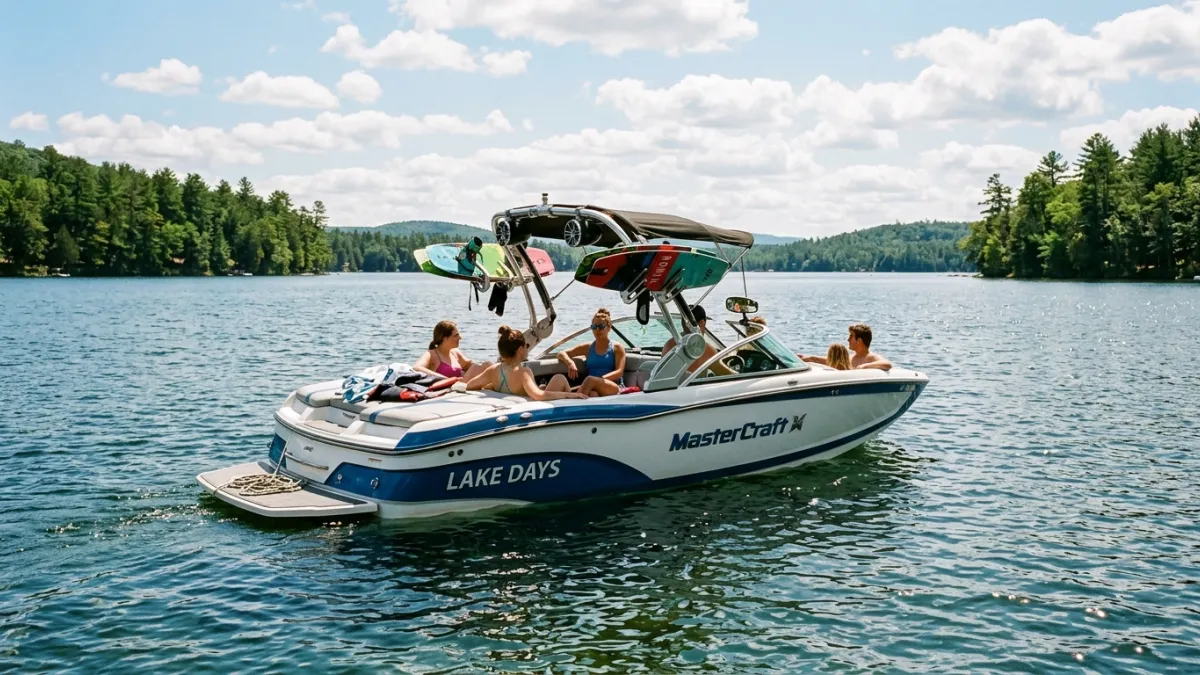
Wake boats, by contrast, rely on deep-V or aggressive hybrid displacement hulls featuring deadrise angles ranging from 16 to 22 degrees near the entry that taper into deep transom zones. Instead of seeking early planing efficiency, a wake boat's hull is specifically shaped to dig deep into the water column as speed settles between 10 and 22 mph. This intentional drag forces hundreds of gallons of water outward and upward, creating a clean, defined lip for wakeboarders seeking vertical pop or a surging wave face for unattached wakesurfers.
Additionally, modern wake boats incorporate strakes, running surfaces, and integrated wake-shaping plates along the transom. Hydraulic tabs—such as Malibu's Surf Gate or Nautique's Surf System (NSS)—extend asymmetrical force into the slipstream to delay water convergence on one side. This asymmetric flow converts a dual-sided wake into an endless, rideable surf wave without requiring passengers to manually stack sitting weight on one side of the cockpit.
On-the-water tip: Never attempt to wakesurf behind a stern-drive (I/O) or outboard boat where exposed propeller blades sit directly behind the transom. Dedicated wake boats and ski boats utilize true inboard engines where the propeller sits safely tucked underneath the hull, well forward of the rear swim platform.
Powertrain Layouts: Direct-Drive vs. V-Drive Configuration
Engine placement dictates not only the boat's wake footprint but also interior layout, handling characteristics, and weight distribution. Tournament ski boats traditionally utilize a direct-drive powertrain layout. The inboard V8 engine rests dead-center in the midship cockpit, connected straight to an inline shaft log that exits under the center of the hull. This central engine placement achieves a balanced 50/50 static weight distribution, keeping the bow glued to the water line, reducing draft down to 16–22 inches (0.4–0.55 m), and allowing instantaneous hole-shot acceleration without significant stern squat.
Wake boats employ a V-drive transmission layout. Here, the engine resides all the way in the stern inside an aft motor box. The driveshaft extends forward into a V-drive transmission gear unit beneath the floor, which reverses the power angle back toward a short propeller shaft under the hull. Moving 1,000+ pounds of iron or aluminum block directly over the transom naturally sinks the stern, increasing water displacement before filling a single ballast tank. Moreover, relocating the engine to the rear opens up the central cockpit for spacious wrap-around U-lounge seating, transforming the boat into an open social platform for 12 to 18 passengers.
- Direct-Drive Advantages: Flat wake profile, surgical tracking on slalom courses, rapid acceleration, minimal draft, and simple maintenance access.
- Direct-Drive Disadvantages: Midship engine box blocks cockpit movement, limited passenger capacity (typically 6–8 people), minimal wake size for boarding.
- V-Drive Advantages: Deep displacement for big wakes/waves, open bow-to-stern floor plans, high passenger capacity, and elevated towing towers.
- V-Drive Disadvantages: Increased draft (28–36 inches / 0.7–0.9 m), heavier fuel consumption, increased bow rise during hole-shot, and complex shaft alignment.
Ballast Systems, Hydrofoils, and Tow Towers
To scale from a modest wakeboard pop to a waist-high surfing wave, modern wake boats utilize integrated subfloor ballast systems. High-volume, reversible flexible-impeller or ballast pumps draw lake water through thru-hull pickups into rigid poly tanks or baffled bladders built into the floor liner. Mid-size to flagship wake boats carry between 2,000 and 4,800 pounds (900 to 2,175 kg) of liquid ballast, filling or emptying in under six minutes at the touch of a touchscreen interface.
Ski boats completely forego heavy ballast tanks. In fact, tournament standards established by USA Water Ski require minimal structural weight. A dedicated slalom rig like a MasterCraft ProStar or Ski Nautique relies on lightweight fiberglass composite materials, keeping dry weight under 3,300 lbs (1,497 kg). Every extra pound of weight on a ski boat works against the hydrodynamics by enlarging the wake wash that slalom skiers strive to avoid.
Towing hardware also differs dramatically. Wake boats feature structural, aircraft-grade aluminum towers rising 6 to 7 feet above the cockpit floor. The high tow point pulls wakeboarders upwards during aerial launches, allowing maximum hang time. Ski boats use a low, centerline pylon mounted directly over the midship engine box, keeping the line pull low to prevent pulling the stern off-course as a slalom skier exerts hundreds of pounds of lateral force during hard cuts.
Performance Specifications and Features Comparison
Selecting between these two specialized categories requires analyzing real-world operational metrics, engine horsepower requirements, passenger capacities, and tow speeds. The following matrix outlines standard factory specifications across modern production vessels in both classes.
| Specification / Feature | Tournament Ski Boat | Modern Wake / Surf Boat |
|---|---|---|
| Length Overall (LOA) | 20 ft – 21 ft 4 in (6.1 m – 6.5 m) | 21 ft – 25 ft 6 in (6.4 m – 7.8 m) |
| Beam Width | 95 in – 98 in (2.41 m – 2.48 m) | 100 in – 102 in (2.54 m – 2.59 m) |
| Draft (Drive Down) | 16 in – 22 in (0.41 m – 0.56 m) | 28 in – 36 in (0.71 m – 0.91 m) |
| Dry Weight (Approx.) | 3,000 lbs – 3,500 lbs (1,360 – 1,587 kg) | 4,800 lbs – 6,800 lbs (2,177 – 3,084 kg) |
| Factory Ballast Capacity | 0 lbs (None) | 2,000 lbs – 4,800+ lbs (907 – 2,177+ kg) |
| Engine Power Output | 350 hp – 430 hp (5.3L / 6.0L V8) | 400 hp – 600+ hp (6.0L / 6.2L Supercharged V8) |
| Tow Speed Range | 30 mph – 36 mph (Slalom) | 10.5 mph (Surf) / 18 – 22 mph (Wakeboard) |
| Seating Capacity | 6 – 7 Passengers | 12 – 18 Passengers |
| Primary Hull Profile | Flat / Micro-Deadrise Transom | Deep-V / Variable Deadrise Displacement |
Buying Guide: Matching Your Boat Choice to Your On-the-Water Goals
Before making a financial investment, evaluate your primary discipline, typical lake conditions, and passenger requirements. If your morning routine revolves around running early-weather slalom courses at 34 or 36 mph, a dedicated ski boat like a Ski Nautique 200, MasterCraft ProStar, or Malibu Response TXi remains unmatched. These craft offer zero-off GPS speed control, laser-straight tracking fins, and soft wakes that will not upset your ski edge. However, they are tight on storage space, lack deep cockpit depth for rough water, and cannot support modern wakesurfing.
If your weekends involve entertaining family and friends, teaching kids to wakeboard, or spending hours wakesurfing on large, open inland lakes, a V-drive wake boat is the clear winner. Premier models—such as the MasterCraft X24, Malibu Wakesetter 23 LSV, or Nautique Super Air Nautique G23—offer high freeboard for rough water safety, massive internal ballast tanks, and luxurious wrap-around lounges. If you need a middle ground, consider crossover hybrid models (such as the Malibu 20 VTX or MasterCraft XT series) which utilize versatile hull geometries that flatten out at high speeds with ballast empty while still accepting rear ballast for casual surf sessions.
For buyer safety and compliance, always ensure your vessel is fitted with Coast Guard-required safety gear: USCG-approved Type I/II/III PFDs for all passengers, a operational USCG approved fire extinguisher, throwable flotation cushion, marine horn, and an auxiliary sound-signaling device. Always use an auto-retracting safety lanyard attached to the emergency engine cut-off switch (ECOS) whenever operating at speed.
If your ultimate goal is high-capacity social cruising paired with wakesurfing and wakeboarding, purchase a 22-to-24-foot V-drive wake boat equipped with a factory-integrated surf system and minimum 3,000-pound ballast capacity. If absolute slalom precision, ultra-flat wakes, and track-like maneuverability are your top priorities, buy a direct-drive ski boat and keep your gear lightweight.
Frequently Asked Questions
Can you wakesurf behind a traditional direct-drive ski boat?
No, wakesurfing behind a traditional ski boat is generally unsafe and impractical. Direct-drive ski boats lack the heavy stern displacement required to create a rideable surf wave, and their flat hulls do not shape water outward. More importantly, attempting to surf behind a boat without an extended swim platform or proper exhaust routing poses severe safety risks due to proximity to prop blades and carbon monoxide accumulation.
Can you slalom water ski behind a wake boat?
Yes, you can slalom ski behind a wake boat by draining all ballast tanks, retracting all surf tabs and hydrofoils, and bringing the boat up to 30–32 mph. While the wake will remain firmer and wider than that of a dedicated direct-drive ski boat, recreational slalom skiers can comfortably enjoy open-water cuts behind a wake boat with its ballast fully emptied.
Why do wake boats require so much horsepower compared to ski boats?
Wake boats carry massive total displacement when fully ballasted, often pushing combined vessel weights over 9,000 to 11,000 pounds (4,000 to 5,000 kg) through the water at low planing speeds. Overcoming this immense hydrodynamic drag requires high-displacement 6.0L or supercharged 6.2L marine V8 engines delivering high low-end torque coupled with low-pitch, large-diameter propellers.