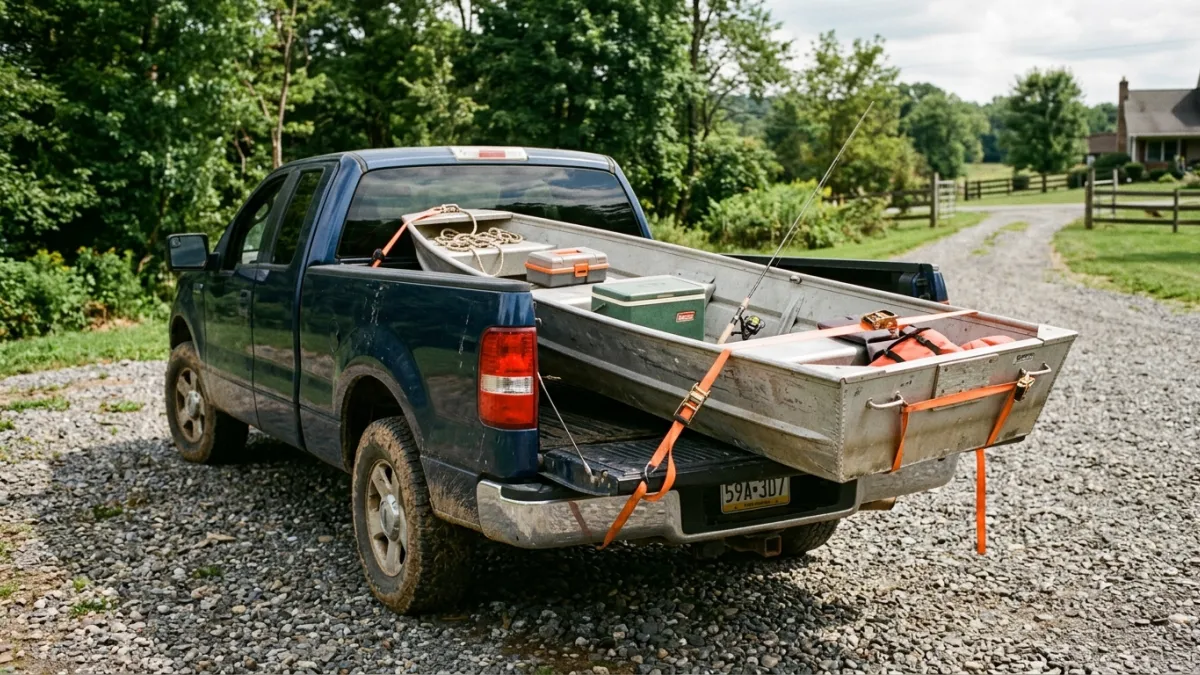
Quick answer: Yes, a standard 10 ft jon boat will fit into virtually any full-size or mid-size pickup truck bed when the tailgate is lowered down flat. With a standard 6.5 ft bed and open tailgate providing about 8 feet of support, the boat overhangs by roughly 2 feet, which is well within legal limits across most jurisdictions.
Understanding Pickup Bed Sizes and 10 ft Jon Boat Dimensions
To determine how well a 10 ft jon boat rests in your cargo box, you first need to compare the physical hull dimensions against your truck's bed length and width between the wheel wells. Most 10-foot aluminum jon boats measure roughly 9 feet 10 inches to 10 feet in Length Overall (LOA), with a total beam (overall width) ranging from 44 inches to 55 inches and a bottom width between 32 inches and 36 inches. Because the hull tapers from the top gunnel down to a narrow, flat bottom, the hull footprint rests comfortably inside the typical 48-inch clearance found between the interior wheel arches of most mid-size and full-size trucks.
The total length supported by your truck depends heavily on your bed configuration and tailgate stance. Short beds (5.5 ft) extended by an open tailgate offer roughly 7 feet to 7.5 feet of continuous flat deck support, leaving 2.5 to 3 feet of the boat hanging past the end of the tailgate. Standard beds (6.5 ft) with the tailgate lowered yield around 8.5 feet of support, which leaves only 1.5 feet overhanging. Long beds (8 ft) with the tailgate down provide over 9.5 feet of continuous bed surface, meaning the entire hull rests supported with virtually zero rear projection.
Hull weight is rarely a bottleneck for modern trucks. Popular models like the Tracker Grizzly 1036 weigh approximately 115 lbs dry, while the Alumacraft 1036 weighs around 100 lbs. Even when loaded with oars, battery, a small outboard engine, and fishing tackle, the total weight rarely exceeds 200 to 250 lbs—a tiny fraction of a pickup tailgate's typical 500 to 1,000 lb static weight rating.
Popular 10 ft Jon Boat Models and Truck Fit Specs
Different manufacturer models feature unique beam widths, transom heights, and hull profiles that affect how they sit inside a truck bed. Below is a detailed breakdown comparing common 10-foot aluminum jon boat specifications against typical truck bed support lengths:
| Boat Model | Length Overall (LOA) | Beam / Bottom Width | Average Dry Weight | Recommended HP | Support in 5.5' Bed (Tailgate Open) | Support in 6.5' Bed (Tailgate Open) |
|---|---|---|---|---|---|---|
| Tracker Grizzly 1036 | 9 ft 10 in | 52 in / 36 in | 115 lbs | 3.5 HP | 7.5 ft support (2.3 ft overhang) | 8.5 ft support (1.3 ft overhang) |
| Alumacraft 1036 | 10 ft 0 in | 55 in / 36 in | 100 lbs | 3.0 HP | 7.5 ft support (2.5 ft overhang) | 8.5 ft support (1.5 ft overhang) |
| Lowe Jon 1032 | 10 ft 0 in | 48 in / 32 in | 96 lbs | 3.0 HP | 7.5 ft support (2.5 ft overhang) | 8.5 ft support (1.5 ft overhang) |
| G3 Boats 1036 | 10 ft 0 in | 52 in / 36 in | 105 lbs | 3.0 HP | 7.5 ft support (2.5 ft overhang) | 8.5 ft support (1.5 ft overhang) |
Legal Requirements, Overhang Limits, and Safety Regulations
When hauling any cargo that extends past the rear bumper of a motor vehicle, state and federal Department of Transportation (DOT) laws dictate maximum allowable overhang and required safety markings. In the United States, federal baseline guidelines permit up to 4 feet of rear cargo overhang before specialized permits or lighting requirements apply. Because a 10 ft boat in a short bed or standard bed protrudes only 1.5 to 3 feet past the edge of the open tailgate, it complies with standard rear overhang distance limits in almost every jurisdiction.
However, safety visibility regulations must still be observed. Most state codes require driver compliance regarding red safety flags or warning markers whenever cargo extends 4 feet or more past the vehicle's rear taillights. Even if your boat overhangs by only 2 feet beyond the open tailgate, attaching a bright red or fluorescent orange safety flag (at least 12x12 inches or 18x18 inches depending on state law) to the rearmost center of the transom or motor bracket is highly recommended to alert following drivers.
Night driving introduces stricter requirements. If you transport your jon boat during hours of darkness or reduced visibility, state regulations usually mandate a red light affixed to the extreme end of the load, visible from a distance of at least 500 feet to the rear. Never rely solely on your truck's standard taillights when the tailgate is open, as the tailgate itself or the boat hull can partially obscure the factory light housings from certain viewing angles.
On-the-water tip: Always remove your outboard motor from the transom and transport it inside the bed or cab floor during highway transit. Small aluminum transoms on 10 ft boats are rated for lightweight motors (typically 3.5 HP or 35-45 lbs max), and road vibration combined with speed bumps can crack the transom welds if a heavy motor is left clamped on while bouncing down the highway.
Step-by-Step Guide to Securing Your Jon Boat in a Truck Bed
Properly securing your boat requires a structured approach to prevent side-to-side shifting, wind lift, or hull abrasion against metal bed linings. Following a proven sequence keeps your gear intact and protects both vehicle and vessel paint during transit.
- Protect the Bed and Hull: Place a rubber bed mat, pool noodles, or thick moving blankets on the truck bed deck and across the rim of the lowered tailgate. This prevents scratches on the aluminum hull powder coat and dampens road chatter.
- Slide the Boat Stern-First or Bow-First: Position the boat stern-first toward the cab if you plan to keep a trolling motor mounted, or bow-first toward the cab if you want the narrow bow nose wedged against the front bed wall. Loading bow-first creates less wind resistance at highway speeds.
- Establish a Forward Anchor: Run a heavy-duty ratchet strap across the forward portion of the boat through a bow eye or forward bench handle, pulling down and forward toward the bed's front tie-down anchors.
- Secure the Rear Transom: Run a second ratchet strap across the top stern gunnels or through the transom lifting handles, cranking down firmly into the rear bed tie-down rings. Avoid overtightening to prevent warping thin 0.050-inch aluminum hull walls.
- Attach Safety Flags and Check Clearances: Secure a bright red flag to the lowest point of the trailing transom. Verify that your license plate and rear turn signals remain clearly visible to traffic behind you.
Alternative Transport Methods: Roof Racks and Bed Extensions
If you need to haul camping gear, coolers, and fishing crates inside your truck bed, placing the boat flat on the bed deck limits available cargo volume. In these scenarios, two primary alternative loading systems offer additional utility without towing a trailer.
Overhead truck ladder racks or bed-mounted utility racks allow you to slide a 100 to 115 lb jon boat upside-down over the truck cab. This completely frees up the cargo box below for heavy gear, generators, and tackle boxes. Because aluminum jon boats feature rigid bench seats and flat bottoms, upside-down roof transport cuts wind resistance dramatically while keeping rainwater from pooling inside the hull during highway trips.
Hitch-mounted bed extenders present another affordable option. These T-bar steel supports fit into a standard 2-inch receiver hitch and adjust upward to match the height of your lowered tailgate. A bed extender extends your support deck by an additional 2 to 3 feet, ensuring that even a short-bed pickup supports 95% of the boat's total hull length directly from underneath, eliminating sagging and cantilever pressure on the tailgate hinges.
Final Recommendation for Boat Owners
For anglers and outdoor enthusiasts seeking maximum portability, hauling a 10 ft aluminum jon boat in a truck bed is one of the safest, most efficient transport methods available. If you drive a standard bed (6.5 ft) or short bed (5.5 ft) pickup, simply drop the tailgate, lay down a protective pad, secure the hull with two rated ratchet straps, and attach a bright orange safety flag to the rear transom. Always stow your outboard motor separately inside the bed, double-check your tie-down tension after the first 5 miles of highway driving, and enjoy swift launches without ever waiting in line at the boat ramp!
Frequently Asked Questions
Can one person load a 10 ft jon boat into a truck bed alone?
Yes. Because most 10 ft aluminum jon boats weigh between 95 and 115 lbs, a single adult can easily lift one end onto the lowered tailgate and slide the vessel forward into the cargo box. Installing transom wheels or plastic bed slide rails makes solo loading even easier.
Do I need a trailer license plate or permit to carry a jon boat in my bed?
No trailer registration or permit is required because the boat is carried as vehicle cargo rather than towed on road wheels. However, you must adhere to state cargo overhang laws and attach a red safety flag if the hull extends past legal bumper thresholds.
Can I haul my jon boat with the tailgate closed?
You can haul with the tailgate closed only if you prop the boat up at an angle over the closed tailgate using an elevated rack or tailgate pad. Placing a 10 ft boat flat inside a 5.5 ft or 6.5 ft bed with the tailgate closed forces nearly 4 to 5 feet of the hull into the air at a steep incline, which creates extreme wind lift and unsafe tie-down geometry.
How fast can I drive with a jon boat in the truck bed?
You can drive at normal highway speed limits (65–70 mph) provided the boat is firmly secured with high-quality ratchet straps anchored to bed tie-down points. Always check your straps after driving the first few miles to ensure road vibration has not loosened the tension.
If you want more details, check out our complete guide on a 10 ft boat.Sources
- TRACKER Boats Official Specifications & Grizzly 1036 Data
- Alumacraft Boats Official Utility Jon Specifications
- California Department of Transportation (Caltrans) Vehicle Overhang Code
- US Federal Highway Administration Truck Size & Load Regulations