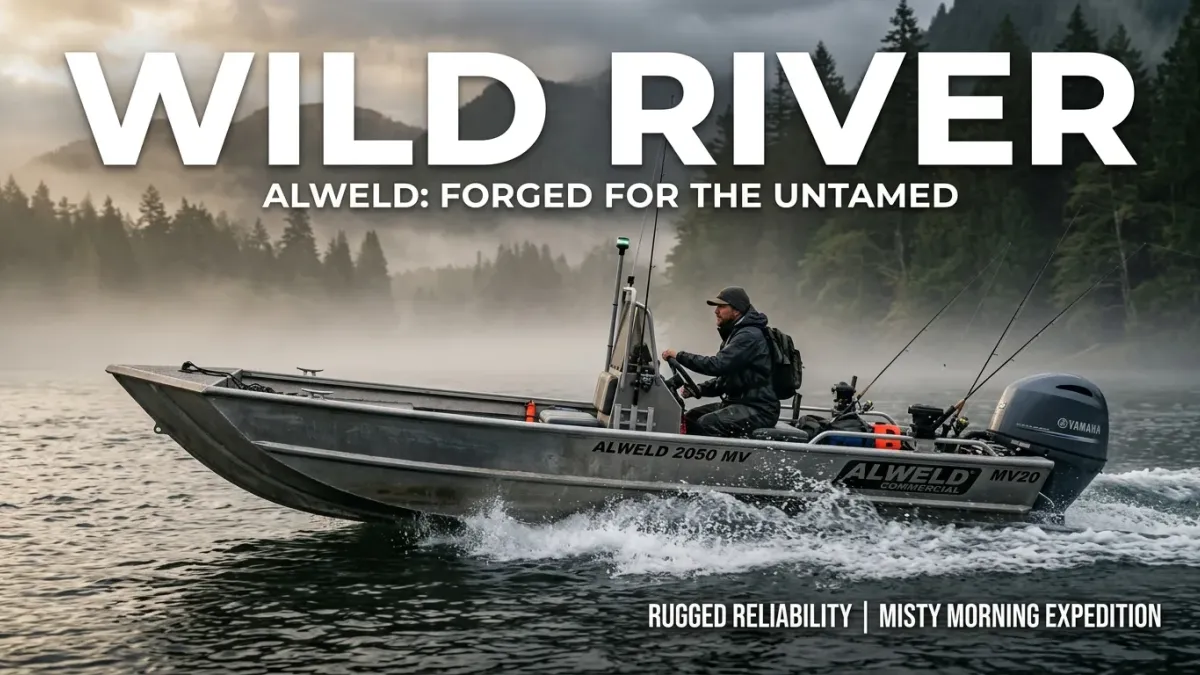
If you have spent any significant time navigating timber-laced river bends, shallow bayous, or rocky reservoir channels, you know that fiberglass hulls demand constant vigilance. In environments where submerged logs and gravel bars are part of the daily routine, continuous welded aluminum reigns supreme. Alweld has spent over four decades building an absolute reputation for producing ultra-tough, no-nonsense utility vessels designed to take abuse without flexing or weeping at the seams.
Quick answer: An all weld jon boat from Alweld eliminates the structural weak points of traditional riveted craft by fusing heavy-gauge 5052-H34 marine-grade aluminum into a monolithic structure. Built with hull thicknesses ranging from .100" to .125", these vessels offer maximum impact resistance, shallow-draft versatility, and lifetime leak protection for anglers, hunters, and commercial operators.
The Engineering Advantage: Why All Weld Jon Boat Construction Wins
To understand the enduring popularity of an all weld jon boat, you first need to look at how traditional aluminum boats fail. Standard budget craft rely on pop rivets or bucked rivets to hold aluminum sheets together across internal ribs. Over time, the repeated twisting of running through chop, combined with vibration from an outboard motor, stresses those riveted holes. The holes elongate, rivets loosen, and persistent underwater leaks become inevitable.
Alweld eliminates this structural vulnerability entirely through continuous MIG and TIG welding. By uniting the floor plates, longitudinal stringers, side walls, and transom into a single unified grid, structural energy spreads across the entire hull rather than concentrating on individual fasteners. When you hit a submerged cypress knee or run up on a gravel sandbar, the energy dissipates harmlessly throughout the high-yield aluminum sheet.
Material selection plays an equally vital role. Alweld utilizes 5052-H34 marine aluminum alloy across its line, paired with 6061-T6 structural extrusions for gunwales and corner ribs. This specific marine alloy provides exceptional tensile strength while maintaining the ductility needed to resist cracking during heavy cyclic loading. Thickness matters tremendously here: while off-the-shelf utility skiffs often use thin .063" or .080" aluminum, Alweld standardizes on .100" minimum thickness, bumping up to heavy-duty .125" on larger commercial-grade hulls.
Alweld Boat Specifications and Model Comparison
Choosing the right all weld jon boat requires matching hull width, deadrise, and bottom plate thickness to your specific operating conditions. A narrow flat-bottom craft draft in mere inches of water, making it ideal for backwater marshes, whereas a wider Modified-V (Mod-V) bow design softens chop when crossing open bays or wide reservoirs.
When shopping available inventory, operators should look beyond length overall (LOA) and carefully evaluate bottom width, beam, and transom height. A wider bottom width provides dramatic gains in initial stability and weight-carrying capacity without significantly increasing draft depth. For detailed insights on choosing hull configurations, review our guide to utility fishing boats and flat-bottom hull dynamics.
| Model Class | LOA (ft / m) | Bottom Width | Hull Gauge | Max HP Range | Primary Application |
|---|---|---|---|---|---|
| Alweld 1448 Flat Jon | 14' 0" / 4.26m | 48 inches | .100" Aluminum | 25 – 30 HP | Skinny water, small rivers, backwater timber |
| Alweld 1652 Panfish / Craft | 16' 0" / 4.87m | 52 inches | .100" – .125" | 40 – 60 HP | Crappie fishing, duck hunting, river navigation |
| Alweld 1860 Mod-V Bow | 18' 0" / 5.48m | 60 inches | .125" Aluminum | 70 – 115 HP | Open lake fishing, heavy gear transport, bayous |
| Alweld 2070 Commercial Jon | 20' 0" / 6.09m | 70 inches | .125" Aluminum | 115 – 150 HP | Workboat operations, guide services, heavy load hauling |
Rigging Your Boat: Engine Pairings and Hull Dynamics
Powering an all weld jon boat requires understanding weight distribution and propulsion style. Flat-bottom models excel when paired with lightweight mid-range outboards, such as 25 to 50 horsepower 4-stroke units from Yamaha or Mercury. These engines offer clean torque curves capable of popping flat-bottom hulls onto plane in under three seconds, even when loaded down with decoys, dogs, or heavy coolers.
On-the-water tip: When setting up a heavy-gauge welded boat with a jet-drive outboard or shallow-running surface drive, stern weight is your biggest performance enemy. Installing fuel tanks and trolling motor batteries under the forward casting deck balances the longitudinal center of gravity, preventing mid-range porpoising and reducing running draft by up to two full inches when idling over mud flats.
For shallow river navigation over rocky riverbeds, pairing an Alweld hull with a jet outboard or a tunnel hull modification allows the intake to sit flush with or above the bottom line of the keel. If you routinely operate in timber-choked waterways, adding an aggressive heavy-duty transom kit prevents motor bracket flex under heavy reverse thrust or sudden prop strikes. Proper motor selection and shaft length tuning are vital steps; explore our detailed analysis on outboard motor rigging and transom height setup for step-by-step guidance.
Durability, Safety Standards, and Long-Term Maintenance
While an all weld jon boat is virtually indestructible compared to fiberglass counterparts, basic marine maintenance ensures it stays operating in prime condition for decades. Aluminum naturally forms a protective surface oxide layer that shields against atmospheric corrosion. However, operating in brackish water or estuaries requires installing sacrificial zinc or aluminum anodes on the stern to prevent galvanic corrosion when running stainless steel propellers or underwater transducers.
From a safety perspective, Alweld equips hulls with injected closed-cell polyurethane foam flotation between floor ribs and side gunwales. This meets and exceeds United States Coast Guard (USCG) regulations, ensuring that even if the vessel takes on water from an oversized wake, the hull maintains positive upright flotation. Maintaining this internal structure is simple: keep limber holes free of mud and forest debris so bilge water drains freely toward the transom sump.
- Inspect Anodes Regularly: Replace zinc or aluminum anodes once they wear past 50% mass to safeguard hull fittings from galvanic degradation.
- Rinse Hull After Saltwater Use: Flush hidden interior pockets and bilge channels with fresh water after brackish water outings.
- Check Transom Bolts: Periodically torque engine mounting hardware to manufacturer specifications to avoid hole wallering.
- Keep Bilge Wells Clean: Ensure leaf litter and organic material do not block automatic bilge pump float switches.
For complete seasonal storage routines and corrosion defense steps, check out our resource on aluminum hull care and preventative maintenance.
Choosing the Ideal Alweld Setup for Your Needs
If your primary boating involves small inland rivers, timber impoundments, or solo fishing trips, a 14' to 16' flat-bottom Alweld with a .100" hull and 25 to 40 HP outboard delivers unmatched agility and effortless hand launching. For operators carrying heavy cargo, running guide trips, or venturing into open reservoirs subject to heavy wind-chop, select an 18' to 20' Modified-V model featuring a .125" heavy-duty bottom plate and 90+ HP outboard. Begin by measuring your vehicle towing limits and garage clearance, then visit an authorized aluminum marine dealership to physically inspect floor plan layouts in person.
Frequently Asked Questions
Is an all weld jon boat better than a riveted aluminum boat?
Yes. Fully welded hulls fuse the metal sheets together into a seamless unit, completely eliminating rivets that flex, wear out, and leak over time. Welded boats are significantly stiffer, handle rougher conditions, and hold higher resale value.
What gauge aluminum is best for a heavy-duty jon boat?
.100-inch aluminum is the industry benchmark for heavy-duty recreational utility boats, providing excellent impact resistance. For commercial use, running shallow rocky rivers, or heavy workboat applications, .125-inch thick aluminum offers maximum puncture protection.
Can you run an Alweld boat in saltwater?
Absolutely. Alweld builds hulls with 5052 marine-grade aluminum, which offers excellent natural corrosion resistance. When used in saltwater, ensure proper sacrificial anodes are fitted and rinse the hull thoroughly with fresh water after each trip.
What is the draft of an Alweld flat-bottom boat?
Depending on engine weight and hull size, an Alweld flat-bottom jon boat typically drafts between 3 to 6 inches of water at rest, allowing access to shallow backwaters that deep-V hulls cannot reach.