Disclosure: As an Amazon Associate, we earn from qualifying purchases.
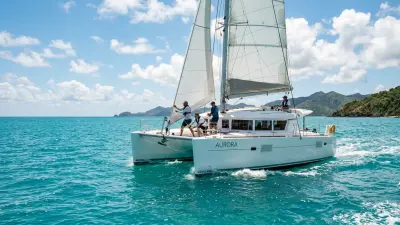
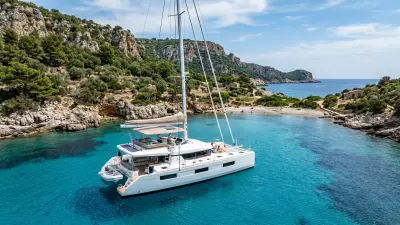
Catamarans are multihull vessels featuring two parallel hulls connected by a central deck, offering significantly greater stability, interior living space, and shallower drafts than traditional single-hulled monohulls. Unlike monohulls that rely on heavy lead or iron ballast keels to counter wind-induced heel, a catamaran derives its form stability from its wide beam—typically equal to 45% to 50% of its overall length (LOA). This engineering profile keeps heeling angles under 5 degrees in typical sailing conditions, allows drafts as shallow as 1.0 to 1.4 meters (3.3 to 4.6 feet), and delivers up to 40% more usable floor area than a monohull of equivalent length.
Understanding Catamaran Physics and Hull Architecture
The core advantage of a multihull lies in how it interacts with water displacement and rights itself under load. In a single-hull sailboat, righting moment increases as the vessel heels, pulling a heavy keel out of alignment with gravity. In contrast, a catamaran relies on the wide distance between its twin hulls (the beam). When wind pressure acts on the sails or waves roll beneath the boat, buoyancy shifts instantly toward the leeward hull, creating a powerful restoring moment without forcing the passengers to walk on tilted decks.
Key design elements defining catamaran performance include:
- Bridge Deck Clearance: The vertical distance between the waterline and the underside of the central bridge deck. Higher clearance (typically 70 cm or more on blue-water cruisers) minimizes "bridgedeck slamming"—the structural impact of waves crashing under the bridge deck in chop.
- Hull Fineness Ratio: Catamaran hulls are significantly narrower at the waterline than monohulls. This reduces wave-making resistance, allowing cruising catamarans to travel efficiently at high speeds without needing excessive ballast.
- Daggerboards vs. Fixed Keels: Performance-focused multihulls utilize retractable carbon or fiberglass daggerboards to minimize leeway when sailing upwind, drawing up into the hull when sailing downwind or entering shallow anchorages. Production cruising cats often rely on shallow fixed stub keels for protection against groundings and ease of maintenance.
Sailing Catamarans vs Power Catamaran Yachts
While sharing twin-hull underwater profiles, sailing catamarans and power catamaran yachts serve distinct cruising preferences and operational requirements.
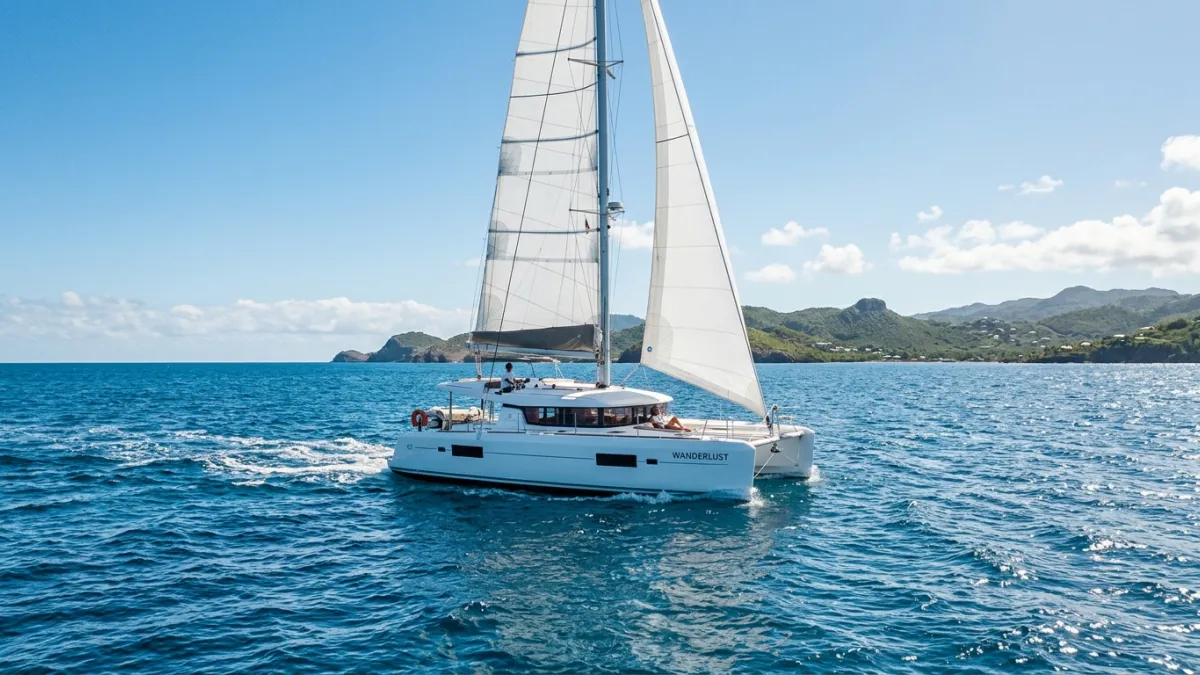
A comprehensive sailing catamaran review highlights propulsion flexibility and long-range energy independence. Sailing catamarans feature tall rigs, large mainsails, and headsails (such as self-tacking jibs or code zeros). They use smaller twin auxiliary diesel engines (typically 30 HP to 57 HP each) primarily for harbor maneuvering or calm weather motoring. Under sail, modern 40-to-45-foot cruising catamarans regularly achieve speeds of 8 to 12 knots on reach points of sail without consuming fossil fuel.
Conversely, a modern power catamaran eliminates the rig, mast, and standing rigging entirely. Designers redistribute structural weight to optimize hull forms for twin high-output engines—ranging from twin 150 HP outboards on light sport models to twin 370 HP or 440 HP inboard diesels on luxury power catamaran yachts. Without the aerodynamic drag and heeling forces of a mast, power cats provide smooth, flat cruising at speeds from 15 to 25+ knots. Furthermore, the absence of a mast step allows for massive full-beam flybridges, expanded master suites forward, and seamless single-level living environments.
Renogy 400Watt Premium Solar Kit with 40A MPPT Charge Controller

Why the 42ft Catamaran is the Global Sweet Spot
Across global charter fleets and private blue-water cruising grounds, the 42ft catamaran class represents the sweet spot between manageable short-handed sailing and maximum offshore comfort. Benchmark models in this size range—such as the Lagoon 42, Leopard 42, and Fountaine Pajot Astréa 42—consistently demonstrate why this length works so well for couples and families.
At approximately 12.80 meters (42 feet) overall length and beams spanning 7.20 to 7.70 meters, a 42-foot multihull provides around 1,000 square feet of total living space across the saloon, cockpit, foredeck lounge, and cabins. Displacement generally ranges between 11,500 kg and 14,000 kg dry weight, allowing the boat to be safely handled by two crew members using centralized winch layouts near a raised helm station.
The standard layout configurations in this size class include:
- Owner’s (3-Cabin) Layout: The entire starboard hull is dedicated to a master suite with a queen bed, desk area, hanging lockers, and a spacious head with a separate shower. The port hull accommodates two double guest cabins with shared or en-suite heads.
- Charter (4-Cabin) Layout: Both hulls feature two symmetrical double cabins, each equipped with its own dedicated head and shower unit, maximizing accommodation for up to 8 to 10 guests.
Monohull vs Catamaran Feature Comparison
To evaluate whether a multihull fits your cruising goals, consider how key operational factors compare directly against a single-hulled vessel of identical length:
| Feature | 42ft Sailing Catamaran | 42ft Monohull Sailboat |
|---|---|---|
| Form Stability & Heeling | Stays upright; heel rarely exceeds 5° | Heels 15° to 25° when sailing on a breeze |
| Draft & Bay Access | 1.1 m to 1.35 m; anchors close to shore | 1.9 m to 2.3 m; restricted in shallow lagoons |
| Usable Living Deck Area | High saloon deck with panoramic 360° views | Below-deck galley and saloon recessed into hull |
| Docking & Maneuverability | Twin engine controls allow 360° spot turns | Single engine requires bow thruster assistance |
| Upwind Sailing Angle | Sails best at 45° to 50° apparent wind angle | Points tightly upwind at 30° to 35° AWA |
| Haul-Out & Marina Costs | Requires wide haul-out slips; ~1.5x beam fee | Standard slip width; widely available travelifts |
Practical Ownership and Maintenance Considerations
Conducting a thorough catamaran review before purchasing requires analyzing long-term operational costs alongside upfront buying prices. While catamarans offer exceptional comfort, their dual systems demand disciplined maintenance schedules.
Excalibur APEX Anchor (45 LB):Next Gen Bolt-Together Hot Dipped Galvanized-Steel Shovel-Scoop Style Boat/Yacht/Sailboat Anchor

Dual Mechanical Systems
Every catamaran carries double the mechanical systems of a standard single-engine boat. You will manage two engine compartments, two saildrives or shafts, two rudders, and dual fuel systems. Regular service items—such as oil changes, saildrive gear oil replacement, impeller swaps, and zinc anode replacements—must be performed twice per service interval.
Marina Slip and Haul-Out Logistics
Because a 42-foot catamaran features a beam approaching 25 feet (7.7 meters), transient marina slips often charge a 30% to 50% premium over monohulls, or require dockage on linear tee-heads. Furthermore, shipyard maintenance requires specialized wide-beam travelifts or marine railway haul-out systems capable of lifting beam widths over 7.5 meters.
Rigging and Structural Integrity Inspection
On sailing catamarans, rig loads do not dissipate through heeling. Instead, wind gusts transfer directly into structural loads across the standing rigging, chainplates, and the crossbeam. Rigging stays and diamond stays must be tensioned correctly, and stainless steel fittings must undergo ultrasound or die-penetrant testing every 5 to 7 years to prevent hidden stress fatigue.
Key Buyer Checklist for Multihull Surveys
When inspecting pre-owned power or sailing catamarans, ensure your marine surveyor pays close attention to these critical areas:
- Bridgedeck-to-Hull Joints: Inspect for stress fractures, gelcoat crazing, or delamination along the high-load joints where the central bridge deck fuses to the twin hulls.
- Saildrive Diaphragm Seals: Verify the installation date of rubber saildrive gaiter seals; manufacturers generally recommend replacement every 5 to 7 years.
- Rudder Stock Bearings and Linkage: Test for excessive play in tie-bars connecting the dual rudders to ensure synchronized steering response under load.
- Weight Distribution & Payload: Check that previous owners have not overloaded the aft transom quarters with heavy davit gear, generators, or oversized tenders, which adversely affects trim and induces heavy bridgedeck pounding.
AcuRite Iris (5-in-1) Professional Weather Station with LCD Display and Lightning Detection (01022M)

Frequently Asked Questions
Can a cruising catamaran capsize in heavy weather?
Because catamarans lack ballast keels, they rely entirely on form stability. While it is theoretically possible for extreme wind gusts and breaking seas to flip a multihull, modern cruising catamarans possess immense righting moments. Blue-water sailors maintain safety in heavy seas by shortening sail early according to the manufacturer’s wind reefing matrix and using sea anchors or drogues to manage heavy ocean swells.
Is a power catamaran more fuel-efficient than a monohull motor yacht?
Yes. A power catamaran's twin slender hulls create significantly less wave drag at displacement and semi-displacement speeds than a wide single hull. This allows power cats to achieve 20% to 30% better fuel economy at 12–18 knot cruise speeds compared to a monohull motor yacht of similar displacement.
Can a 42ft catamaran be comfortably managed by a couple?
Absolutely. Modern 42ft catamarans feature self-tacking jibs, electric halyard winches, and all control lines led directly back to a protected helm station. Paired with twin engines that allow effortless rotation in tight marina basins, two experienced boaters can handle docking and sailing operations with ease.
Sources
- ISO Small Craft Standards (ISO 12217-2 Stability and Buoyancy Assessment)
- Royal Institution of Naval Architects (RINA) - Multihull Design Guidelines
- Lagoon Catamarans Technical Specifications & Layout Guides
Check Out Our Top Recommended Boat Gear on Amazon
Hand-picked sailing & boating essentials we actually recommend.
As an Amazon Associate, we earn from qualifying purchases.