Disclosure: As an Amazon Associate, we earn from qualifying purchases.
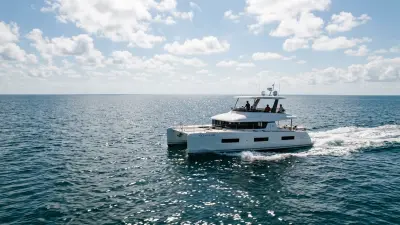
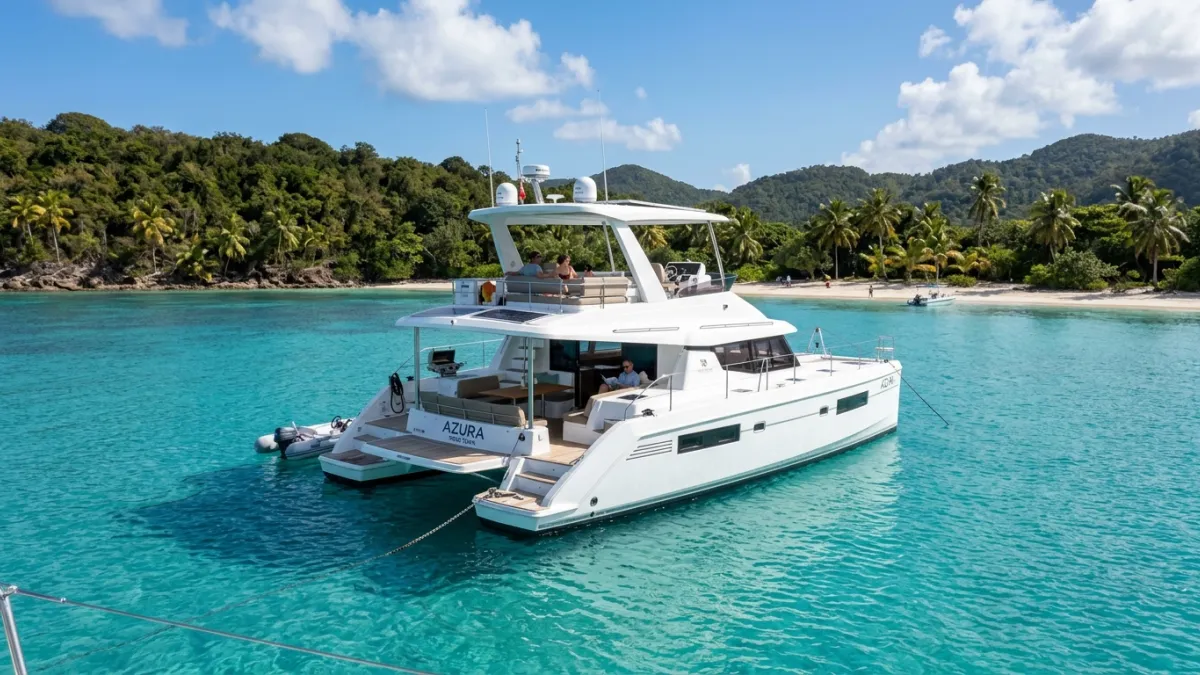
A power catamaran offers up to 30% greater fuel efficiency, 40% more usable living space, and significantly enhanced roll stability compared to a monohull motor yacht of equivalent length. Built on two slender hulls connected by a broad bridge deck, cruising power catamarans deliver comfortable, high-speed passage-making with shallow drafts often under 3.5 feet (1.1 meters), allowing access to secluded anchorages that traditional deep-V monohulls cannot reach.
Key Advantages of Power Catamaran Yachts
When analyzing a power catamaran review or shopping for a new vessel, multihull design advantages become immediately obvious across five core operational areas:
- Unmatched Initial Stability: Catamarans rely on form stability provided by two widely separated hulls. Instead of the continuous rolling motion typical of monohulls at anchor or in a beam sea, power cats remain flat, reducing sea sickness and fatigue during long coastal or offshore passages.
- Expanded Living Space: Because the beam (width) of a catamaran typically measures 40% to 50% of its overall length, living areas extend across a vast single-level main deck. A 44-foot power cat routinely offers the saloon and cockpit square footage of a 55-foot monohull.
- Fuel Efficiency and Range: Slender catamaran hulls generate far less wave resistance than a heavy, displacement or semi-displacement single hull. Driven by twin diesel engines or modern outboard setups, power cats achieve cruising speeds between 15 and 24 knots while burning noticeably less fuel per nautical mile.
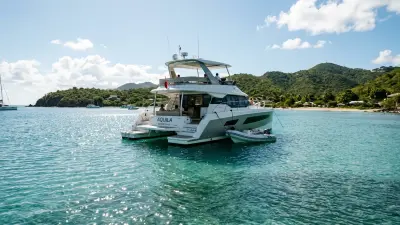
- Shallow Draft Access: Drafts ranging from 2.5 to 3.5 feet allow owners to navigate shallow coastal waters, intracoastal waterways, and tropical reefs safely without risking groundings.
- Engine Redundancy and Maneuverability: Twin engines positioned far apart in separate hulls act like twin-screw propulsion systems. By placing one engine in forward and the other in reverse, a power cat can pivot 360 degrees within its own length without needing a bow thruster.
Power Catamaran vs. Monohull Motor Yacht Comparison
To evaluate whether a power catamaran yacht fits your cruising goals, consider how the two designs compare across key ownership specifications:
Garmin Striker Cast, Castable Sonar with GPS, Pair with Mobile Device and Cast from Anywhere, Reel in to Locate and Display Fish on Smartphone or Tablet (010-02246-02)

| Feature / Metric | Power Catamaran (approx. 44 ft) | Monohull Motor Yacht (approx. 44 ft) |
|---|---|---|
| Beam (Width) | 21 ft to 23 ft | 13 ft to 14.5 ft |
| Average Draft | 3.0 ft to 3.5 ft | 4.0 ft to 5.5 ft |
| At-Anchor Roll Motion | Minimal (High Form Stability) | Moderate to High (Requires Stabilizers) |
| Usable Deck Area | Significantly Larger (Wide Bridge Deck) | Standard Tapered Layout |
| Engine Redundancy | Dual Fully Independent Engine Rooms | Single or Shared Engine Compartment |
Layout and Living Comfort on a Cruising Power Catamaran
The interior architecture of a cruising power catamaran provides separation between social zones and private accommodations. The central saloon, galley, and aft cockpit sit on one continuous deck level, eliminating stairs between main entertaining spaces. Large glass doors create an unbroken indoor-outdoor living flow.
Sleeping quarters occupy the twin hulls below. In an "Owner's Configuration" (Master Version), one entire hull is dedicated to a private suite featuring a master cabin, desk/vanity, walk-in closets, and an expansive head with a separate shower. The opposite hull houses two guest cabins with private or shared en-suite bathrooms. In charter layouts, both hulls offer identical guest cabins to maximize guest capacity.
Performance, Handling, and Seakeeping Characteristics
Unlike sailing catamarans adapted for engine use, purpose-built power catamarans feature hulls designed specifically for dynamic hydrodynamic lift. Designers shape the bow entries to slice through chop while incorporating tunnel clearance underneath the bridge deck to minimize wave slapping ("sneezing") at high speeds.
In head seas, twin narrow hulls cut through waves cleanly rather than pounding over them. When running downwind or in a quartering sea, tracking remains straight with minimal stern wander. Navigating tight marinas becomes straightforward: wide-set dual engine throttles afford precise control in heavy crosswinds without relying heavily on thrusters.
Bennett Marine Bolt Electric Boat Trim Tab System 12" x 12", Includes Integrated Helm Control, Actuators, Wires Harnesses and Mounting Hardware, Complete Kit BOLT1212, 12V DC - FO4321

Considerations Before Buying a Power Cat
While power catamarans offer clear lifestyle benefits, buyers should account for operational factors unique to wide-beam multihulls:
- Marina Slip Availability and Cost: A 22-foot beam requires a wider marina slip or T-head dockage. Marinas in crowded areas may charge a multihull surcharge (typically 1.2x to 1.5x the standard linear foot rate).
- Haul-Out Facilities: Hauling a power catamaran for bottom paint or hull maintenance requires a travelift with sufficient inside width or a specialized hydraulic trailer.
- Bridge Deck Slapping: In short, steep head seas, waves can strike the underside of the bridge deck. Opting for a design with adequate vertical bridge deck clearance mitigates this effect.
Frequently Asked Questions
Are power catamarans safer in rough seas than monohulls?
Yes, power catamarans are exceptionally safe in heavy weather. Their broad stance provides high initial resistance to capsizing, and twin independent engine systems ensure full propulsive redundancy if one engine or fuel line experiences an issue.
Taylor Made Products 31007 Low Freeboard Boat Fender, 7 x 23 inch, White

How fast does a typical cruising power catamaran travel?
Most mid-sized cruising power catamarans cruise comfortably between 16 and 22 knots, reaching top speeds of 24 to 28 knots depending on engine horsepower, hull design, and displacement loading.
Do power catamarans consume more fuel because of two engines?
No. Although they operate two engines, multihull forms face far less hydrodynamic drag than displacement monohulls. As a result, running two smaller engines on a catamaran often consumes less fuel per nautical mile than running larger engines required to push a heavy single hull at comparable speeds.
Sources
- American Boat and Yacht Council (ABYC)
- International Organization for Standardization (ISO Small Craft Standards)
- United States Coast Guard Boating Safety Division
Check Out Our Top Recommended Boat Gear on Amazon
Hand-picked sailing & boating essentials we actually recommend.
As an Amazon Associate, we earn from qualifying purchases.