Disclosure: As an Amazon Associate, we earn from qualifying purchases.
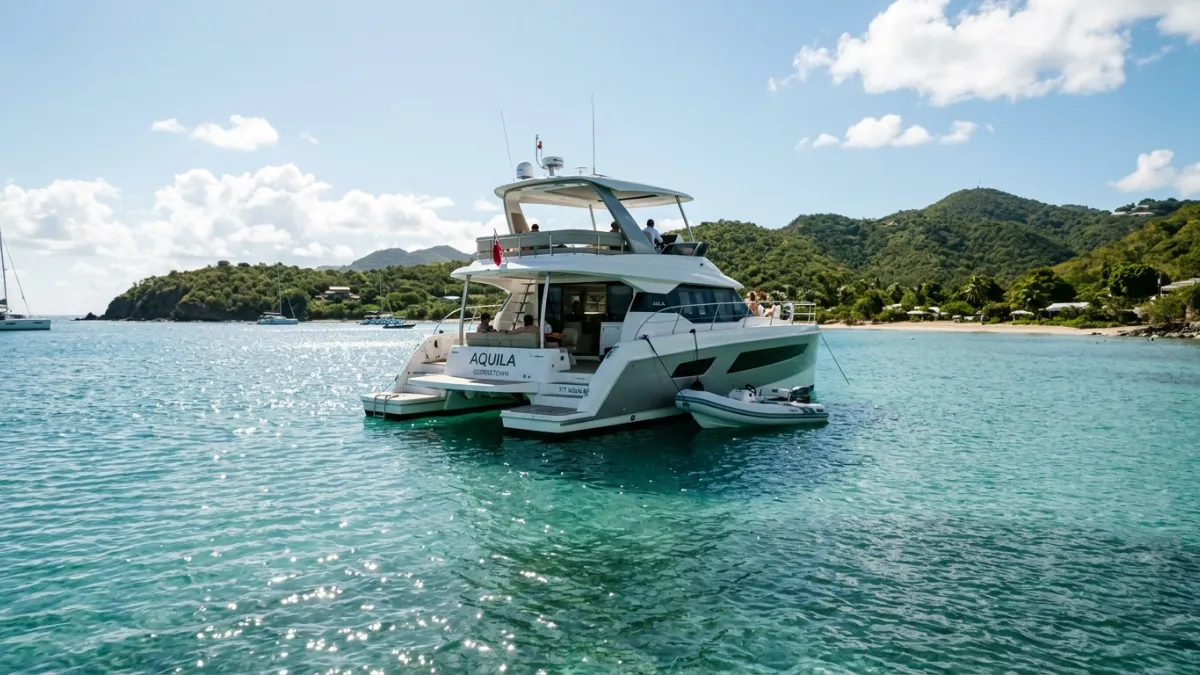
A power catamaran yacht is a multi-hulled motor vessel engineered with twin parallel hulls that deliver up to 36% superior fuel efficiency at mid-range cruising speeds, exceptional natural roll stability at anchor, and approximately 25% more usable deck space than a traditional monohull motor yacht of equivalent length. Purpose-built for power rather than adapted from sailing hulls, modern power catamaran yachts span from 30-foot outboard weekenders reaching over 40 knots to 70-foot luxury blue-water cruisers capable of transoceanic range. By replacing a deep, heavy single hull with two slender, low-drag hulls, these vessels offer shallow drafts around 3 to 4 feet (0.9–1.2 m), allowing access to thin-water anchorages that conventional yachts cannot reach.
Hydrodynamics: Efficiency, Speed, and Stability
Understanding why a cruising power catamaran performs differently than a monohull comes down to hull form and hydrodynamic drag. A monohull motor yacht relies on a wide, deep hull that displaces a massive volume of water, requiring heavy horsepower to overcome bow wave resistance and transition onto a plane. In contrast, a powercat distributes displacement across two narrow, finely entry hulls. This configuration minimizes the wetted surface area relative to total beam, drastically reducing bow wake and wave resistance.
Real-world sea trials and manufacturer test data demonstrate that at a standard cruising setting of 3,000 RPM, twin-engine power catamarans achieve up to 36% better fuel economy (NMPG/MPG) than monohulls carrying identical propulsion packages. Because the hull form glides easily without a dramatic "hump" transition to planing speeds, powercats maintain smooth fuel burn acceleration throughout their powerband.
Stability is another defining engineering advantage. Monohulls depend on deep ballast or complex active gyro-stabilizers to counteract rolling forces at sea and at anchor. A power catamaran relies on initial form stability created by its wide stance—often carrying a beam-to-length ratio of 1:2 or wider. When surface waves hit, the righting moment created by twin hulls keeps the vessel upright, reducing side-to-side roll by up to 80% and lowering accelerometer-measured G-force impacts through chop by 25% compared to monohulls.
Power Catamaran vs. Monohull Motor Yacht
Choosing between a multi-hull design and a classic monohull involves evaluating trade-offs in living space, draft, fuel consumption, and marina costs. The table below outlines key technical parameters for a thorough catamaran review against traditional options:
Optimization & Fuel Tracking: Garmin GFS 10 Fuel Sensor

| Feature / Metric | Power Catamaran (45–50 ft) | Monohull Motor Yacht (45–50 ft) |
|---|---|---|
| Beam (Width) | 21 to 25.5 ft (6.4 – 7.8 m) | 14 to 16 ft (4.2 – 4.9 m) |
| Draft | 3.2 to 4.0 ft (1.0 – 1.2 m) | 4.5 to 6.5 ft (1.4 – 2.0 m) |
| Fuel Efficiency at Cruise | Up to 36% lower fuel burn | Standard higher fuel burn baseline |
| Roll at Anchor | Minimal natural roll (wide stance) | Significant roll (requires stabilizers) |
| Usable Deck Area | 20–25% greater square footage | Standard baseline area |
| Marina Slip Surcharge | 50–100% beam surcharge in some ports | Standard single-slip pricing |
Layout Features and Onboard Accommodation
The interior architecture of modern power catamaran yachts offers living arrangements resembling waterfront apartments. Because the beam carries straight across the deck from bow to stern, the main deck saloon spans the entire width of the bridge deck. This allows for a single-level salon, galley, and aft cockpit layout with panoramic 360-degree glass windows.
Accommodations are distributed across the twin hulls, providing enhanced acoustic privacy between guest cabins:
- Owner's Master Suite: On vessels over 45 feet (such as the Aquila 54 or Leopard 53), builders often locate an expansive full-beam master cabin forward on the main deck or dedicate an entire hull to a master stateroom with a walk-in wardrobe and double vanity head.
- Guest Staterooms: Guest cabins reside in the port and starboard hulls, each featuring dedicated en-suite heads and large hullside window ports.
- Flybridge and Foredeck: The massive top flybridge deck frequently accommodates an upper helm station, outdoor grill, wet bar, and dining area for 8 to 10 guests. Forward bow seating areas often replace traditional trampolines with solid teak sun lounges.
Handling, Engines, and Marina Operational Costs
Maneuvering a power catamaran in close quarters is remarkably intuitive due to engine placement. Because the twin diesel inboards or outboard engines sit far apart—typically 18 to 22 feet center-to-center—the boat can be spun on its own axis by applying forward throttle on one engine and reverse on the other, often making bow thrusters unnecessary.
Propulsion configurations vary based on vessel size and intended usage style:
Precision Virtual Anchoring: Minn Kota Riptide Terrova 72”

- Outboard Engines: Popular on 30 to 45-foot sport powercats (e.g., twin Mercury Verado V12 600 HP or twin Yamaha 300 HP setups). Outboards deliver high top speeds exceeding 40 knots, easy engine tilt for ultra-shallow waters, and lower initial maintenance costs.
- Inboard Diesels: Common on 40 to 70-foot long-range cruisers (e.g., twin Volvo Penta D6 380 HP to 480 HP engines on V-drive or straight shaft setups). Inboards offer extended engine longevity, high torque at low RPM, and long cruising ranges exceeding 800 to 1,200 nautical miles at economic displacement speeds.
The primary operational compromise of powercat ownership involves marina berthing fees. Marinas in crowded cruising destinations (such as the Mediterranean or Florida Keys) frequently levy a 50% to 100% surcharge on slip rates due to the vessel's width exceeding standard 16-foot berths. However, many owners offset this by anchoring out in shallow, quiet coves where monohulls cannot safely navigate due to draft restrictions.
Prominent Models and Market Benchmarks
Several leading shipyards specialize in modern luxury powercats, each catering to different cruising preferences:
- Aquila Power Catamarans: Known for models like the Aquila 42, 45 Sport, 50, and 54 Yacht, offering high-volume flybridges, bulbous bow extensions for pitch damping, and options for twin Volvo Penta inboards or high-horsepower Mercury outboards.
- Leopard Catamarans: Built by Robertson & Caine (e.g., Leopard 40 PC, 46 PC, 53 PC), prioritizing ocean-crossing durability, forward cockpit access doors directly from the main salon, and efficient shaft-drive diesels.
- Fountaine Pajot Motor Yachts: Featuring models like the MY4.S and 67, emphasizing sleek European styling, low-resistance hulls designed by Daniel Andrieu, and optimized fuel economy.
Frequently Asked Questions
Are power catamarans harder to dock than monohulls?
Sprawling Deck & Vinyl Preservation: Marine 31 Protectant Kit

No, power catamarans are generally easier to dock. Because their twin engines are mounted far apart in separate hulls, opposing engine thrust creates a powerful pivot point that allows the vessel to rotate 360 degrees within its own length without using a bow thruster.
What is the average speed of a cruising power catamaran?
Inboard diesel cruising powercats typically cruise comfortably between 17 and 22 knots, with top speeds around 22 to 26 knots. High-performance outboard-powered models can reach top speeds of 40 to 45+ knots and cruise between 30 and 35 knots.
Do power catamarans slam in rough seas?
Tunnel slamming (wave impact against the underside of the bridge deck) can occur if wave height exceeds the vertical clearance of the tunnel. Modern powercat designers mitigate this by engineering higher bridge deck clearances, central wave-breaker nacelles, and optimized tunnel geometry to cushion air-water flow.