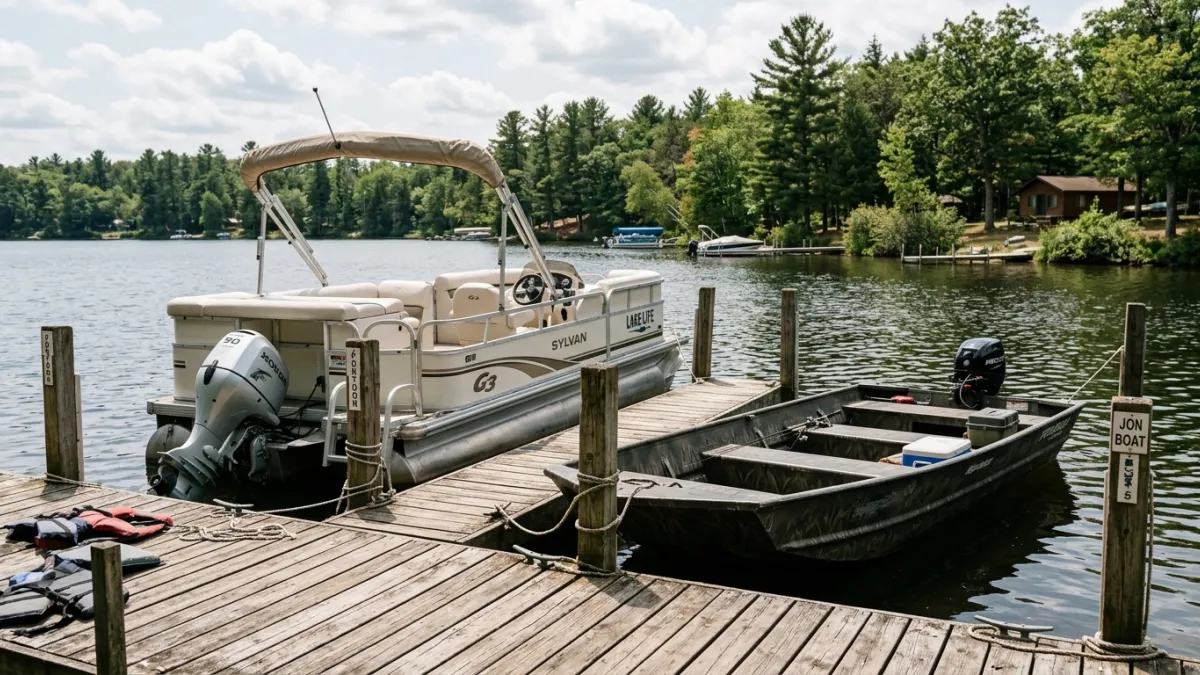
Quick answer: Choose a jon boat if you need an affordable, lightweight aluminum utility craft for shallow marshes, creek navigation, and solo or duo fishing trips. Opt for a pontoon boat if your primary goal is family comfort, spacious entertaining, and all-day cruising on open inland lakes with a large group.
Design Philosophy and Hull Architecture
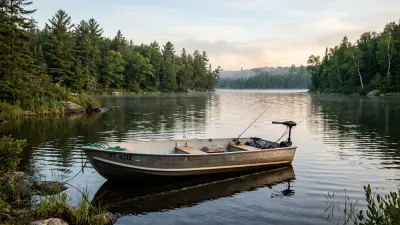
The core structural design of jon boats and pontoons highlights their divergent purposes. Jon boats are typically constructed from riveted or all-welded marine-grade aluminum, featuring a squared-off bow and a flat or shallow mod-V hull. Models like the Tracker Grizzly 1448 feature a beam around 72 inches and weigh under 300 pounds empty, making them extremely lightweight and structural rigid. Their low-profile sides and flat bottoms allow them to skim across water barely six inches deep, giving anglers and hunters access to backwaters that traditional v-hulls cannot reach.
Pontoons, on the other hand, rely on two or three buoyant aluminum cylinders (known as tubes or logs) topped by a flat, wide deck. Modern pontoon logs, such as those built by Bennington or Sun Tracker, generally range from 23 to 27 inches in diameter and feature welded internal baffles for safety. This structural arrangement lifts the main deck entirely above the waterline, providing a expansive surface area that feels more like a patio than a traditional boat hull. While pontoon logs are technically rounded, the overall footprint acts as a wide, flat platform that provides unparalleled lateral stability at rest.
On-the-water tip: When docking a light jon boat in a crosswind, remember that its flat bottom lacks deep tracking resistance; short, confident bursts of reverse throttle will help control stern drift far better than long, slow turns.
Performance, Draft, and Shallow Water Capability
In terms of raw draft and skinny-water navigation, the jon boat remains undefeated. A standard 12-to-16 foot aluminum jon boat equipped with a small 9.9 hp to 25 hp outboard can slide through aquatic vegetation and over submerged shoals with less than five inches of water beneath the hull. This shallow draft makes jon boats the undisputed champions for duck hunting, shallow creek exploration, and targeting bass in heavy lily pads where larger craft would instantly ground out.
Pontoon boats draw more water than their simple skiff cousins, generally requiring 12 to 24 inches of draft depending on load and log diameter. While a pontoon can operate in relatively shallow lake bays, its exposed outboards and under-deck crossmembers make it vulnerable to hidden stumps and rocks. Furthermore, powering a pontoon requires substantially more horsepower; while a jon boat runs smoothly on a light portable engine, a 20-foot pontoon typically demands a 90 hp to 150 hp outboard to maintain a 25 mph cruising speed.
Space, Comfort, and Passenger Capacity
When it comes to onboard comfort and social gatherings, pontoon boats stand in a league of their own. Featuring plush marine-grade vinyl couches, Bimini tops, swivel helm chairs, integrated Bluetooth sound systems, and optional swim ladders, pontoons are built specifically for human comfort. A standard 22-foot deck comfortably accommodates 10 to 12 passengers alongside coolers, watersports gear, and personal belongings without feeling cramped.
Conversely, jon boats emphasize utility over luxury. Most traditional jon boats feature basic bench seating, open aluminum decks, and exposed structural ribs. While modern bowfishing and hunting editions include non-skid deck coatings and pedestal seat bases, space remains strictly limited. A typical 14-foot jon boat carries a maximum weight capacity of around 600 to 900 pounds, making it ideal for two or three anglers rather than a social gathering.
Comparing Key Specifications: Jon Boat vs. Pontoon Boat
To help visualize how these two flat-bottom vessel styles stack up in measurable metrics, review the general specification ranges below:
| Specification | Standard Jon Boat (14-16 ft) | Standard Pontoon Boat (20-22 ft) |
|---|---|---|
| Overall Length (LOA) | 14' 0" – 16' 0" | 20' 0" – 22' 6" |
| Beam (Width) | 4' 5" – 6' 0" | 8' 0" – 8' 6" |
| Draft (Engine Up) | 4 – 6 inches | 12 – 18 inches |
| Hull Material | Aluminum (0.080" - 0.100" gauge) | Aluminum Tubes / Plywood Deck |
| Average Dry Weight | 250 – 550 lbs | 1,800 – 2,800 lbs |
| Engine Horsepower Range | 9.9 hp – 40 hp | 60 hp – 150+ hp |
| Passenger Capacity | 2 – 4 persons | 8 – 12 persons |
| Primary Safety Gear (USCG) | Type II PFDs, Throw Cushion, Flares | Type II PFDs, Throw Cushion, Extinguisher |
Cost, Maintenance, and Towing Requirements
The financial barrier to entry represents one of the starkest differences between these two boat categories. A complete, brand-new 14-foot aluminum jon boat, trailer, and 15 hp Mercury or Yamaha outboard package can often be purchased for under $8,000 to $12,000. Maintenance is practically non-existent beyond routine outboard gear oil changes, basic battery care, and rinsing down the hull after use. Towing is equally effortless, as almost any small crossover or compact SUV can easily pull a 600-pound boat-and-trailer rig.
Pontoon ownership involves a significantly larger financial commitment. New mid-range pontoon packages routinely cost between $35,000 and $65,000, with high-end tritoons pushing past $100,000. Operating costs are higher due to fuel consumption from larger engines, seasonal storage requirements, winterization, and protective canvas cover replacements. Towing a 22-foot pontoon requires a mid-size or full-size truck capable of pulling 3,500 to 5,000 pounds, and its wide beam creates significant wind resistance on the highway.
Ownership Checklist: Matching the Boat to Your Lifestyle
When selecting your ideal vessel, consider the following primary criteria to narrow down your decision:
- Launch Conditions: If you frequently launch in unpaved backwater areas, gravel banks, or small ponds without formal boat ramps, the lightweight jon boat is your best choice.
- Crew Size: If you regularly host groups larger than three people, a pontoon is essential for comfort and Coast Guard safety compliance.
- Storage and Garage Space: Jon boats can often fit inside a standard residential garage, eliminating monthly marina or storage yard fees.
- Primary Activity: Dedicated waterfowl hunters and skinny-water anglers should favor jon boats; families wanting sunset cruises, swimming platforms, and tubing should choose pontoons.
Your ultimate decision comes down to defining your regular boating routine. If your dream weekend involves solo dawn fishing trips, duck blinds, and pulling up onto remote river sandbars on a modest budget, buy a heavy-duty aluminum jon boat. However, if your ideal day involves anchoring in a sunny cove, swimming with family, and hosting cookouts with ten friends on board, the investment in a pontoon boat will deliver far greater satisfaction.
Frequently Asked Questions
Are pontoon boats safe in rough water?
Pontoon boats are designed primarily for inland lakes and protected bays. While their twin-tube flotation makes them stable, severe chop or ocean swells can bow-spear under heavy waves, making them unsuitable for offshore or rough water conditions.
Can you pull a tube or skier behind a jon boat?
Small jon boats with 10 to 25 hp engines lack the speed and towing post setup required for watersports. Larger modified-V jon boats equipped with 40+ hp outboards can pull light tubes, but pontoons with 90+ hp engines are far better suited for watersports.
Do jon boats sink easily?
Modern commercial jon boats manufactured by brands like Tracker or Lund feature built-in closed-cell foam flotation inside bench seats or side gunnels. This ensures that even if the cockpit fills completely with water, the hull remains afloat in compliance with US Coast Guard standards.
Sources
- United States Coast Guard Safety Standards
- Tracker Boats Official Specification Database
- Yamaha Outboards Marine Engine Specs