Quick answer: The J/Boats J/105 excels because it pioneered the combination of a retractable bowsprit and asymmetrical spinnaker on a stable offshore hull, enabling high-speed downwind performance with minimal crew. Its strict one-design class rules keep racing competitive and affordable, while its solid construction ensures lasting resale value.
Design Philosophy and Hull Architecture
The core concept behind the J/105 was to make fast sailing accessible to smaller crews without sacrificing offshore structural integrity. Measuring 34.5 feet overall with a beam of 11.0 feet, the hull shape engineered by Rod Johnstone features moderate displacement and swept-back lines that minimize wetted surface area. Unlike flat-bottomed sportboats that slam violently when beating into chop, the J/105 uses a classic V-shaped bow section that slices cleanly through ocean swells. This makes the boat remarkably comfortable during long offshore passages, whether you are competing in a coastal distance race or passage-making along the coast.
Below the waterline, the J/105 relies on a deep fin keel paired with an efficient bulb, casting a total draft of 6.5 feet in its standard configuration (though a 5.5-foot shoal draft version was also produced). With a total displacement of approximately 7,750 lbs and 3,400 lbs of ballast, the boat boasts a ballast ratio close to 44 percent. This high level of inherent stability allows the boat to carry sail deep into mid-range breezes without requiring six people hanging off the hiking lifelines. A balanced fiberglass spade rudder connected to a large wheel system provides light, immediate feedback at the helm.
Construction utilizes J/Boats’ proven SCRIMP resin infusion process on later models, while earlier hulls featured hand-laid GRP with a Baltek balsa core in the deck and hull above the waterline. This composite sandwich technique provides incredible panel stiffness while keeping weight to a absolute minimum. The solid laminate below the waterline ensures structural safety against impacts, while solid stainless steel keel bolts securely tie the cast lead fin into a heavy transverse floor grid.
Rigging, Sail Handling, and Cockpit Ergonomics
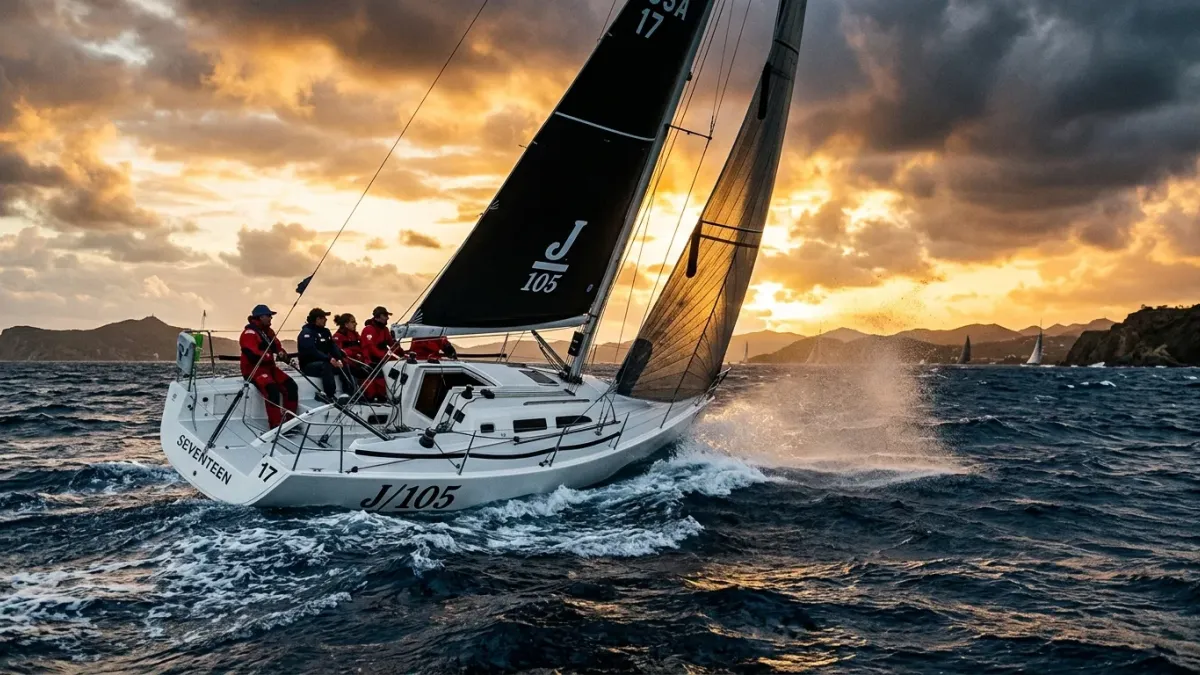
The defining innovation of the J/105 is its bowsprit system. The carbon-fiber retractable pole extends out of the starboard bow deck at the push of a line, allowing the boat to set a massive asymmetrical spinnaker without needing a traditional spinnaker pole, foredeck crew, or complex topping lifts and foreguys. Gybing downwind simply requires sweeping the sail around the forestay, a maneuver easily handled by a crew of two. This setup revolutionized downwind sailing in the 1990s and set the benchmark for modern racer boats across the marine industry.
The boat utilizes a fractional sloop rig supported by double-swept aluminum spreaders. Standing rigging was originally rod, which provides low stretch and holds rig tension exceptionally well over time. Control lines, including halyards, outhaul, reefing lines, and the vang, are led aft to a pair of Lewmar cabintop winches flanked by rope clutches. The mainsheet features a multi-purchase coarse/fine tune system that gives the helm or main trimmer instant power adjustments without tiring out. Primary sheet winches sit within easy reach of the wheel, allowing a single-handed sailor to adjust the jib while steering.
The cockpit layout is notoriously spacious—often compared to the cockpits of 40-foot vessels. With long bench seats and an unobstructed floor, there is plenty of room for an active race crew to move during maneuvers, or for a family to stretch out during afternoon cruises. Deep coamings provide comfortable back support, while sturdy stainless steel pulpits and double lifelines meet strict World Sailing offshore safety standards.
On-the-water tip: When driving a J/105 in over 18 knots of wind upwind, do not try to pinch to keep the boat flat. Instead, ease the main traveler down 4 to 6 inches, flatten the foot with maximum outhaul, and let the deep blade rudder do the work. The boat carries noticeable weather helm if heel exceeds 20 degrees, which slows you down dramatically due to rudder drag.
Specifications Overview
To understand how the J/105 compares against similar performance cruisers from builders like Beneteau or Jeanneau, reviewing its technical dimensions provides clear insight into its balanced performance profile.
| Specification | Measurement (Imperial) | Measurement (Metric) |
|---|---|---|
| Length Overall (LOA) | 34.50 ft | 10.52 m |
| Waterline Length (LWL) | 29.50 ft | 8.99 m |
| Beam | 11.00 ft | 3.35 m |
| Draft (Standard Keel) | 6.50 ft | 1.98 m |
| Displacement | 7,750 lbs | 3,515 kg |
| Ballast | 3,400 lbs | 1,542 kg |
| Sail Area (Upwind) | 577 sq ft | 53.6 m² |
| Auxiliary Engine | Yanmar Diesel (18–20 HP) | Inboard Shaft Drive |
Interior Comfort and Auxiliary Systems
While the J/105 was engineered primarily for performance, the interior is far from a spartan racing shell. Belowdeck, the accommodation layout provides functional, utilitarian comfort suitable for coastal cruising and overnight regattas. The interior finish features molded fiberglass liners accented by teak trim, offering a clean, bright atmosphere that is exceptionally easy to wash down and maintain after a wet weekend on the ocean.
The layout features twin settees in the main saloon that double as full-length sea berths equipped with lee cloths. Forward, a private V-berth offers comfortable sleeping quarters for two adults, while double quarter berths aft provide additional sleeping capacity or dry storage space for sails. A marine head with a holding tank is located forward behind a privacy bulkhead. The basic galley area includes a sink with manual or pressure water, alongside space for a top-loading icebox and a portable stove setup.
Under the companionway steps sits a reliable inboard Yanmar diesel engine (typically 2GM20F or 3YM20 models), driving a two-blade folding propeller through a stainless steel shaft. Access to the engine bay is excellent, allowing simple routine maintenance such as changing raw water impellers, oil filters, and fuel-water separators. Electrical needs are served by a straightforward dual-battery system with an alternator and DC circuit panel, supplying power to navigation lights, VHF radio, basic instruments, and bilge pumps.
The One-Design Class Advantage and Maintenance
One of the strongest arguments for investing in a J/105 is the strength of its class association. The J/105 Class Association enforces strict one-design rules that limit sail inventories, ban exotic hull modifications, and regulate crew weight. This philosophy ensures that races are won through tactical skill and boat handling rather than equipment spend. Because every boat in the fleet remains mechanically identical, owners enjoy high resale values and ready availability of replacement parts through dedicated marine suppliers.
Maintaining a J/105 involves straightforward fiberglass maintenance practices. Annual haul-outs are necessary to service bottom paint, inspect the spade rudder stock for wear, and check anode protection on the shaft line. Standing rigging should undergo thorough dye-penetrant or visual inspections every five years, with complete wire or rod replacement recommended every 10 to 12 years to prevent sudden rig failure during offshore events.
Where to Go From Here
If you are seeking a fast, structurally robust performance sailboat that balances thrills on the racecourse with simple handling for weekend family cruises, the J/105 stands out as an unbeatable market choice. Look for well-maintained pre-owned models in established sailing hubs, hire a qualified marine surveyor specializing in composite hulls to perform a thorough pre-purchase inspection, and get involved with your local fleet to experience true one-design camaraderie.
Frequently Asked Questions
Can the J/105 be sailed single-handed?
Yes, the J/105 is notably easy to single-hand or double-hand thanks to its retractable bowsprit, asymmetrical spinnaker setup, and all control lines being led aft to the cockpit near the helm.
Is the J/105 suitable for true offshore distance racing?
Absolutely. The boat meets strict offshore stability standards and has completed famous distance races like the Newport Bermuda Race, Chicago Mac, and Rolex Fastnet with impressive safety records.
What engine comes standard on a pre-owned J/105?
Most J/105 models are equipped with an inboard Yanmar 2-cylinder or 3-cylinder diesel engine ranging from 18 to 20 horsepower, connected to a shaft drive with a folding propeller.