Mastering Catamaran Docking: Your Guide to Tight Marina Maneuvers
There’s a common misconception out there, isn’t there? People see a big, beautiful catamaran and immediately picture docking it as some Herculean task, especially in a crowded marina. They imagine endless turning circles, bumper-boat scenarios, and perhaps a few muttered apologies. But let me tell you something important, based on decades of experience on the water: while a catamaran is certainly a larger vessel, its unique design actually gives you a significant advantage when it comes to precision maneuvering. You just need to know the art, and that’s exactly what we’re going to dive into today.
Table Of Content
- Your Catamaran’s Secret Weapon: The Twin Engines
- The Pre-Docking Ritual: Setting Up for Success
- The Reconnaissance Mission
- Crew Briefing & Equipment Check
- The Twin-Engine Tango: Mastering the Docking Maneuver
- The Pivot Turn
- Crabbing Sideways
- Approaching the Dock
- Conquering Tight Marinas & Tricky Conditions
- Working With (Not Against) Wind and Current
- Don’t Be Afraid to Abort and Re-evaluate
Docking a catamaran, even in the tightest of marinas, can be a smooth, stress-free operation if you understand its capabilities and approach the task with a plan. We’re talking about making those monohull owners green with envy as you effortlessly slide into a spot that looks impossible. Forget everything you thought you knew about prop walk and limited maneuverability; your catamaran is a master of its domain. So, let’s unlock those secrets and turn you into a docking guru.
Your Catamaran’s Secret Weapon: The Twin Engines
The single biggest game-changer for catamaran docking is right there at your stern: two independent engines. This isn’t just about redundancy; it’s about unparalleled control. Unlike a monohull, which typically relies on a single prop and often fights against its own “prop walk” (the sideways thrust caused by the propeller’s rotation), a catamaran has two powerplants, each with its own rudder effect. This means you can create differential thrust, pushing one engine forward and the other in reverse simultaneously.
What does this mean for you? It means you can pivot your boat almost in its own length. Imagine rotating your entire vessel without moving significantly forward or backward – it’s like having a giant joystick for your boat. In my opinion, this capability alone makes catamarans far easier to handle in close quarters than many single-engine monohulls of comparable size. You don’t have to fight the boat; you can make it dance.
Furthermore, because the propellers are set wide apart, you get incredible leverage. This wide separation amplifies the turning force when one engine is forward and the other reverse. It allows for precise lateral movement, often called “crabbing,” which is invaluable for sliding into narrow slips or moving away from a dock without touching it. Understanding and harnessing this twin-engine magic is the cornerstone of catamaran docking mastery.
The Pre-Docking Ritual: Setting Up for Success
Before you even think about approaching that slip, preparation is key. Honestly, half the battle is won before you even get close. This isn’t just about safety; it’s about confidence and efficiency. Remember, slow is always pro when it comes to docking.
The Reconnaissance Mission
As you approach the marina, slow down and take a good look. What are the conditions? Is there a strong crosswind? What about current? Are there any unexpected obstacles or other boats already pushing the boundaries of their slips? Observe how other boats are sitting in their slips. This visual reconnaissance gives you invaluable information about the wind and current, allowing you to formulate your approach plan.
Look for your assigned slip and identify which side you’ll be docking on. Is it port or starboard side to? Is it a finger pier or a stern-to mooring? Knowing this helps you determine your approach angle and where your fenders and lines need to be placed. Don’t be afraid to do a slow pass by your slip to get a feel for the conditions before committing.
Crew Briefing & Equipment Check
If you have crew on board, make sure everyone knows their role. Communication is paramount. Designate who will handle which lines and fenders. Brief them on hand signals if engine noise might make verbal commands difficult. I always tell my crew, “When in doubt, don’t tie it off!” You want the lines ready to deploy, not necessarily secured until instructed.
- Fenders: Deploy at least 3-4 fenders on the side you’ll be docking, adjusting their height for the dock.
- Dock Lines: Have your bow, stern, and spring lines ready, tied to their respective cleats on the boat. Ensure they are free of tangles and ready to be thrown or passed.
- Radio/Phone: Keep your VHF radio on a working channel or your phone handy for marina contact if needed.
- Engines & Thrusters: Briefly test your engines (forward and reverse) and any bow thruster if you have one, ensuring they respond correctly before you commit to the approach.
The Twin-Engine Tango: Mastering the Docking Maneuver
Now for the fun part – putting those twin engines to work. The key here is using minimal throttle. You’re not racing; you’re finessing. Think of your throttles as painting brushes, not sledgehammers. Most maneuvers will be done at idle or just above idle RPMs.
The Pivot Turn
This is where your catamaran truly shines. To turn your boat in place, engage one engine in forward gear and the other in reverse. For example, to turn to starboard, put the starboard engine in reverse and the port engine in forward. The boat will spin beautifully around its central axis. Adjust the throttle slightly to control the speed of the turn. Practice this in open water first; it’s incredibly satisfying.
Crabbing Sideways
Imagine you need to move directly sideways into a slip with limited fore and aft space. This is a classic catamaran move. With your rudders centered, put both engines into forward gear for a moment, then both into reverse, then one forward, one reverse. By alternating short bursts of forward and reverse on each engine, you can “walk” the boat sideways. It takes a bit of practice to get the rhythm right, but once you master it, you’ll be able to slide into spots that seem impossible for other boats.
Approaching the Dock
Approach your slip slowly, at a very shallow angle. Aim to have your windward hull make contact with the dock first if there’s a crosswind. This allows the wind to gently push the rest of the boat into position. Use short bursts of forward and reverse on the appropriate engine to control your speed and direction. For example, if you’re approaching port side to a dock and need to bring the stern in, put the starboard engine into a brief forward burst. This will kick the stern to port.
For example, imagine this situation: you’re backing into a narrow slip, and there’s a gentle crosswind pushing your bow to port. Instead of fighting it with excessive throttle, you’d use a short burst of forward on the port engine and reverse on the starboard engine. This combination helps bring the bow back to starboard while simultaneously pivoting the stern towards the dock. It’s all about small, precise adjustments, constantly evaluating your boat’s movement.
Conquering Tight Marinas & Tricky Conditions
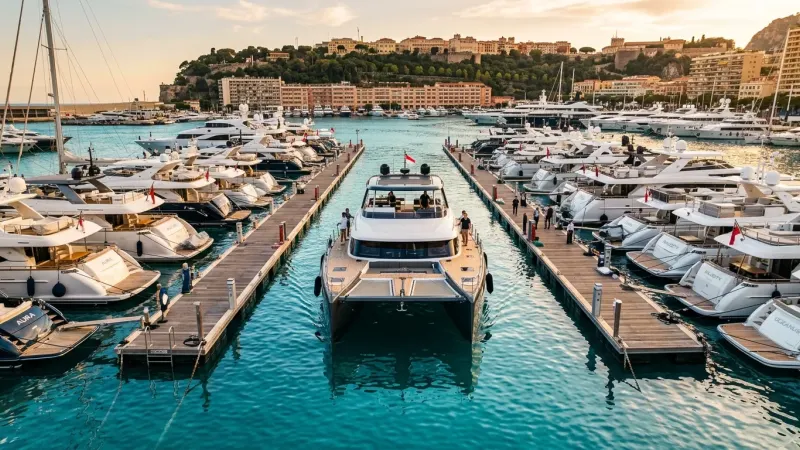
Tight marinas often come with their own set of challenges: narrow fairways, strong crosswinds, or unpredictable currents. Don’t let these intimidate you; they just require a bit more planning and confidence in your catamaran’s abilities.
Working With (Not Against) Wind and Current
Wind and current are your best friends or your worst enemies, depending on how you use them. When approaching a dock with a crosswind, try to approach from the downwind side, allowing the wind to gently push your boat onto the dock. If you must approach from the upwind side, come in with a bit more speed (but still controlled!) and use your engines to hold the boat against the wind as you apply lines.
With current, try to approach against the current if possible. This gives you more control over your boat speed. If you’re going with the current, you’ll need to use more reverse throttle to slow your boat down. Always remember, the catamaran’s wide stance means it has a significant surface area for both wind and current to act upon, so anticipate these forces.
Don’t Be Afraid to Abort and Re-evaluate
This is crucial. If an approach isn’t feeling right – if the wind gusts unexpectedly, or you misjudged an angle – don’t hesitate to pull out and try again. There’s no shame in it; in fact, it’s a sign of a truly experienced skipper. It’s far better to make another loop than to force a bad situation and risk damage. But what would you do in this situation? You would simply power out, circle around, and restart the approach, perhaps from a different angle or with a revised plan. That’s the smart move.
Another technique I find invaluable in really tight spots, particularly with a crosswind, is using a spring line. If you can get a midship spring line onto a cleat on the dock first, you can then use your engines against that line to literally pull or push your catamaran sideways into the slip. This offers tremendous control and minimizes the risk of impact. It’s a technique worth practicing!
Mastering catamaran docking in tight marinas is less about brute force and more about finesse, understanding your boat’s unique characteristics, and a healthy dose of patience. Your catamaran, with its twin engines, is truly one of the most maneuverable vessels on the water once you learn its language. So, next time you’re heading into a crowded harbor, instead of apprehension, feel that surge of confidence. Practice these techniques, trust your judgment, and you’ll be docking your cat like a seasoned pro. The open water and the cozy slip are waiting for you!