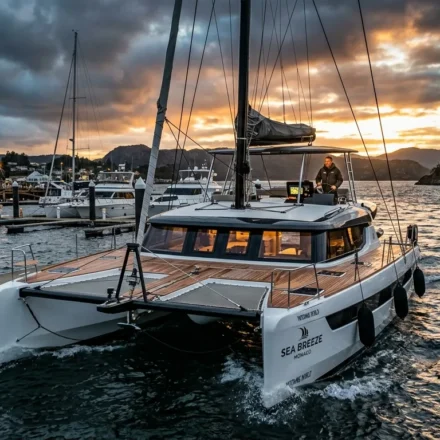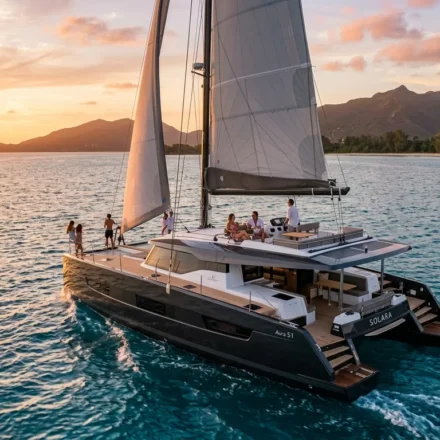



There’s nothing quite like the feeling of sailing or motoring your catamaran into a bustling marina after a great day out on the water. The sun is setting, the air is buzzing, and you’re ready to tie up and enjoy the evening. But then, you spot it: that incredibly tight marina slip, surrounded by other boats, with a bit of a crosswind kicking up. Suddenly, that sense of blissful relaxation might just give way to a knot of anxiety, right?
Table Of Content
- Why Catamarans Handle Differently (and How to Use It to Your Advantage)
- The Power of Twin Engines: Your Secret Weapon
- The Docking Mindset: Preparation and Patience
- Your Pre-Docking Checklist
- Mastering the Maneuver: Step-by-Step for Tight Spots
- 1. The “Zero-Speed” Approach
- 2. The “Opposite Throttle” Turn (Your Best Friend)
- 3. Side-to Docking
- 4. Stern-to Docking (Med Mooring)
- 5. Bow-to Docking
- What to Watch Out For: Navigating Challenges
- Wind and Current
- Crowded Marinas
- Tide
- Common Mistakes to Avoid
- 1. Going Too Fast
- 2. Not Using Twin Engines Effectively
- 3. Poor Crew Communication
- 4. Lack of Preparation
- 5. Panicking Under Pressure
- Frequently Asked Questions
- Can a single-engine catamaran dock easily?
- How do you handle strong crosswinds when docking?
- What’s the best way to practice catamaran docking?
Docking a catamaran, especially in tight marina spaces, is often perceived as a daunting task. After all, these beautiful multihulls are wide, can catch a lot of wind, and their unique handling characteristics are a world apart from a traditional monohull. But honestly, with the right approach and a solid understanding of your vessel, it becomes less of a dreaded chore and more of a ballet on water. As an old salt who’s seen countless boats come and go, I can tell you that mastering catamaran docking is absolutely within your reach.
Why Catamarans Handle Differently (and How to Use It to Your Advantage)
Before we dive into the nitty-gritty of actual maneuvers, let’s talk about why catamarans have a reputation for being tricky to dock – and why that reputation isn’t entirely fair. A catamaran, by its very nature, is a different beast from a monohull. It has two hulls, a wide beam, and usually a shallow draft. This combination means more surface area for the wind to push against, which can make things interesting on a blustery day. The windage is a significant factor, no doubt about it.
However, the real game-changer – and your biggest ally – is the twin-engine setup. Unlike a single-engine monohull that relies heavily on prop walk and a rudder for directional control at low speeds, a catamaran’s twin engines offer unparalleled maneuverability. Think of them as individual thrusters that you can operate independently. This allows you to spin the boat on its own axis, move sideways, or hold a position against a current with surprising precision. In my opinion, once you get the hang of it, docking a catamaran can actually be easier than a monohull in many situations, particularly in a tight spot.
The Power of Twin Engines: Your Secret Weapon
This is where the magic happens. Your two engines, separated by a good amount of distance, provide incredible leverage. You can put one engine in forward and the other in reverse simultaneously, and your boat will pivot almost in place. This capability is gold when you’re trying to navigate a narrow fairway or turn into a slip that seems barely wider than your boat.
Here’s a quick cheat sheet for how those twin engines translate into boat movement:
| Engine Control | Port Engine | Starboard Engine | Boat Movement |
|---|---|---|---|
| Straight Ahead | Forward | Forward | Forward |
| Straight Back | Reverse | Reverse | Reverse |
| Pivot Starboard (Bow Right) | Forward | Reverse | Spins right (bow moves right, stern moves left) |
| Pivot Port (Bow Left) | Reverse | Forward | Spins left (bow moves left, stern moves right) |
| Move Starboard Sideways (Subtle) | Forward (short burst) | Neutral | Bow tends right, stern moves slightly left |
| Move Port Sideways (Subtle) | Neutral | Forward (short burst) | Bow tends left, stern moves slightly right |
The key here is small, short bursts of power. You’re not looking to accelerate; you’re looking to *control* movement. Think of it like feathering the throttle in a car – gentle touches, not flooring it.
The Docking Mindset: Preparation and Patience
Before you even think about approaching that marina slip, you need to prepare both your boat and your mind. Rushing things is the biggest mistake I see boaters make. Take a deep breath. Slow down. Remember, you’re the captain, and you dictate the pace.
Your Pre-Docking Checklist
- Fenders Out: Have enough fenders deployed on both sides, at the correct height for the dock you’re approaching. Don’t be shy; more fenders are better than fewer.
- Dock Lines Ready: Get your bow and stern lines, and potentially spring lines, ready. Coil them neatly so they don’t tangle, with one end secured to the boat and the other ready to be tossed to shore or secured to a cleat.
- Crew Briefing: If you have crew, make sure everyone knows their role. Who handles which line? Who’s ready with a boat hook? Who’s the “lookout” for obstructions or other boats? Clear communication is paramount.
- Observe Conditions: Before you commit, take a minute to watch the wind and current. How are they affecting other boats? What’s the best angle of approach for your catamaran given these conditions?
- Visualize the Maneuver: Mentally walk through the entire docking process, from approach to final tie-up. Imagine every step.
Honestly, a well-prepared crew and a calm captain can make even the trickiest docking scenario manageable. It’s about setting yourself up for success.
Mastering the Maneuver: Step-by-Step for Tight Spots
Now, let’s talk about the actual docking techniques. The overarching principle for catamaran docking, especially in a tight marina, is “slow is pro.” Use minimal throttle, let the boat’s momentum and the twin engines do the work.
1. The “Zero-Speed” Approach
Try to approach your slip with as little forward momentum as possible. Cut your engines well before you reach the dock and let the boat glide. This gives you more time to react and correct. You want to be able to stop your boat precisely where you want it with just a touch of reverse throttle. If you’re zooming in, you’ll overshoot or slam into something, and that’s no fun for anyone.
2. The “Opposite Throttle” Turn (Your Best Friend)
This is the core technique for catamaran maneuvering. Imagine you need to turn your bow to port to get into a slip. Put the starboard engine in a short burst of forward and the port engine in a short burst of reverse. Watch your bow swing to port. Neutralize both engines. Repeat as needed. The beauty is you can do this while making very little forward or backward progress. This is invaluable in a crowded marina. Let me add something here: don’t hold the throttles down. It’s tap-tap-tap, not push-and-hold.
3. Side-to Docking
This is probably the most common scenario. Approach parallel to the dock, heading into the wind or current if possible. This helps slow you down. As you get close, use your outside engine (the one away from the dock) in a short forward burst to bring your bow into the dock, while using your inside engine (the one closer to the dock) in reverse to kick the stern in. Simultaneously, have your crew on the bow ready with a line. Once the bow is secure, use short bursts of forward on the inside engine and reverse on the outside engine to bring the stern alongside. Once both are secure, you can adjust your spring lines.
For example, imagine this situation: You’re approaching a side-to dock with a gentle breeze pushing you off. You want to bring your port side to the dock. You’d approach at a slight angle, maybe 15-20 degrees, pointing your bow slightly into the breeze. As you get closer, a quick burst of forward on the starboard engine (the one away from the dock) will push the bow to port, while a short touch of reverse on the port engine will pull the stern in. Your crew on the port bow can grab the dock line. Once that’s loosely secured, use the port engine in forward bursts and the starboard engine in reverse bursts to “walk” the stern into the dock. It’s a dance, really.
4. Stern-to Docking (Med Mooring)
This is where the wide beam of a catamaran can sometimes feel like a disadvantage, especially if there are narrow spaces between boats. The key here is a controlled approach and using those engines to pivot. Approach the desired spot bow-first, then pivot your boat 180 degrees using the opposite throttle technique, so your stern faces the slip. Maintain a very slight forward momentum (or even hold against the wind/current) while your stern swings. Then, slowly back into the slip, using your engines to correct your alignment. Having crew on the stern to guide you and handle lines is extremely helpful. If you’re backing down against a stern current, use slightly more forward throttle on the engines to maintain steerage and control.
5. Bow-to Docking
Less common in tight slips unless specifically designed for it, but the principle is similar to stern-to, just in reverse. Approach, pivot, then slowly move forward into the slip. Again, minimal throttle, maximum control. What would you do if there’s a strong current trying to push your bow away? You’d use those independent throttles to counteract it, holding the boat in place while you inch forward.
What to Watch Out For: Navigating Challenges
Even with the best techniques, real-world conditions throw curveballs. Here’s what to keep an eye on:
Wind and Current
These are your biggest adversaries – and sometimes, your friends. A strong crosswind on your wide multihull can push you sideways faster than you think. Always try to approach with the wind or current on your bow, or at least at an angle that allows you to use your engines to counteract its effects. If you’re coming into a slip with a strong crosswind from your port side, for instance, you’ll need to apply more starboard engine power to keep your bow from being pushed downwind. It’s a constant battle of small corrections.
Crowded Marinas
Patience, patience, patience. Don’t feel pressured by other boaters. If you need to do another lap, do another lap. If someone is watching, who cares? Better to take your time and dock safely than to rush and cause damage. Communication with other boats or marina staff can also clear up potential confusion.
Tide
If you’re in an area with significant tidal swing, remember that the height of the dock and the depth of the water can change dramatically. Factor this into your approach. Your fenders need to be at the right height, and you need to ensure you have enough water under your keels or skegs, especially with a shallow-draft catamaran.
Common Mistakes to Avoid
As a marine enthusiast, I’ve seen my share of docking mishaps. Most of them boil down to a few preventable errors:
1. Going Too Fast
This is the cardinal sin of docking. Speed amplifies every mistake. You lose control, you have less time to react, and the consequences are much greater. Always remember: “Slow is pro.” If you think you’re going slow enough, go even slower. Seriously. Just barely enough way on to maintain steerage.
2. Not Using Twin Engines Effectively
Many new catamaran owners are hesitant to use their engines independently. They treat it like a car, steering with the wheel. But the wheel is practically useless at very low speeds on a catamaran. Your engines are your steering. Embrace them! Practice in open water until it feels second nature.
3. Poor Crew Communication
A silent crew is a dangerous crew. Make sure everyone knows what’s expected of them, and that you’re giving clear, concise commands. Hand signals are great if engine noise is an issue. A brief huddle before you start the approach can save a lot of headaches and frayed nerves.
4. Lack of Preparation
Skipping the fender and line setup, or not observing conditions, is asking for trouble. Those few extra minutes of preparation save you hours of potential repair work or embarrassment. This includes checking your prop for line entanglement before entering the marina. I’ve seen it happen!
5. Panicking Under Pressure
It’s easy to get flustered, especially with an audience. But taking a moment, pausing, even backing out and re-approaching, is always better than trying to force a bad situation. Your boat, your rules. Just take a deep breath and regain your composure.
Frequently Asked Questions
Can a single-engine catamaran dock easily?
Docking a single-engine catamaran is significantly more challenging than a twin-engine. You lose the incredible pivoting power, relying more on rudder, prop walk, and momentum. It requires even more finesse, planning, and often a well-placed stern thruster to manage effectively in tight spaces.
How do you handle strong crosswinds when docking?
Strong crosswinds are tough for any boat, but especially wide catamarans. The best strategy is to approach with the bow pointed slightly into the wind, allowing you to use engine power to fight the drift. You’ll need more aggressive, but still short, bursts of power on the leeward engine to prevent the bow from blowing away.
What’s the best way to practice catamaran docking?
Practice, practice, practice! Find an empty area of the marina or open water and set up some imaginary dock lines or buoys. Practice pivoting, moving sideways, and approaching at different angles. Do it on calm days first, then introduce a bit of wind. Repetition builds confidence and muscle memory.
Ultimately, docking a catamaran in a tight marina is an art form. It requires patience, practice, and a deep understanding of how your specific vessel responds to its twin-engine controls. Don’t be discouraged by initial challenges. Every experienced boater, myself included, has had their moments. Keep practicing, keep learning, and before you know it, you’ll be gliding into those slips with the confidence of a seasoned pro. The joy of having full command of your beautiful multihull, even in the most challenging situations, is truly one of the most rewarding aspects of boat ownership. Happy docking!