


There’s nothing quite like the feeling of gliding across the water on your motor yacht, the hum of the engines a steady companion, and the horizon stretching out before you. It’s freedom, pure and simple. But for those moments when the horizon isn’t so clear, or when you’re navigating unfamiliar waters, what’s on your helm makes all the difference. We’re talking about advanced navigation systems – the brains and eyes of your vessel.
Table Of Content
- Why Advanced Navigation Isn’t Just a Luxury Anymore
- The Core Components of Your Digital Helm
- Multi-Function Displays (MFDs): The Brains of the Operation
- Radar and Sonar: Your Eyes Below and Beyond
- AIS (Automatic Identification System): Know Who’s Around
- Autopilots & Integrated Steering: Your Smart Co-Pilot
- Satellite Communications: Staying Connected, Anywhere
- Key Features & Technologies That Elevate Your Experience
- Seamless System Integration: The Power of Networking
- High-Resolution Chart Plotting & 3D Views
- Weather Overlay & Optimized Routing
- Night Vision & Thermal Cameras: See in the Dark
- Digital Switching & Remote Monitoring
- Choosing the Right System for Your Motor Yacht
- Understand Your Cruising Style and Yacht
- Budget vs. Capability: Finding Your Sweet Spot
- Expandability and Future-Proofing
- The Importance of Professional Installation and Support
Gone are the days when a simple compass and paper chart were enough. Today’s motor yachts, whether you’re a coastal cruiser or an offshore adventurer, demand sophisticated electronics that enhance safety, efficiency, and frankly, the sheer enjoyment of your journey. As someone who’s spent decades around boats of all kinds, I’ve seen firsthand how these systems have evolved, becoming indispensable tools for serious mariners. But what exactly do you need, and what should you look for?
Why Advanced Navigation Isn’t Just a Luxury Anymore
Let’s be honest, for some, the term “advanced navigation” might conjure images of overly complex, button-laden dashboards. But in reality, these systems are designed to simplify your life on the water, not complicate it. Their primary purpose is to provide you with unparalleled situational awareness, making your time at sea safer and more relaxed. Think of them as your extra pair of eyes and a highly skilled co-pilot.
Safety is, without a doubt, the number one reason to invest in top-tier navigation. Imagine this situation: you’re making good time on a long passage, the sun is setting, and an unexpected bank of fog rolls in, thick and fast. Suddenly, your visual references are gone. What would you do without a reliable radar to pierce through the mist, an AIS system to identify nearby vessels, or a crystal-clear chart plotter showing your exact position and a safe route? Honestly, in moments like these, these systems aren’t just helpful; they’re lifesavers. They help you avoid collisions, navigate tricky channels, and find safe harbor even when conditions turn sour.
Beyond safety, advanced navigation significantly boosts efficiency and comfort. Optimized routing software can help you avoid rough seas or find the fastest current, saving fuel and making for a smoother ride. Digital switching and remote monitoring capabilities allow you to control and check on your yacht’s systems from your helm – or even from shore – adding a layer of convenience that was unimaginable a few decades ago. It’s about taking the stress out of command so you can focus on enjoying the journey.
The Core Components of Your Digital Helm
So, what exactly makes up one of these advanced systems? It’s not just one magic box, but rather an integrated network of sophisticated instruments working in harmony. Let’s break down the essential components you’ll find on a modern motor yacht.
Multi-Function Displays (MFDs): The Brains of the Operation
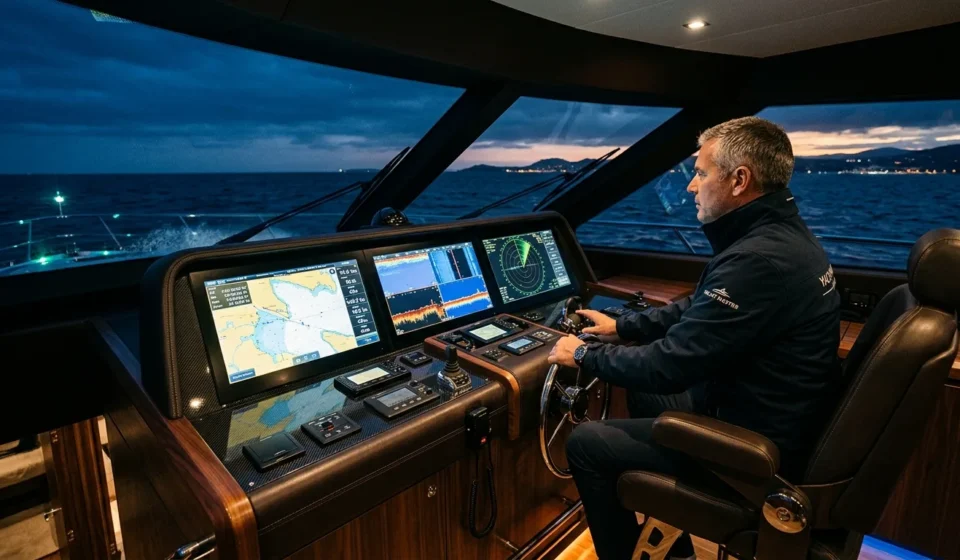
These are the large, vibrant screens at your helm, often touch-enabled, that act as the central hub for all your navigation data. From displaying high-resolution charts and radar overlays to engine diagnostics, sonar readings, and even entertainment, MFDs consolidate everything into an intuitive interface. When you’re looking at MFDs, consider screen size, brightness for direct sunlight, and processing power for smooth operation. A good MFD is the nerve center of your yacht’s navigation system.
Radar and Sonar: Your Eyes Below and Beyond
A high-definition radar is indispensable, especially for navigating in fog, at night, or in busy shipping lanes. Modern radars offer incredible clarity, differentiating between small targets like buoys and larger vessels, and even showing weather patterns. Complementing this is advanced sonar – not just for depth, but for detailed bottom mapping, fish finding, and even forward-looking sonar to detect underwater obstacles before you get to them. These technologies provide crucial situational awareness that simply looking out the window cannot.
AIS (Automatic Identification System): Know Who’s Around
AIS is a truly revolutionary safety tool. It automatically broadcasts your yacht’s position, speed, and course, and simultaneously receives the same information from other AIS-equipped vessels in your vicinity. This data is then overlaid onto your chart plotter, giving you a clear picture of vessel traffic, their intentions, and potential collision courses. For anyone cruising in busy waters, or even just crossing shipping lanes, an AIS transceiver is, in my opinion, non-negotiable.
Autopilots & Integrated Steering: Your Smart Co-Pilot
Modern autopilots are far more than just devices that hold a course. Integrated with your MFDs and GPS, they can follow complex routes, optimize for fuel efficiency, and even adjust to sea conditions. Paired with integrated steering systems, they offer precise control and allow for seamless transitions between manual and automated steering, freeing you up to focus on other tasks or simply enjoy the view. Some advanced systems even offer “virtual anchor” capabilities, holding your position precisely using GPS and engine thrust, perfect for holding station without dropping the hook.
Satellite Communications: Staying Connected, Anywhere
For offshore cruising, satellite communication systems are vital. They provide reliable access to weather forecasts, email, internet, and critical emergency services, even when you’re far beyond cellular range. From basic text-based satellite messengers to full-blown VSAT systems offering broadband internet, the options allow you to choose the level of connectivity that suits your cruising style and safety needs. Staying connected out there is more important than ever, both for peace of mind and for accessing critical real-time data.
Key Features & Technologies That Elevate Your Experience
Beyond the core components, it’s the integration and advanced features that truly distinguish a state-of-the-art navigation system. These are the details that transform a functional setup into an extraordinary one.
Seamless System Integration: The Power of Networking
The magic happens when all these components talk to each other. Protocols like NMEA 2000 and marine Ethernet allow for a seamless flow of data between your MFDs, radar, AIS, autopilot, engine monitors, and even entertainment systems. This integration means you can view and control virtually every aspect of your yacht from any display at your helm, or even wirelessly from a tablet. It reduces clutter, simplifies operation, and ensures all your systems are working as one cohesive unit.
High-Resolution Chart Plotting & 3D Views
Modern charting software offers incredibly detailed maps, often with satellite imagery, aerial photos, and even 3D perspectives of the seabed and surrounding landmasses. This level of detail provides exceptional situational awareness, allowing you to identify landmarks, plan routes through complex areas, and visualize your surroundings with unprecedented clarity. Some systems even offer “augmented reality” overlays, combining camera feeds with chart data for an even more intuitive view.
Weather Overlay & Optimized Routing
Why just react to weather when you can anticipate it? Advanced systems can overlay real-time weather data – wind, waves, currents, and precipitation – directly onto your charts. Combined with sophisticated routing software, your system can suggest the most comfortable, fuel-efficient, or safest route based on forecasted conditions and your yacht’s specific characteristics. This is a game-changer for long passages and helps you avoid nasty surprises.
Night Vision & Thermal Cameras: See in the Dark
Navigating at night or in low visibility conditions can be challenging. Thermal imaging cameras detect heat signatures, allowing you to “see” unlit obstacles, debris, or even people in the water long before they would be visible to the naked eye. Low-light cameras enhance what little ambient light is available. Integrating these cameras into your MFDs provides an invaluable safety layer, especially when entering crowded anchorages or transiting busy channels after dark. Let me add something here: based on my experience, a good thermal camera is an investment you’ll never regret, especially if you do a lot of night cruising.
Digital Switching & Remote Monitoring
Imagine controlling your yacht’s lights, pumps, air conditioning, and even checking tank levels, all from your MFD. That’s the power of digital switching systems like CZone or EmpirBus. Even better, many systems now offer remote monitoring, allowing you to check on your yacht’s batteries, bilge pumps, security cameras, or even location from your smartphone when you’re ashore. Talk about peace of mind!
Choosing the Right System for Your Motor Yacht
So far we’ve covered what’s out there. Now let’s get to the really critical point: selecting the right system for *your* specific needs. This isn’t a one-size-fits-all decision, and several factors should guide your choices.
Understand Your Cruising Style and Yacht
Are you primarily a coastal cruiser, sticking to familiar waters and day trips? Or do you dream of long offshore passages, perhaps even venturing into international waters? The scope of your adventures will heavily influence the level of sophistication you need. A smaller coastal cruiser might prioritize a robust MFD with good charting and radar, while an ocean-going motor yacht will definitely benefit from full integration, satellite comms, and advanced weather routing.
Budget vs. Capability: Finding Your Sweet Spot
To be fair, advanced navigation systems represent a significant investment. Prices can vary widely depending on the brand, number of displays, and the specific sensors and features you choose. Set a realistic budget, but also consider the long-term value. A more capable system can enhance your safety, enjoyment, and even the resale value of your yacht. Don’t cheap out on safety equipment, but also don’t overspend on features you’ll never use. It’s about finding the right balance for your boating habits.
Expandability and Future-Proofing
Technology evolves quickly. When choosing a system, consider its expandability. Can you easily add new sensors or displays down the line? Is the software regularly updated? Opt for systems that are built on open, industry-standard protocols (like NMEA 2000) rather than proprietary ones, as this ensures greater compatibility and future upgrade options. Investing in a system that can grow with your needs will save you money and headaches in the long run.
The Importance of Professional Installation and Support
This is crucial. Even the most advanced system is only as good as its installation. Wiring, calibration, and integration of complex marine electronics require specialized expertise. Always work with a reputable, certified marine electronics technician or a trusted yacht broker who can recommend one. They can ensure your system is installed correctly, optimized for your yacht, and provide the necessary training for you to use it effectively. Good support after the sale is just as important as the initial purchase.
Navigating the world of advanced marine electronics can seem daunting, but it’s an incredibly rewarding journey. These systems are designed to make your time on the water safer, more efficient, and ultimately, more enjoyable. They empower you with knowledge and control, transforming every voyage into a confident adventure.
So, as you plan your next upgrade or consider a new motor yacht, take the time to explore these incredible technologies. Talk to experts, visit marine electronics dealers, and imagine the possibilities. Investing in a truly advanced navigation system isn’t just buying equipment; it’s investing in peace of mind and unlocking a whole new level of boating enjoyment. Your next perfect passage starts with the right gear, and we at Sail & Power & Boats & Motor Yachts are here to help you make informed choices every step of the way.