Quick answer: Restoring an antique wooden boat requires a methodical balance between traditional joinery and modern marine chemistry, typically taking anywhere from 300 to over 1,000 labor hours depending on structural decay. Success hinges on a precise survey of rot, choosing historically accurate or rot-resistant timber like Honduran mahogany or White Oak, and deciding early between a traditional flexible seam construction or a modern epoxy-encapsulated cold-molded system.
Evaluating Your Project: Survey, Timber, and Fasteners
Every successful restoration begins with an unsparing assessment of the vessel’s structural integrity. Before bringing a single chisel or sander to the hull, you must determine whether the boat requires minor cosmetic refurbishment or an extensive structural rebuild. Moisture retention, improper storage, and freshwater pooling are the primary enemies of antique hulls, often causing dry rot (consequence of fungi such as Serpula lacrymans) in unseen frames, floor timbers, and stem posts.
Inspecting an antique wooden hull requires methodical probing using a simple awl or moisture meter. Focus heavily on high-stress areas: the keel assembly, lower garboard planks, transom knees, and framing surrounding the engine beds or mast step. What looks like sound paint on a cedar plank can mask crumbling, punky wood underneath. Uncovering soft timber in a single frame usually indicates that neighboring structural members have absorbed elevated moisture levels as well.

Selecting the right timber for replacement pieces is crucial for structural longevity and historic accuracy. Modern shipwrights rely on specific hardwood and softwood species that offer superior natural rot resistance and grain stability:
- White Oak (Quercus alba): The industry standard for steam-bent frames, keels, and deadwood due to its closed cellular structure and immense shear strength.
- Honduran Mahogany (Swietenia macrophylla): Highly prized for planking, topsides, and brightwork on classic runabouts due to its straight grain, stability, and ease of working.
- Western Red Cedar or Atlantic White Cedar: Light, flexible, and exceptionally rot-resistant, making them ideal choices for strip planking or lapstrake construction.
- Marine Plywood (BS 1088 Okoume or Sapele): Excellent for structural sub-decks, bulkheads, and cold-molding applications where multi-directional strength is required.
Structural Hull Repairs and Fastener Replacement
Once the initial survey is complete, structural stabilization becomes the top priority. Wooden hulls rely on thousands of individual fasteners—traditionally copper rivets, bronze woodscrews, or hot-dipped galvanized bolts—to hold planks tightly against steam-bent frames. Over decades of immersion and drying cycles, fasteners undergo galvanic corrosion or "crevice corrosion," losing their grip and causing planks to back off or leak severely.
Refastening a hull, often called "re-screwing," is one of the most transformative stages of a restoration project. Replacing degraded steel or brass fasteners with high-grade Silicon Bronze (ANSI/C16200) fasteners ensures superior corrosion resistance without degrading the surrounding wood fibers. If the original frame timber around a screw hole has softened, the hole must be drilled out, plugged with epoxy-soaked hardwood dowels, and re-drilled before driving a new fastener.
On-the-water tip: When backing out original bronze fasteners on a classic hull, never force a seized screw with a standard driver. Apply heat directly to the screw head with a soldering iron for 10–15 seconds; the localized thermal expansion will break the bond between the oxidized metal and wood fibers, allowing you to back it out cleanly without tearing the plank.
Plank replacement requires precise pattern-making, traditionally achieved using spiling battens. When replacing curved carvel planks, each board must be shaped to fit tightly against adjacent planks while leaving a slight bevel on the outer edge to receive traditional cotton caulking and marine seam compound.
Methodology Comparison: Traditional vs. Modern Epoxy Methods
Restorers in 2026 must choose between preserving traditional construction techniques or adopting modern epoxy encapsulation systems (often referred to as WEST System technology). Both methods have clear advantages, depending on whether your goal is historic museum accuracy or lower long-term maintenance for active cruising.
| Factor | Traditional Restoration | Modern Epoxy / Cold-Molded |
|---|---|---|
Choosing between these methods fundamentally changes how the vessel behaves. A traditional carvel-planked boat relies on the natural expansion of wet timber to make the hull watertight, requiring a soak period after launch each spring. Conversely, epoxy encapsulation creates a completely sealed, dry hull, eliminating swelling cycles but requiring complete isolation of wood from internal bilge moisture.
Sanding, Brightwork, and Marine Coating Systems
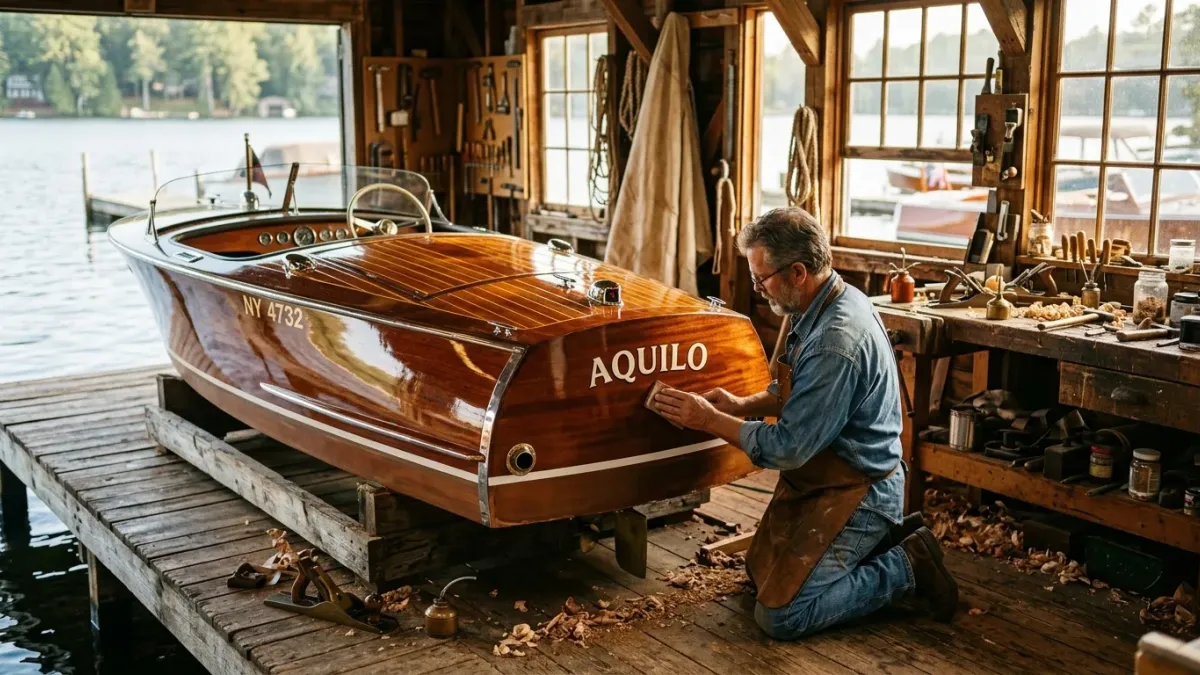
The visual signature of any restored antique boat lies in its brightwork—the gleaming, glass-like finish on exposed mahogany decks, transoms, and covering boards. Achieving a durable finish demands meticulous surface preparation. Sanding must always follow the natural grain of the wood, progressing systematically through grit sequences from coarse (80 grit for leveling) down to fine (220 or 320 grit for final finishing).
Applying traditional spar varnish formulated with high UV-inhibitor content (such as Epifanes Gloss Varnish or Captain's Varnish) requires extreme patience. Professional restorers apply between 8 and 12 coats, sanding lightly between each application with 320-grit paper or fine bronze wool to eliminate dust nibs and build high optical depth.
For high-wear areas like cabin soles or cockpit decks, synthetic polyurethane finishes or marine-grade breathable oils offer strong alternative protection. However, traditional tung-oil-based spar varnishes remain unmatched in their flexibility, expanding and contracting alongside the timber as ambient temperature and humidity fluctuate across changing seasons.
Restoration Specifications: Sample 22-Foot Mahogany Runabout
To put a typical project into practical perspective, consider the key technical specifications and resource requirements for restoring a classic 22-foot mid-century mahogany runabout:
- Length Overall (LOA): 22 ft (6.70 m)
- Beam: 6 ft 10 in (2.08 m)
- Draft: 2 ft 1 in (0.63 m)
- Displacement: Approx. 3,200 lbs (1,450 kg)
- Hull Type: V-bottom mahogany planking over white oak frames
- Engine Configuration: Inboard gas engine (e.g., Original Chris-Craft K-series or modernized marine V8, 135–220 hp)
- Fastener Requirements: ~2,500 Silicon Bronze wood screws (#8 and #10 sizes)
- Estimated Labor Hours: 450 to 700 DIY hours (or professional shop build)
Before launching any newly restored classic vessel, ensure all mandatory marine safety equipment is installed and tested. United States Coast Guard (USCG) regulations mandate compliant PFDs for all passengers, a functioning bilge pump system with automatic float switches, marine-rated fire extinguishers rated for fuel and electrical fires, sound signaling devices, and up-to-date visual distress flares.
For your first antique restoration project, look for an un-restored 18 to 22-foot freshwater mahogany runabout or a small cedar-planked daysailer with intact frames and original hardware. Begin by stabilizing the structural keel and frames in a climate-controlled workshop before touching cosmetic brightwork, ensuring your time and investment build on a solid foundation.
Frequently Asked Questions
How long does a typical antique wooden boat restoration take?
A cosmetic refurbishment usually takes 150 to 300 hours, whereas a full bottom-up structural restoration of a 20-to-25-foot classic hull routinely demands between 500 and 1,200 labor hours depending on structural frame damage and carpenter skill level.
Can I leave a wooden boat in the water all season?
Yes, provided the boat is traditionally caulked and maintained, or properly encapsulated in marine epoxy. Traditionally planked boats must remain in the water to keep the hull timber swollen, whereas epoxy-sealed hulls can safely transition between water and dry storage on a trailer.
Is epoxy or traditional caulking better for classic hull repairs?
Traditional caulking is preferred for maintaining historic value, flexibility, and original construction on museum-grade vessels. Epoxy encapsulation is ideal for boaters who want a rigid, leak-free hull with lower annual maintenance and easier trailering capabilities.