
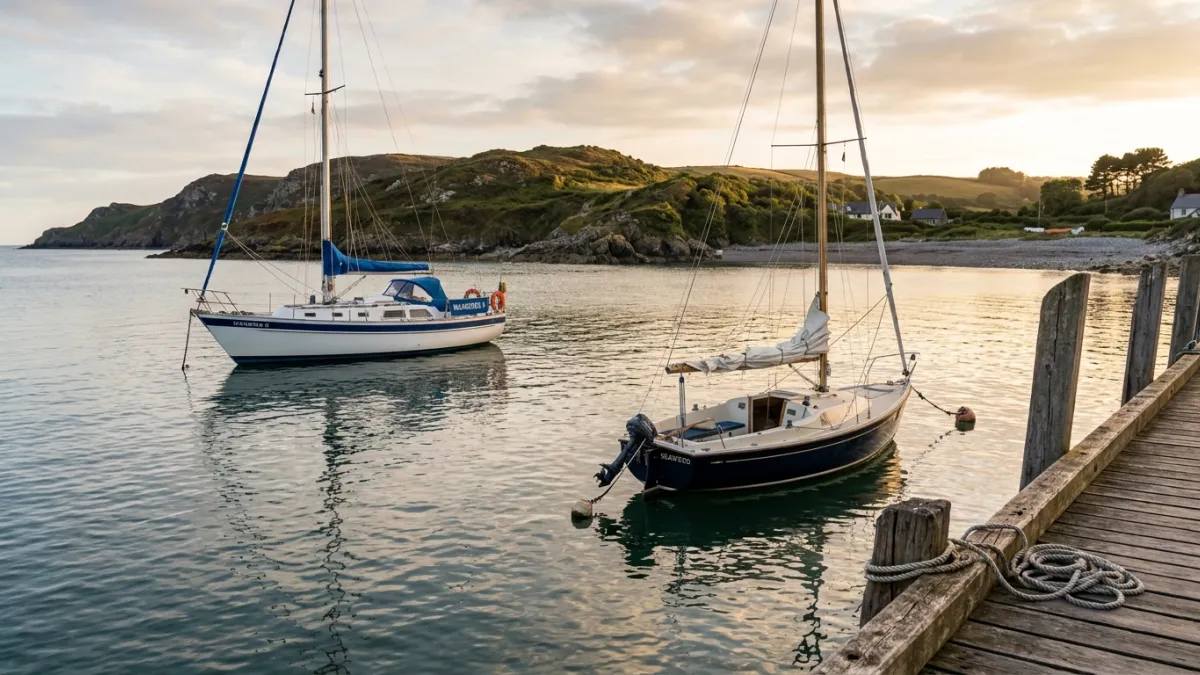
Quick answer: Compact daysailers (18–25 ft) feature lighter displacements and shallower drafts ideal for quick rigging and exploring hidden coves, while coastal cruisers (26–35 ft) offer fixed keels, full headroom, and standing amenities for multi-night comfort. Choosing between them depends on whether your priority is easy trailerability and instant launching or liveaboard comfort across variable coastal weather.
Understanding Hull Geometries: Daysailer vs. Coastal Cruiser
Hull geometry dictates almost every characteristic of how a sailboat behaves when the wind picks up and waves start build up. Compact daysailers generally feature length overall (LOA) ranges between 18 and 25 feet (5.5 to 7.6 meters), with beams kept narrow—typically under 8.5 feet (2.6 meters)—to comply with standard highway towing regulations without requiring special wide-load permits. Their hulls prioritize low wetted surface area, flat aft sections for occasional planing in heavy breezes, and shallow drafts achieved through swing keels, centerboards, or water ballast systems. As a result, a daysailer like a Catalina 22 or a Com-Pac Horizon can glide through water as shallow as 1.5 to 2 feet with its board up, granting access to remote beaches and shallow estuaries inaccessible to deeper draft vessels.
Coastal cruisers, spanning from 26 to 35 feet (7.9 to 10.7 meters) in length, shift the structural priority toward sea-keeping abilities, ultimate stability, and displacement capacity. With beams extending from 9.5 feet to well over 11 feet (2.9 to 3.4 meters), these hulls provide immense initial stability (form stability) combined with deep ballast ratios—often 30% to 40% of their overall weight hung down low in a cast iron or lead fin keel. Hulls such as the Beneteau Oceanis 30.1 or the Jeanneau Sun Odyssey 349 utilize moderate displacement hulls with hard chine lines running aft. These chines widen the beam above the waterline, creating a stiffer ride when heeled over and opening up huge internal volumes for comfortable aft cabins and enclosed heads.
The trade-off between these two design philosophies comes down to dynamic motion and resistance to heavy seas. A compact daysailer with a displacement of 2,000 to 3,500 lbs (900 to 1,580 kg) will react quickly to passing boat wakes and short wind chops, translating wave energy into sudden pitch and roll motions. Conversely, a coastal cruiser weighing between 7,000 and 12,000 lbs (3,170 to 5,440 kg) possesses the inertia required to slice through choppy waters without losing momentum. This added mass stabilizes the rig, calms motion sickness for less experienced crew members, and provides a predictable helm balance across wider wind ranges.
On-Deck Ergonomics and Rigging Complexity
Cockpit layout and rigging arrangements govern how much physical effort is required to get under way for a 48-hour trip. Compact daysailers rely heavily on fractional fractional fractional sloop rigs with modest sail areas—typically between 180 and 300 square feet (16.7 to 27.8 m²). The control lines, including halyards, outhauls, and reefing lines, are frequently handled directly at the mast or led to small deck-mounted cleats. Cockpits in this class are sprawling relative to the boat's overall length because deck space isn’t sacrificed for large cabin trunks. A open transom daysailer allows clear sightlines, fast sail adjustments, and effortless single-handed maneuvering using a simple tiller connected directly to an outboard rudder or transom cassette.
Coastal cruisers introduce sophisticated deck hardware designed to manage much higher line loads. Main sails and headsails routinely exceed 500 to 700 square feet (46.4 to 65 m²) of canvas, demanding self-tailing winches (often size 30 to 40), dual-line slab reefing systems, and rigid boom vangs. Dual steering wheels have become standard on modern coastal designs above 30 feet, improving visibility around large bimini covers and providing clear passage straight to an integrated fold-down swim platform. While these systems make handling heavy loads manageable, they also add multiple points of mechanical maintenance, including steering cables, quadrant checks, deck organizers, and multi-clutch line stoppers.
On-the-water tip: When short-handed during a sudden afternoon squall, a compact daysailer with a tiller can be turned into the wind in seconds with a simple push, whereas a wheel-steered coastal cruiser with heavy weather helm requires anticipatory mainsail depowering via the traveler to prevent rounding up violently.
Accommodation and Living Space for Weekend Trips
The interior of a sailboat defines how refreshing your weekend anchors will feel after a long day of tacking against the wind. Compact daysailers generally offer "sitting headroom" ranging from 4.2 to 4.8 feet (1.28 to 1.46 meters). Below deck, you will usually find a v-berth, two quarter berths, a port-a-potty tucked beneath a cushion, and a single-burner portable stove. While adequate for sleeping off a day on the bay or taking shelter from a sudden rain shower, weekending on a daysailer closely resembles marine camping. Storage space is limited to under-cushion lockers, and freshwater is supplied via portable jerrycans rather than pressurized plumbing systems.
Coastal cruisers elevate weekend stays into genuine luxury vacations. Standing headroom of 6.2 to 6.5 feet (1.88 to 1.98 meters) extends throughout the main saloon, galley, and private aft staterooms. These vessels feature marine head systems complete with holding tanks, hot and cold pressurized shower systems, multi-burner propane stoves with ovens, and 12V refrigeration units. Furthermore, dual-battery banks (often 200+ Ah AGM or Lithium setups) combined with shore power chargers or solar panels enable running cabin lights, refrigeration, electronics, and water pressure pumps for days off the grid without draining starting batteries.
| Design Parameter | Compact Daysailer (20-24 ft) | Coastal Cruiser (28-34 ft) |
|---|---|---|
| Length Overall (LOA) | 20 - 24 ft (6.1 - 7.3 m) | 28 - 34 ft (8.5 - 10.4 m) |
| Beam Width | 7.5 - 8.5 ft (2.3 - 2.6 m) | 9.8 - 11.5 ft (3.0 - 3.5 m) |
| Average Draft | 1.5 - 3.5 ft (Centerboard down) | 4.5 - 6.2 ft (Fixed Deep/Shoal Keel) |
| Displacement | 2,200 - 3,500 lbs (1,000 - 1,600 kg) | 7,500 - 12,500 lbs (3,400 - 5,660 kg) |
| Auxiliary Engine | 5 - 9.9 HP Outboard (Gasoline) | 15 - 30 HP Inboard (Diesel) |
| Berth Capacity / Headroom | 2 - 4 Berths / Sitting Headroom | 4 - 6 Berths / Full Standing Headroom |
| Primary Mooring/Storage | Trailerable / Dry Stack / Slip | Marina Slip / Permanent Mooring |
Maintenance, Logistics, and Total Cost of Ownership
Financial commitment varies substantially between these two classes, far beyond the initial purchase price. Compact daysailers shine brightest when evaluating ongoing operational overhead. Being trailerable means you can store the boat in a backyard, driveway, or dry-storage facility during off-seasons, eliminating monthly slip fees that can range from $200 to over $800 depending on location. Maintenance is straightforward: a single 6 HP to 9.9 HP Four-Stroke outboard engine (such as a Yamaha F9.9 or Mercury 8HP) requires minimal annual servicing, winterization takes an hour, and hull washdowns or bottom painting can be completed in a single afternoon without yard lift equipment.
Coastal cruisers require standard marine slip accommodations or dedicated mooring balls due to their wide beams, heavy displacements, and fixed deep keels. Haul-out services require travelifts, professional jack stands, and specialized bottom-prep labor. The onboard auxiliary propulsion shifts to an inboard diesel marine engine—such as a Yanmar 3YM20 or Volvo Penta D1-30—which necessitates routine heat-exchanger flushing, impeller changes, shaft zinc replacement, and transmission servicing. Equipment complexity also extends to electronics: marine chartplotters, AIS transponders, wind/speed depth transducers, VHF marine radios with DSC, and Coast Guard-mandated safety equipment (Type I PFDs, flares, EPIRBs, life-rafts) all require routine recertifications or battery updates.
- Compact Daysailers: Ultra-low maintenance overhead, minimal slip costs, simple outboard engine servicing, quick trailering ability.
- Coastal Cruisers: Higher slip and yard expenses, continuous systems maintenance (inboard diesel, plumbing, electrical), superior blue-water seaworthiness.
Which Hull Should You Choose for Your Weekend Voyages?
If your ideal weekend involves quick decision-making, exploring shallow bays, launching from different coastal locations, and keeping ownership costs to an absolute minimum, a compact daysailer with a trailerable centerboard or swing keel is your best vehicle. However, if your goal is long-distance coastal hops across open sounds, hosting family or guests overnight in private berths, cooking hot meals aboard, and enjoying complete standing room regardless of weather outside, investing in a proper 28-to-34-foot coastal cruiser will deliver the true yachting lifestyle you are looking for. Assess your local slip availability, towing vehicle capacity, and weekend routines to make the right investment before heading to your local broker.
Frequently Asked Questions
Can you safely stay overnight on a 22-foot daysailer?
Yes, many 22-foot daysailers feature V-berths and quarter berths capable of sleeping two to four adults comfortably. However, amenities are minimal—expect to use portable ice chests for food, a single-burner camping stove for cooking, and a chemical portable toilet instead of an enclosed marine head.
Do I need a heavy truck to tow a compact daysailer?
Most 18-to-22-foot daysailers with trailers have a combined towing weight between 3,000 and 4,500 lbs (1,360 to 2,040 kg). A mid-size SUV or light pickup truck rated for 5,000 lbs towing capacity is usually sufficient, though you should always verify tongue weight and local trailering regulations.
Is an inboard diesel engine better than an outboard for weekend trips?
Inboard diesel engines offer superior fuel efficiency, higher charging output via heavy-duty alternators, and better propeller immersion in steep waves. Outboards are lighter, lower cost, easier to repair or replace, and can be tilted completely out of the water to reduce drag while sailing.
What is the minimum draft needed for coastal cruising?
For coastal cruising along shallow waters like the US East Coast or the Bahamas, shallow-draft shoal keels or wing keels drawing 3.5 to 4.5 feet are ideal. Deep fin keels drawing 5.5 to 6.5+ feet offer better upwind performance but limit entry into shallow anchorages and tidal bays.
Sources
- United States Coast Guard Auxiliary - Boating Safety Standards
- Wikipedia - Sailboat Hull and Keel Designs
- American Boat & Yacht Council (ABYC) - Standards & Technical Information
Check Out Our Top Recommended Boat Gear on Amazon
Hand-picked sailing & boating essentials we actually recommend.
As an Amazon Associate, we earn from qualifying purchases.