


There’s nothing quite like the thrill of chasing big game fish miles offshore. The salty air, the open ocean, the anticipation of that rod bending — it’s what draws so many of us to the water. But for serious offshore anglers, success often hinges on more than just a good boat and a sharp hook; it depends on maximizing your spread and presenting your lures like a pro. That’s where outriggers come in. As your seasoned boating expert from boatandsailboat.com, I’ve seen countless anglers transform their offshore game with these essential pieces of equipment, and I’m here to guide you through everything you need to know.
Table Of Content
- What Exactly Are Outriggers?
- Why Every Offshore Angler Needs Them
- Types of Outriggers: Finding Your Perfect Match
- 1. Outrigger Poles
- 2. Outrigger Bases
- 3. Center Rigger
- The Anatomy of an Outrigger System
- Choosing the Right Outriggers for Your Vessel
- Installation: A Foundation for Success
- Rigging Your Outriggers for Action: Step-by-Step
- Maintenance for Longevity: Keeping Your Gear Shipshape
- Ready to Extend Your Reach?
What Exactly Are Outriggers?
Simply put, outriggers are long poles, typically extending out and away from each side of your boat, designed to spread multiple fishing lines wider than your boat’s beam. Think of them as extensions of your vessel, allowing you to cover more water and present more lures simultaneously, without tangling.
Why Every Offshore Angler Needs Them
For boats venturing into the bluewater, outriggers are indispensable. Here’s why:
- Wider Spread: They allow you to troll multiple lines at varying distances from the boat, creating a wider “fishing footprint” and increasing your chances of encountering fish.
- Enhanced Lure Action: By elevating the fishing line, outriggers lift your lures higher out of the water, making them skip and dance enticingly across the surface, mimicking baitfish.
- Reduced Tangles: With lines spread far apart, the risk of tangling during turns or when a fish strikes is significantly reduced.
- Clearer Wake: By positioning lures outside the boat’s prop wash, you offer a more natural presentation, especially beneficial for finicky species.
Types of Outriggers: Finding Your Perfect Match
Outriggers come in various forms, tailored for different boat sizes and fishing styles:
1. Outrigger Poles
- Telescoping Poles: These are popular for boats under 35-40 feet, like many center consoles (e.g., Boston Whaler, Grady-White) or smaller express cruisers. They collapse for easy storage or trailering, making them convenient.
- Fixed Poles: Typically found on larger sportfishing yachts (e.g., Viking, Hatteras) or dedicated offshore fishing machines, these are one-piece poles offering maximum strength and rigidity.
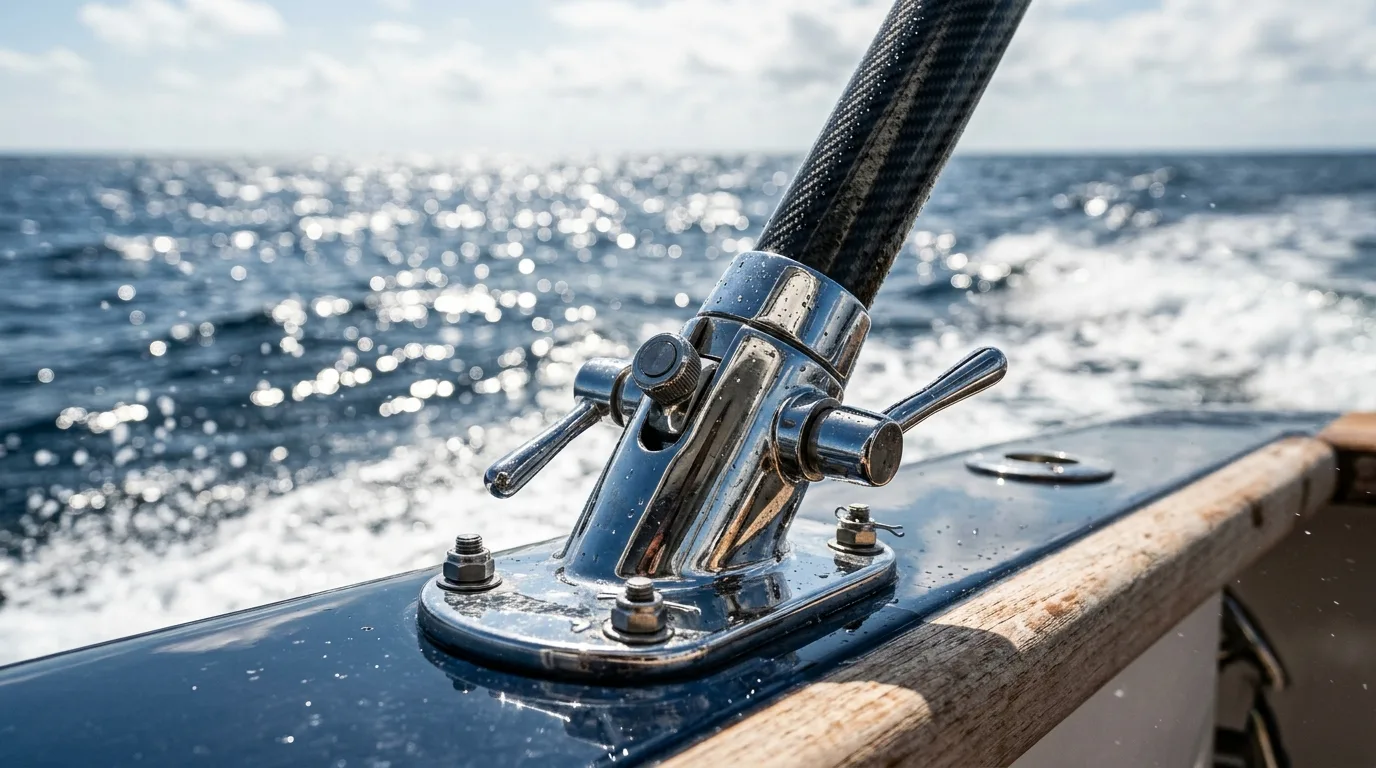
- Materials: Most modern poles are made from durable aluminum or lightweight, high-strength carbon fiber. Carbon fiber offers superior stiffness and less wind resistance.
2. Outrigger Bases
The base is where the pole attaches to your boat, and it’s crucial for stability:
- Gunwale Mounts: Installed on the side of the boat’s gunwale – the upper edge of the boat’s side. Ideal for smaller to mid-sized boats.
- T-Top/Hardtop Mounts: Very common on center consoles and express boats, these bases attach to the T-top or hardtop structure. They often feature an adjustable rotation mechanism for easy deployment and retraction.
- Cabin Side/Side Mounts: Less common, these attach directly to the cabin side of larger vessels.
3. Center Rigger
A single pole mounted in the center of the boat, often on the T-top or hardtop. A center rigger is designed to run a single line far back in the spread, creating an additional presentation zone, usually for a deep-running lure or a bait specifically targeting billfish.
The Anatomy of an Outrigger System
Beyond the poles and bases, a complete outrigger system includes:
- Rigging Kit: This includes the heavy-duty line (often Dacron or monofilament), release clips, bungee cords (to keep lines taut), and snubbers (to absorb shock).
- Release Clips: These ingenious devices hold your fishing line while trolling and release it with a precise amount of tension when a fish strikes, allowing you to fight the fish directly from your rod.
Choosing the Right Outriggers for Your Vessel
Matching the right outriggers to your boat and fishing style is key:
- Boat Size and Type: For a 25-30 ft center console, telescoping poles with T-top mounts might be perfect. For a 40 ft sportfish, fixed poles with robust T-top or gunwale mounts are more appropriate.
- Fishing Style: Are you targeting small pelagics or monster marlin? The size and strength of your outriggers should match the demands of your quarry.
- Budget: High-end carbon fiber systems offer peak performance but come at a premium. Quality aluminum options provide excellent value and performance.
Installation: A Foundation for Success
Proper installation is paramount. Outriggers exert significant force, especially in rough seas or when a fish hits. For fiberglass or aluminum hulls, this means ensuring robust backing plates are used and mounted to strong points. While a handy owner might tackle simple installations, for larger, more complex systems, I always recommend professional installation. This ensures structural integrity, proper alignment, and safety for your vessel and crew.
Rigging Your Outriggers for Action: Step-by-Step
Once installed, rigging them for fishing is straightforward:
- Run the Hal Yards: Thread the rigging line (hal yard) through the eyelets on the outrigger pole. Typically, you’ll have two lines per outrigger: one for the “short” rigger and one for the “long” rigger.
- Attach Release Clips: Securely tie a release clip to the end of each hal yard.
- Deploy and Set Tension: Extend your outriggers and use the bungee cord system to keep the hal yards taut.
- Attach Your Fishing Line: After deploying your lure, simply clip your main fishing line into the release clip. The clip will hold the line at the desired position and release it when a fish strikes.
Experiment with lure placement. Often, the “short” rigger is closer to the boat, while the “long” rigger is further back, creating an enticing spread that looks like a school of baitfish.
Maintenance for Longevity: Keeping Your Gear Shipshape
Like all marine equipment, outriggers demand regular care to withstand the harsh saltwater environment:
- Rinse After Every Trip: A thorough freshwater rinse of poles, bases, and rigging hardware will prevent salt buildup and corrosion.
- Inspect Regularly: Check all lines, clips, pulleys, and mounting hardware for wear, fraying, or corrosion. Replace any suspect components immediately.
- Lubricate Moving Parts: Annually, or more often in heavy use, lubricate the moving parts of your outrigger bases with marine-grade grease or silicone spray to ensure smooth operation.
- Corrosion Prevention: Pay special attention to stainless steel hardware where dissimilar metals might meet aluminum poles. Use anti-corrosion compounds where appropriate.
- Sail Care and Storage: While outriggers aren’t sails, their lines and clips benefit from being stored out of direct sunlight when not in use, prolonging their life.
Ready to Extend Your Reach?
Outriggers are more than just fishing gear; they’re an investment in your offshore adventure. They allow you to chase that dream catch further, faster, and more effectively. Whether you’re upgrading your trusty center console or outfitting a new sportfish, choosing the right outrigger system will dramatically enhance your offshore fishing experience. The stories waiting to be written, the sunsets on the horizon, the thrill of the chase – it all begins with the right setup. Get out there, spread those lines wide, and make some unforgettable memories on the open water!