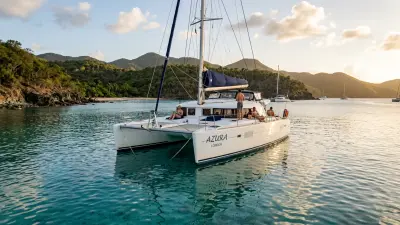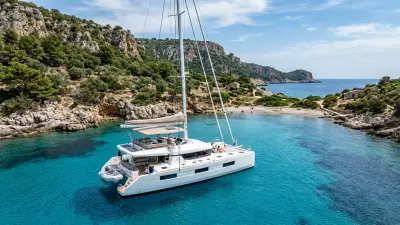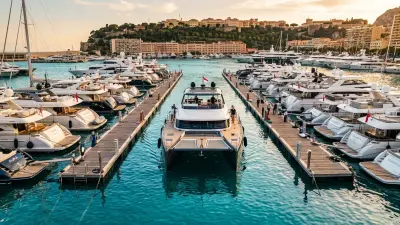
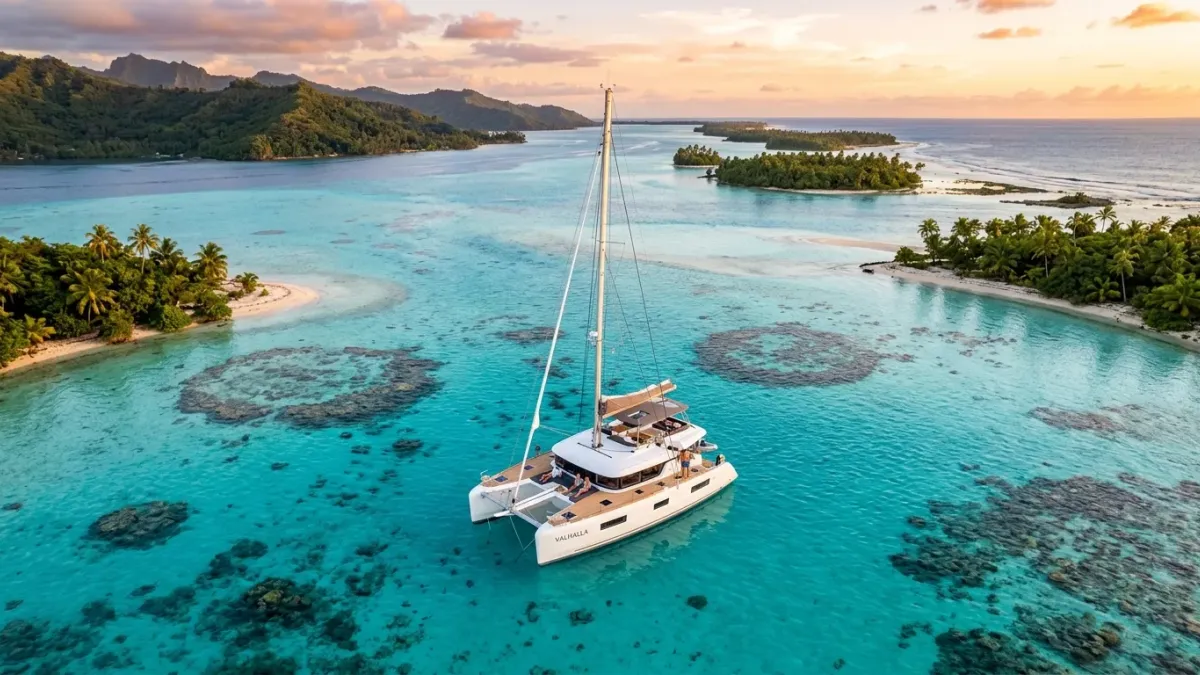
Quick answer: The Lagoon 50 is one of the most capable and comfortable liveaboard catamarans in the 50-foot class, offering unmatched volume, excellent indoor-outdoor flow, and an easily managed rig. While it is built primarily for comfort over light-air speed, its vast storage, tankage, and luxury amenities make it a top-tier choice for long-term blue-water cruising.
Design Philosophy and Architectural Breakthroughs
The collaboration between VPLP Design, Patrick le Quément, and Nauta Design brought significant structural changes to the Lagoon 50 compared to previous generations. The most notable architectural evolution is the aft-stepped mast. By moving the rig further aft, the designers created a shorter boom and a larger foretriangle, which allows for a self-tacking jib. This setup drastically reduces the physical effort required to tack or gybe a 50-foot multihull, making short-handed sailing genuinely manageable for a couple.
Below the waterline, the Lagoon 50 utilizes composite glass-reinforced plastic (GRP) sandwich construction with balsa core above the waterline and solid GRP below. Fixed keels protect the saildrives and rudders during accidental groundings, avoiding the complexity and maintenance overhead of daggerboards. The hull shape features a subtle step along the topsides that creates extra beam above the waterline, dramatically expanding interior cabin volume without adding excessive drag to the submerged sections.
Weight management is always a critical factor on a multihull, and the Lagoon 50 carries a light displacement of approximately 20.8 metric tons (45,860 lbs). When loaded up with full water, fuel, safety gear, and personal belongings for long-term cruising, operational displacement comfortably reaches 25 to 26 tons. Its generous beam of 26 feet 7 inches (8.10 meters) yields an immense righting moment, providing incredible initial stability that reassures nervous crew members in heavy seas.
On-the-water tip: Because the mast is stepped further aft, the mainsail is tall and narrow with a square top. When reefing in heavy weather, drop the mainsail early before the sail pushes hard against the swept-back spreaders. Friction on the full-batten cars increases quickly once you are sailing downwind, so turning slightly upwind to relieve sail pressure makes reefing effortlessly smooth.
Sailing Performance, Rigging, and Engine Power
Under sail, the Lagoon 50 handles like a well-mannered blue-water cruiser. The standard rig carries a total sail area of approximately 1,703 square feet (158.2 m²), featuring a 1,056 sq ft (98 m²) full-batten mainsail and a 647 sq ft (60 m²) self-tacking jib. For light-wind conditions, setting a Code 0 or an asymmetric spinnaker off the continuous-line furler is practically mandatory if you want to keep moving at 7 to 9 knots when the breeze drops below 12 knots. In 18 to 22 knots of true wind, this yacht easily locks into a steady 8.5 to 9.5-knot cruise on a reach.
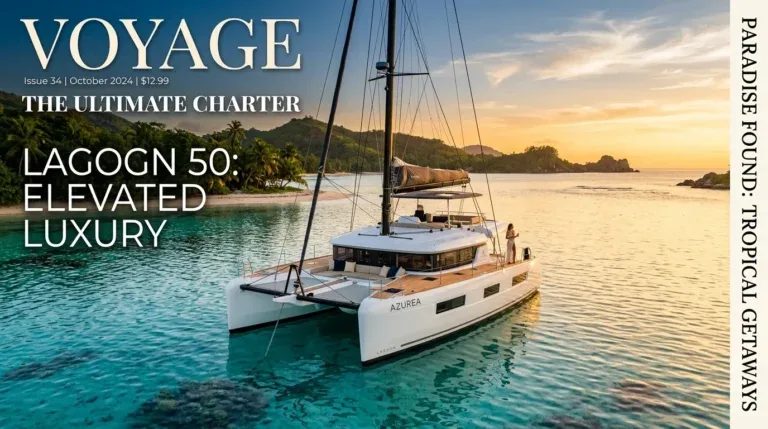
Propulsion is powered by twin Yanmar or Volvo Penta diesel engines. Standard configuration starts with twin 57 hp units, though most owners opt for the upgraded 80 hp diesels fitted with saildrives and three-blade folding propellers. Maneuvering in tight marinas is stress-free thanks to the wide separation between the two props. By using opposing engine thrust—one forward, one reverse—you can rotate the boat on its own axis even in challenging crosswinds without relying heavily on bow thrusters.
The flybridge helm station consolidates all sail control lines, halyards, and sheet winches into a centralized pod. Having three large electric winches (typically Harken 60s) right at hand allows a single person to raise the main, roll out the head sails, and adjust the traveler. However, because the flybridge is elevated, the skipper is somewhat separated from the main deck level, requiring clear communication or wireless headsets when setting dock lines or mooring pennants.
Layout, Liveaboard Comfort, and Interior Design
Interior space is where the Lagoon 50 sets a benchmark for the industry. Available in configurations ranging from 3 to 6 cabins, the boat caters equally well to charter fleets and private liveaboard owners. The popular 3-cabin "Owner's Version" dedicates the entire starboard hull to a magnificent master suite. It features a island queen bed aft, a central lounge/desk area, vast wardrobe storage, and a massive forward bathroom with a walk-in stall shower.
| Specification | Lagoon 50 Metric | Lagoon 50 Imperial |
|---|---|---|
| Length Overall (LOA) | 14.75 m | 48 ft 5 in |
| Hull Length | 14.31 m | 46 ft 11 in |
| Beam (Width) | 8.10 m | 26 ft 7 in |
| Draft | 1.40 m | 4 ft 7 in |
| Air Draft (Mast Height) | 26.52 m | 87 ft 0 in |
| Light Displacement | 20,800 kg | 45,860 lbs |
| Fuel Capacity | 2 x 520 L | 2 x 137 US gal |
| Freshwater Capacity | 2 x 240 L | 2 x 63 US gal |
| Standard Power | 2 x 57 HP Yanmar | 2 x 57 HP Yanmar |
The main saloon offers vertical wrap-around windows that provide 360-degree visibility, minimizing motion sickness and maximizing natural light. The U-shaped galley faces aft and features a double stainless-steel sink, a three-burner gas cooktop, an oven, and multiple refrigeration drawers. An innovative drop-down window connects the galley directly with the aft cockpit, eliminating barriers between the chef and guests seated outside.
Outside, the cockpit acts as an outdoor living room with a large dining table, comfortable L-shaped seating, and a daybed. Moving forward via wide side decks leads to the forward cockpit and trampolines, which serve as an ideal spot for sunset cocktails. For tender management, Lagoon offers an optional hydraulic stern platform that doubles as a swim deck or comfortably stows a 3.9-meter aluminum RIB with a 30 hp outboard.
Essential Systems, Maintenance, and Operating Costs
Living full-time on a blue-water catamaran requires self-sufficiency, and the Lagoon 50 provides the physical footprint necessary to install heavy-duty off-grid infrastructure. Bluewater cruisers usually spec the boat with a 11kW to 13.5kW generator, an inverter system (3000W to 5000W), and a watermaker capable of producing 30 to 60 gallons per hour. The vast bimini roof and flybridge structures provide ample flat surface area to mount over 1,500 watts of solar panels.
Routine maintenance protocols follow standard multihull practices but require budgeting for double engine components. Expect annual hauled-out maintenance for anti-fouling paint, prop-speed application on saildrives, and replacing zinc anodes. Saildrive leg seals require inspection every season and replacement every 5 years. Standard safety equipment for USCG or offshore blue-water certification must include a 8 to 10-person life raft, an EPIRB, dual high-capacity bilge pumps in each hull, flares, and modern PFDs with integrated AIS beacons.
- Annual Haul-out and Bottom Paint: $3,500 – $5,500 depending on yard rates.
- Engine & Saildrive Service (Twin Yanmar 80hp): $1,500 – $2,500 annually.
- Insurance (Blue-water cover): 1.2% to 2% of insured hull value per year.
- Rigging & Canvas Inspection: Rig replacement recommended every 10 years or 30,000 nautical miles.
If you are planning an extended crossing across the Atlantic or Pacific, consider ordering the 3-cabin layout for maximum storage capacity. Ensure you opt for the upgraded 80 hp engine package and install a robust lithium (LiFePO4) battery bank to run the air conditioning without running the generator all night.
Frequently Asked Questions
Is the Lagoon 50 suitable for short-handed sailing by a couple?
Yes. The aft-stepped mast design, self-tacking jib, and electric winches situated at the flybridge allow a single person to handle all sails easily. However, docking requires good communication due to the elevated helm station.
What is the real-world cruising speed of the Lagoon 50 under power?
With twin 80 hp Yanmars operating at a comfortable 2,200 RPM cruising speed, the Lagoon 50 makes around 7.5 to 8.0 knots in calm water. Pushing to 2,600 RPM brings speed up to roughly 8.8 knots, though fuel consumption rises sharply.
Can the Lagoon 50 fit into standard marina slips?
With a beam of 26 feet 7 inches (8.10 m), the Lagoon 50 requires a dedicated catamaran slip or an end-tie dock. Most modern cruising marinas accommodate this beam, but advance booking is recommended during peak cruising seasons.