Quick answer: The Moody 49 is an authoritative 48-foot center-cockpit blue-water cruiser designed by Bill Dixon, offering 16 metric tons of displacement, 5 metric tons of ballast, and exceptional short-handed ocean-crossing capability. With a solid GRP layup, Yanmar auxiliary power, and a spacious three-cabin interior, it stands out as one of the safest and most comfortable long-distance liveaboard platforms available on the pre-owned market.
The Design Philosophy and Pedigree of Bill Dixon
Bill Dixon approach to the Moody 49 focused on creating an effortless ocean-going vessel that could handle rough northern waters without exhausting its crew. Rather than following contemporary trends toward ultra-light displacements and wide, flat aft sections, Dixon prioritized motion comfort and directional stability. The hull features a moderate beam of 4.40 meters (14 ft 5 in) that carries smoothly aft, preventing the violent slamming common in wider, flatter cruisers when punching into steep head seas. A subtle entry forefoot cuts cleanly through choppy water, preserving forward momentum while keeping heavy spray off the deck house.
safety at sea relies heavily on a balanced sail plan and predictable tracking under autopilot. Dixon achieved this by matching a deep fin keel with a robust skeg-supported rudder, a combination that strikes an ideal balance between low-speed maneuverability and rock-solid tracking on downwind ocean passages. The low center of gravity provided by five metric tons of ballast guarantees a high resistance to capsize and a stiff, forgiving heel angle in sudden squalls. This inherent stability reduces wear on both crew energy and electronic steering drives over thousands of offshore miles.
Halmatic Construction and British Engineering
The build process of the Moody 49 reflects the highest standards of mid-2000s British boatbuilding. Molded by VT Halmatic, renowned for constructing commercial pilot boats and naval craft, the hull employs heavy hand-laid glass-reinforced plastic (GRP) above a substantial structural grid. Transverse floors and longitudinal stringers are glassed directly into the hull to absorb the intense working loads generated by the rig and keel. Structural bulkheads are glassed across both hull and deck joints, forming an exceptionally rigid monocoque structure.
This uncompromising construction philosophy prevents hull flexing when beating upwind in heavy weather. Onboard systems reflect equal diligence, featuring high-capacity bilge pump arrangements, marine-grade bronze thru-hulls, and neatly organized copper grounding networks. Owners frequently note that even after decades of hard ocean sailing, the interior teak joinery remains tight and squeak-free, a testament to the structural integrity engineered into the hull.
Deck Layout and Ocean-Going Ergonomics
On deck, the Moody 49 demonstrates why center-cockpit designs remain the gold standard for dedicated long-distance cruisers. Elevated significantly above the waterline, the central cockpit keeps the helm station high and dry, well isolated from green water rolling over the bows in heavy weather. Deep coamings provide reassuring back support, while sturdy stainless steel handrails run the length of the coachroof to ensure safe crew movement from stern to bow.
All primary control lines, halyards, and reefing pennants feed backward to heavy-duty Lewmar winches positioned within easy reach of the wheel. A couple can manage sail short-handed without stepping outside the safety of the cockpit coaming. The forward deck area remains clear and uncluttered, featuring deep anchor lockers designed to stow dual anchors alongside hundreds of feet of high-test chain.
Rigging Options and Sail Handling
Most Moody 49 hulls left the factory configured as powerful cutter rigs or versatile masthead sloops supported by Selden spars and stainless steel standing rigging. The cutter configuration is particularly favored by ocean passage-makers because it allows the crew to drop the primary genoa and set a heavy-weather staysail on a removable or fixed inner forestay. This keeps the center of effort low and consolidated near the middle of the yacht during high-wind passages.
In-mast roller furling mainsails were a popular option on this model, enabling infinite reefing adjustments from the cockpit with minimal physical exertion. Paired with powerful bow thrusters, the Moody 49 allows a two-person crew to handle a nearly 50-foot vessel inside crowded Mediterranean marinas or tight Caribbean anchorages with complete poise.
Below Deck: Liveability, Layout, and Storage
Stepping down the companionway of the Moody 49 reveals a spacious, light-filled interior crafted in warm Burmese teak or cherry woodwork. Large deck saloon portlights illuminate a generous main saloon, featuring a u-shaped settee to port surrounding a polished dining table. To starboard, a dedicated navigation station houses full-sized paper chart storage alongside modern multifunction displays and electrical distribution panels. Headroom throughout the main living spaces measures a comfortable 2.00 meters (6 ft 7 in).
The passage galley is positioned along the walkway leading aft to the master cabin. Built in a sea-safe linear layout, it provides secure bracing points for the cook when preparing meals under heel. Generous refrigeration space, dual stainless steel sinks, a gimbaled three-burner stove, and dedicated pantry storage make extended offshore provisioning simple and practical.
Aft Master Cabin and Guest Accommodations
The crowning feature of the interior is the palatial aft owner cabin, made possible by the elevated center cockpit deck layout. Centered around a king-sized island berth, this suite features hanging lockers, dressing vanity drawers, opening portlights for cross-ventilation, and a private ensuite bathroom with a separate shower stall. Being isolated from forward hull noise, the aft cabin provides off-watch crew members with exceptionally quiet rest on long ocean passages.
Forward accommodations are equally well thought out for visiting guests or family members. A spacious double guest cabin occupies the forepeak, while a comfortable twin-bunk cabin is located to starboard. These guest spaces share a large forward head and shower, ensuring privacy and convenience for everyone onboard during multi-week cruises.
Technical Specifications and Performance Metrics
Understanding the engineering footprint of the Moody 49 requires looking closely at its key technical measurements and structural proportions. Below is a detailed breakdown comparing the Moody 49 with two recognized blue-water benchmark yachts of similar length and vintage.
| Specification / Metric | Moody 49 | Hallberg-Rassy 48 | Oyster 485 |
|---|---|---|---|
| Length Overall (LOA) | 14.64 m / 48 ft 0 in | 14.99 m / 49 ft 2 in | 14.78 m / 48 ft 6 in |
| Beam | 4.40 m / 14 ft 5 in | 4.50 m / 14 ft 9 in | 4.27 m / 14 ft 0 in |
| Standard Draft | 2.35 m / 7 ft 8 in | 2.35 m / 7 ft 8 in | 2.18 m / 7 ft 2 in |
| Displacement | 16,000 kg / 35,274 lbs | 18,500 kg / 40,785 lbs | 18,600 kg / 41,000 lbs |
| Ballast | 5,000 kg / 11,023 lbs | 5,750 kg / 12,676 lbs | 5,890 kg / 12,985 lbs |
| Engine Power | 100 HP Yanmar 4JH3-HTE | 110 HP Volvo Penta D3 | 75 HP Yanmar 4JH3-TE |
| Fuel Capacity | 527 L / 139 gal | 800 L / 211 gal | 830 L / 219 gal |
| Freshwater Capacity | 800 L / 211 gal | 910 L / 240 gal | 750 L / 198 gal |
The key equipment list on a typical Moody 49 configured for long-distance passagemaking includes:
- Primary Engine: Yanmar 100 HP 4JH3-HTE turbo-diesel with shaft drive and folding propeller.
- Rigging & Spars: White powder-coated Selden aluminum mast, rod or heavy wire standing rigging, and cutter staysail hardware.
- Tankage Systems: 527-liter stainless steel fuel tank and dual GRP freshwater tanks totaling 800 liters.
- Power Generation: Dual high-output alternators, solar panel installations on bimini frames, and optional diesel generators.
- Safety Gear: Integrated USCG/CE Category A ocean safety package including 6-person liferaft, EPIRB, dual manual/electric bilge pumps, and offshore PFD harness attachments.
Real-World Handling and Maintenance Considerations
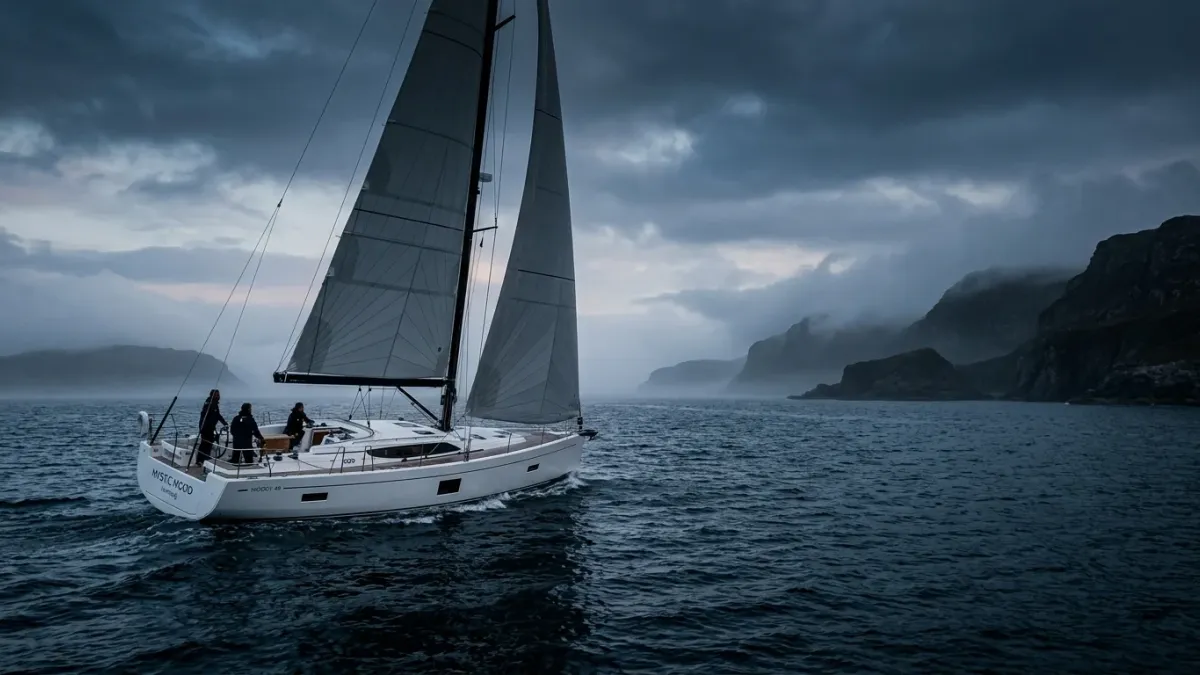
Under sail, the Moody 49 demonstrates the classic characteristics of a heavy-displacement ocean cruiser. In true wind speeds of 15 to 22 knots, the yacht heels gently to its displacement turn, locks onto a groove, and tracks effortlessly at 7.5 to 8.5 knots. The balanced helm feedback allows the helmsman to steer comfortably with light finger pressure, preventing fatigue during long manual watches. While light-air performance below 8 knots of wind requires larger downwind code sails, the trade-off is total comfort when wind conditions spike above 30 knots.
On-the-water tip: When docking a Moody 49 in a stiff crosswind, remember that her high bow and elevated center-cockpit coachroof catch substantial windage before she gathers momentum. Always deploy the bow thruster in short, positive bursts to hold the bow up into the wind before engaging forward prop thrust, and make sure your engine idle speed is set correctly on your Yanmar auxiliary to ensure instantaneous response at the throttle.
From a maintenance standpoint, prospective buyers should pay close attention to teak deck condition, standing rigging age, and engine service records. Many Moody 49 vessels were built with high-grade Burmese teak decks glued and screwed to the composite deck molding. Checking seam caulk integrity and measuring teak thickness during pre-purchase marine surveys is crucial to avoiding expensive re-fitting costs down the line.
Additionally, inspecting chainplates where they pass through the deck, servicing primary Lewmar winches, and checking rudder stock bearings for play are standard maintenance items for vessels of this vintage. The engine compartment, located beneath the companionway stairs, features removable access doors on three sides, making routine oil changes, belt replacements, and impeller swaps straightforward for hands-on owners.
If you are planning an offshore voyage, targeting a well-maintained Moody 49 built between 2003 and 2006 offers one of the best value-to-quality propositions on the international yacht brokerage market. First-time buyers should schedule a rigorous out-of-water marine survey, prioritizing structural moisture checks and standing rigging age over cosmetic upgrades, ensuring a sea-ready platform ready to take you anywhere in the world.
Frequently Asked Questions
Is the Moody 49 suitable for short-handed or couple sailing?
Yes, the Moody 49 was specifically engineered for effortless short-handed operation. With in-mast mainsail furling, electric winches located within easy arm's reach of the helm, and a powerful bow thruster, two experienced sailors can navigate, reef, and dock the vessel without additional crew.
How does the Moody 49 compare to modern light-displacement production boats?
Unlike lighter contemporary production yachts, the Moody 49 features a heavy GRP layup, moderate beam, and a high ballast ratio. This delivers a significantly smoother, drier motion in rough seas, superior structural durability, and better directional stability, though it sacrifices a bit of speed in light winds below 8 knots.
What engine powers the Moody 49, and what is its cruising speed?
The Moody 49 is standardly powered by a reliable 100 HP Yanmar 4JH3-HTE turbocharged marine diesel engine. Under power, the hull comfortably cruises at 7.5 to 8.0 knots at 2,400 RPM while burning approximately 5 to 6 liters of diesel fuel per hour.
Which hull layout options were available on the Moody 49?
The standard layout features a center cockpit with three private cabins: a massive aft owner's suite, a forward guest double cabin, and a starboard twin bunk cabin. It includes two spacious heads with separate shower stalls, a dedicated chart station, and an inline passage galley.