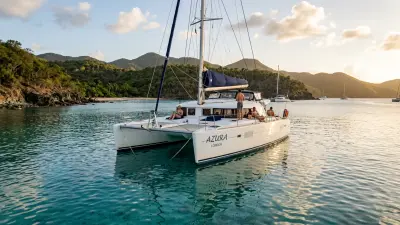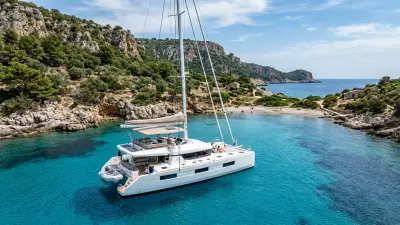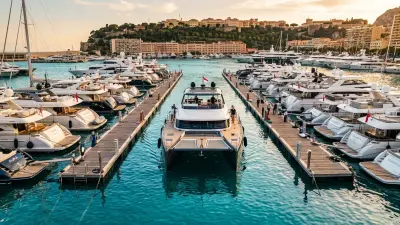
Quick answer: The Ocean Explorer 60 is a premium, Finnish-built carbon-composite performance cruising catamaran designed by Germán Frers. It combines high daily passage speeds (often exceeding 200–250 nautical miles per day) with semi-custom luxury interiors, making it an ideal long-range voyager for discerning owners seeking speed, safety, and ultimate comfort.
Naval Architecture and Build Quality: The Finnish Heritage
The foundation of the Ocean Explorer 60's reputation lies in its advanced structural engineering. Unlike high-volume production catamarans constructed with heavy GRP (glass-reinforced plastic) layups and minimal structural reinforcing, the OE60 utilizes a light, vacuum-infused carbon fiber sandwich construction with Epoxy resin and PVC foam core. Carbon fiber is strategically employed across high-load areas, including main bulkheads, chainplates, and the integrated longitudinal beam structure. This construction strategy results in a lightship displacement of roughly 19,000 kg (41,887 lbs), remarkably light for a 60-foot luxury cruising yacht.
Germán Frers optimized the hull lines specifically to reduce drag while maintaining generous internal volume. The hulls feature sharp bow entries to knife through head seas and flat aft sections that facilitate planing in downwind conditions. Furthermore, retractable carbon daggerboards allow the OE60 to draw just 1.20 meters (3.9 feet) with boards up, granting access to shallow coves, while extending down to 3.20 meters (10.5 feet) for impressive upwind performance, pointing angles, and minimal leeway.
On-the-water tip: When trimming a performance catamaran like the OE60, never over-tighten the mainsheet when sailing upwind with daggerboards fully down. Allow the carbon rig to breathe; trimming by the telltales rather than sheer sheet tension keeps the boat riding on its foils smoothly and prevents premature stall, keeping your speed well above 10 knots in 15 knots of true wind.
Interior Layout and Onboard Luxury
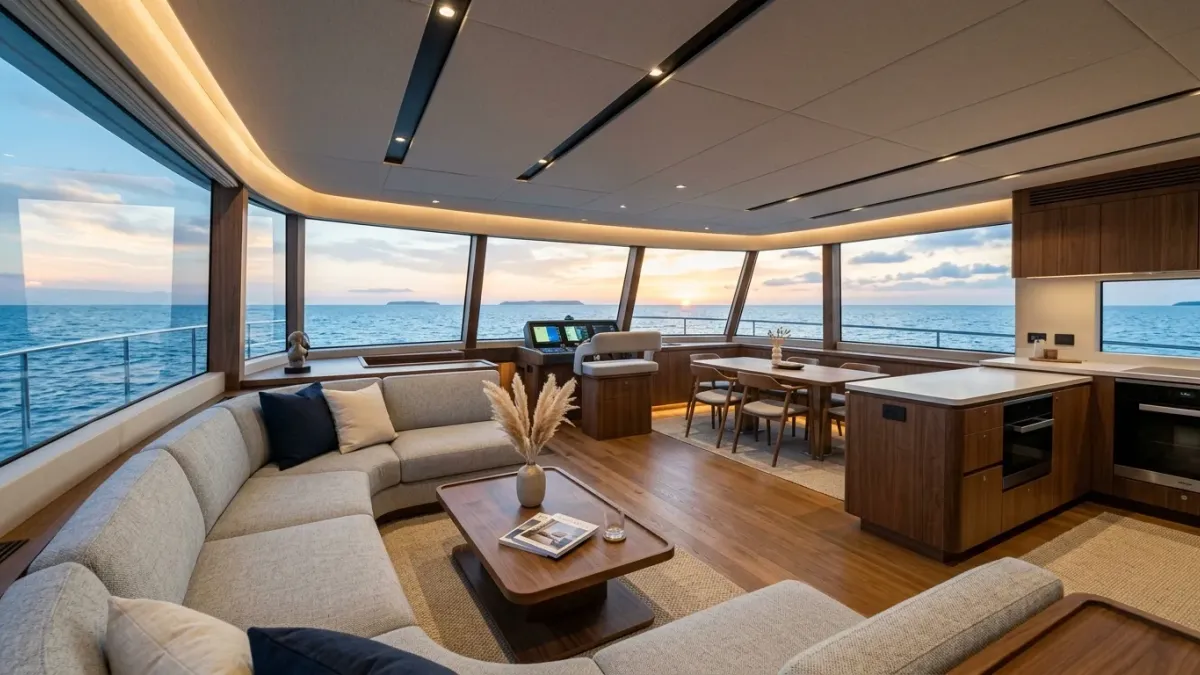
Stepping inside the saloon reveals a grand space that mirrors a luxury penthouse suite. Because the OE60 is built on a semi-custom platform, owners can tailor layout options to match their cruising philosophy, whether planning short family cruises or a full circumnavigation with professional crew. The flush deck layout creates a seamless transition between the cockpit and the main saloon, maximizing natural light via 360-degree tempered glass windows.
The standard owner’s layout features a master suite that occupies an entire hull, complete with a queen-sized island berth, dedicated workspace, walk-in storage, and a private ensuite bathroom with a separate rain shower. The opposite hull typically houses two spacious double guest cabins with private heads, or a combination of guest suites and crew quarters. Finishings incorporate lightweight furniture cores wrapped in high-grade teak, oak, or walnut veneers, preserving structural weight savings without sacrificing plush aesthetics.
- Saloon & Galley: Open-plan arrangement featuring Miele or Bosch appliances, custom refrigeration units, and corian or quartz countertops.
- Climate Control: Chilled-water air conditioning systems paired with high-capacity lithium battery banks for silent night operation without generator noise.
- Navigation Center: Ergonomic helm station with full glass-cockpit integration, autopilot controls, radar overlays, and vessel monitoring systems.
Sailing Performance and Engine Specifications
Under sail, the Ocean Explorer 60 operates in a tier far above standard charter catamarans. The powerful rig features a tall carbon fiber mast paired with a square-top mainsail, self-tacking jib, and bowsprit-mounted Code Zero or asymmetric spinnaker. Passage planning becomes a different discipline entirely when 240-to-280 nautical mile daily runs are easily attainable in moderate breezes.
When motoring through calm calms or maneuvering inside tight marinas, twin inboard diesel engines provide precise control. Standard setups usually pair Yanmar or Nanni diesels with saildrives and folding propellers. The wide beam of 9.15 meters provides immense leverage, allowing experienced skippers to turn the yacht within its own length using asymmetric engine thrust without relying heavily on thrusters.
| Specification Parameter | Value / Measurement |
|---|---|
| Length Overall (LOA) | 18.50 m / 60.7 ft |
| Waterline Length (LWL) | 18.10 m / 59.38 ft |
| Beam (Width) | 9.15 m / 30.0 ft |
| Draft (Boards Up / Down) | 1.20 m (3.9 ft) / 3.20 m (10.5 ft) |
| Lightship Displacement | Approx. 19,000 kg / 41,887 lbs |
| Hull Material | Vacuum-infused Carbon Fiber / Epoxy Sandwich |
| inboard engine Power | Twin 80 HP – 110 HP Diesel (Yanmar / Nanni) |
| Standard Sail Area (Upwind) | Approx. 210 m² / 2,260 sq ft |
| Fuel Tank Capacity | Approx. 1,000 L / 264 US Gal |
| Freshwater Capacity | Approx. 600 L / 158 US Gal |
Ownership Realities, Maintenance, and Market Valuation
Owning a carbon-built luxury catamaran requires an understanding of advanced marine systems. Because the Ocean Explorer 60 utilizes modern electrical backbones (often C-Zone or Masterbus digital switching), high-voltage lithium battery banks, and solar integration, routinely monitoring battery state of charge and electrical loads is vital. Regular maintenance routines must include daggerboard trunk flushing, hydraulic steering inspections, and annual servicing of saildrive seals and folding propellers.
In terms of pricing, purchasing a new Ocean Explorer 60 generally requires an investment starting between $3.5 million and $4.5 million USD, depending heavily on custom layout options, carbon mast packages, and electronics selection. Pre-owned models on the brokerage market hold strong resale values owing to the limited production runs and high demand for top-tier Scandinavian construction standards, typically listing from $2.8 million USD upward depending on age and condition.
Safety onboard is reinforced by modern ocean-cruising equipment requirements. Safety gear loadouts for blue-water voyages typically include dual 6-to-8 person ISO-approved liferafts, an EPIRB (Emergency Position Indicating Radio Beacon), personal AIS units built into inflatable PFDs, fixed fire suppression systems in both engine compartments, and storm sails as mandated by major offshore racing and safety regulations (such as USCG or World Sailing OSR guidelines).
Is the Ocean Explorer 60 Right for You?
If your ultimate goal is long-range blue-water cruising without sacrificing passage speed or living luxury, the Ocean Explorer 60 sits at the peak of what the multihull world offers. Buyers stepping up from production catamarans like Lagoon, Fountaine Pajot, or Leopard will find the OE60 offers exponentially higher sailing feedback, lower leeway upwind, and vastly superior finish quality. It is perfectly suited for experienced owners planning high-latitude journeys, transatlantic crossings, or extended island hopping where speed translates directly to comfort and safety.
Frequently Asked Questions
How fast is the Ocean Explorer 60 under sail?
In 15 to 20 knots of wind, the OE60 easily sails at speeds between 10 and 15 knots on reaching angles. With favorable winds and downwind sails deployed, true speeds can comfortably exceed 18 to 20 knots.
Can the Ocean Explorer 60 be short-handed by a couple?
Yes. Despite its size and performance, electric winches, a self-tacking jib, push-button furling systems, and modern autopilot integration allow an experienced couple to handle sails and dock maneuvering comfortably.
What is the advantage of carbon fiber construction over standard fiberglass?
Carbon fiber offers a significantly higher strength-to-weight ratio compared to traditional fiberglass. This reduces total yacht weight for better performance and lighter loads on rigging, while simultaneously increasing structural rigidity and hull longevity under heavy ocean forces.
Sources
- Ocean Explorer Yachts Official Website
- Frers Naval Architecture & Engineering
- World Sailing Offshore Special Regulations