

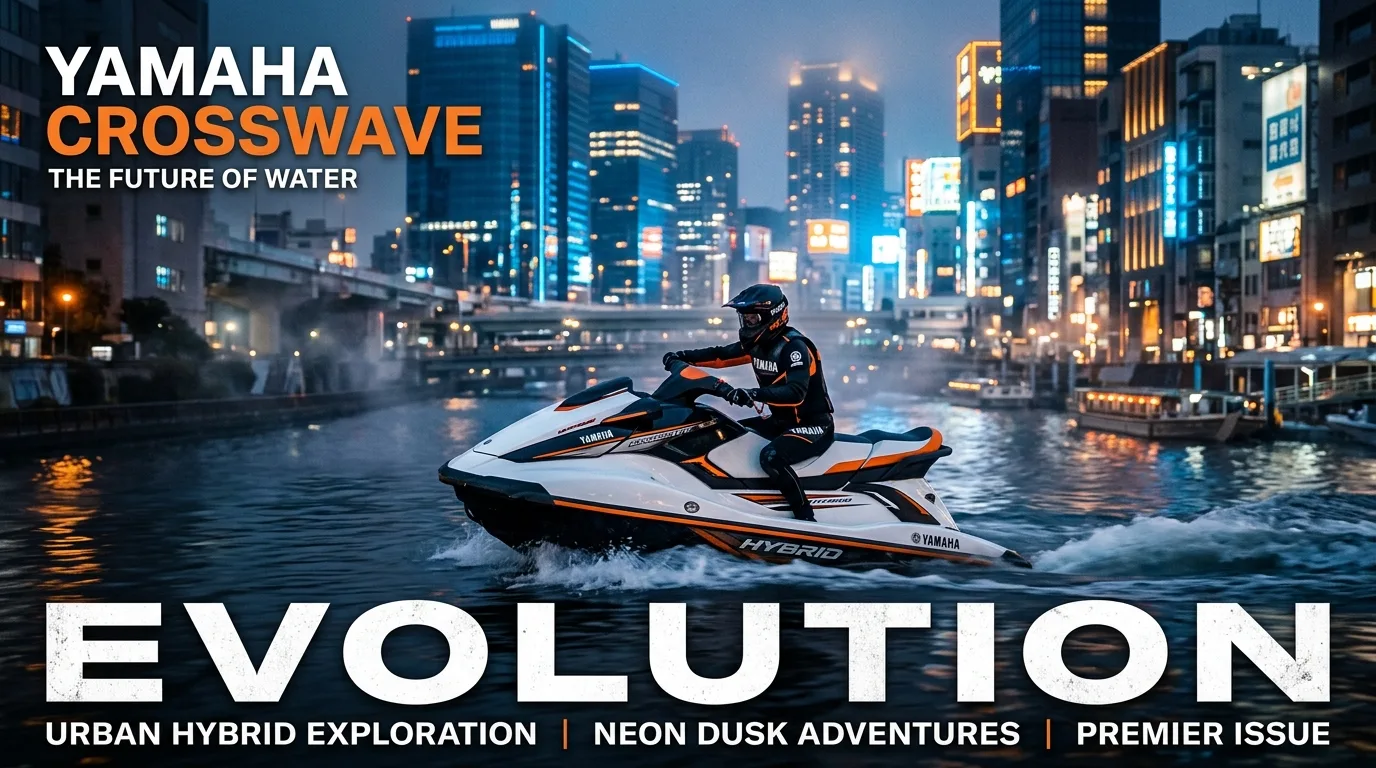

As someone who’s spent decades with salt spray on my face and engine grease on my hands, I’ve witnessed the marine industry evolve in incredible ways. From the early days of personal watercraft (PWCs) to today’s sophisticated yachts, innovation is a constant tide. But every so often, a vessel emerges that doesn’t just add to the fleet; it reshapes our understanding of what’s possible on the water. The Yamaha CrossWave is precisely one of those paradigm-shifting creations.
Table Of Content
- What is the Yamaha CrossWave? Redefining the Personal Watercraft Landscape
- The Concept: A Hybrid for the Modern Boater
- Distinguishing Features: More Than Just a PWC
- Deep Dive into Design and Engineering: Power, Platform, and Practicality
- Engine and Performance: The Heart of the Beast
- Dimensions and Stability: A New Platform
- Hull Design and Handling: Engineered for Versatility
- Fuel Capacity and Range: Extending Your Adventures
- Features and Functionality: Bridging the Gap Between PWC and Boat
- Seating and Comfort: Room for More
- Storage Solutions: Gear for Every Expedition
- Towing Capability: Watersports Ready
- Navigation and Tech: Modern Conveniences
- Thoughtful Touches: From Fishing to Family Fun
- Who is the CrossWave For? Usage Scenarios and My Take
- The Versatile Adventurer
- The Watersports Enthusiast
- The Casual Angler
- The Family Fun Seeker
- My Personal Insight
For years, enthusiasts have faced a classic dilemma: do you opt for the exhilarating speed and nimble handling of a PWC, or the stability, storage, and utility of a small boat? The choice often meant compromise. You either sacrificed the adrenaline rush for practical space, or you gave up the ability to bring along much gear for the thrill of cutting through waves. Yamaha, with the CrossWave, is boldly challenging that convention, proposing a singular solution for a multitude of desires.
Imagine a craft that lets you zip across the lake like a performance PWC, then comfortably cruise to a secluded cove for a picnic, or even tow the kids on a tube with ease. Traditionally, these activities might call for different vessels. The CrossWave, however, is engineered to deliver the best of both worlds, aiming to expand your horizons and make every outing more comfortable and capable. Join me as we cast off and explore every facet of this intriguing new entrant, from its revolutionary design to its practical applications, offering a seasoned perspective on why this might just be the next great leap in personal marine recreation.
What is the Yamaha CrossWave? Redefining the Personal Watercraft Landscape
The Concept: A Hybrid for the Modern Boater
The Yamaha CrossWave isn’t just another personal watercraft; it’s Yamaha’s definitive statement that the line between a high-performance jet ski and a versatile small adventure boat can, and should, be blurred. It’s a hybrid marvel, designed from the keel up to deliver an exhilarating PWC experience without sacrificing the practical utility, stability, and comfort typically associated with a compact boat. This innovation speaks directly to a growing demographic of water enthusiasts who crave versatility and efficiency from their marine investments.
Think about the typical compromises you make when choosing between a PWC and a small runabout. PWCs offer unmatched agility and excitement but limited storage and passenger capacity. Small boats provide space, stability, and the ability to carry more gear, but often lack the PWC’s raw, unadulterated thrill. The CrossWave aims to bridge this gap, offering a compelling blend that makes it suitable for a wider array of activities than either category alone. It’s designed for the family that wants to waterski in the morning, explore hidden coves in the afternoon, and fish at sunset—all from a single, capable vessel.
Distinguishing Features: More Than Just a PWC
From the moment Yamaha first hinted at the CrossWave, the buzz in the marine community was palpable. Could a single craft truly offer the nimble excitement of a WaveRunner alongside the storage, stability, and sheer adaptability of a small fishing or utility boat? Yamaha’s engineers seem to think so, and they’ve packed this machine with features designed to prove it. Its significantly larger footprint, robust hull design, and thoughtful integration of creature comforts set it apart from anything currently on the market. This isn’t just about speed or splash; it’s about expanding your horizons on the water, enabling new types of adventures, and making every outing more comfortable and capable for multiple passengers and their gear.
Deep Dive into Design and Engineering: Power, Platform, and Practicality
Understanding the Yamaha CrossWave means looking beyond the glossy marketing and into the thoughtful engineering that underpins its revolutionary concept. Yamaha hasn’t just tacked on a few extra features; they’ve reimagined the fundamental design of a PWC to create a truly versatile platform. Every dimension, every component choice, speaks to a purpose: blending exhilarating performance with unprecedented utility.
Engine and Performance: The Heart of the Beast
At the heart of the CrossWave lies Yamaha’s proven 4-cylinder, 4-stroke, 1.9L High Output Yamaha Marine Engine. This isn’t a new, untested powerplant; it’s a refined version of an engine celebrated for its reliability, efficiency, and potent performance across Yamaha’s premium WaveRunner lineup, particularly in models like the FX HO series. While specific horsepower figures for the CrossWave have yet to be officially released, we can draw reasonable comparisons to similar engines in the WaveRunner series, which typically produce between 180 to 250 horsepower. This power band is more than ample for exhilarating top speeds, ensuring that thrill-seekers won’t feel short-changed, even with the CrossWave’s larger footprint.
This high-output engine is meticulously engineered with electronic fuel injection (EFI) for precise throttle response and optimal fuel economy, water cooling for sustained performance under demanding conditions, and a wet sump lubrication system for robust reliability in demanding marine environments. What does this mean for you on the water? It translates to smooth, responsive acceleration for quick bursts of speed, the muscle needed for towing watersports enthusiasts, and the peace of mind that comes with a powerplant built for the long haul. Yamaha’s emphasis on “exhilarating yet stable performance” suggests a finely tuned balance, delivering power without compromising the larger craft’s inherent stability, a critical factor for its multi-purpose design.
Dimensions and Stability: A New Platform
When you first encounter the CrossWave, its size immediately sets it apart from traditional PWCs. Measuring 3.94 meters (12’11”) in length, it’s significantly longer than most personal watercraft, which typically hover around the 10-foot mark. This extended length, combined with a substantial width of 1.7 meters (5’7″), provides a dramatically more stable and spacious platform. Think about the difference between standing on a nimble surfboard versus a wide, stable paddleboard – the principles of increased length and beam directly translate to enhanced stability, especially important when multiple people are moving around onboard, or when you’re stationary, perhaps fishing or lounging.
The undisclosed dry weight, expected to be considerably heavier than standard WaveRunners (which range from 350-400 kg or 770-880 lbs), further contributes to its planted feel on the water. This added mass, while requiring a slightly more robust trailer, is a deliberate design choice that enhances ride comfort in choppier conditions and provides a secure base for all the activities the CrossWave is designed to facilitate. The overall height of 1.31 meters (4’3″) also factors into its interior volume and seating position, contributing to a more comfortable, boat-like feel rather than the crouched stance often associated with performance PWCs. This larger footprint truly unlocks new possibilities for onboard living and activity.
Hull Design and Handling: Engineered for Versatility
The CrossWave’s hull design is where Yamaha’s expertise in both performance and utility truly shines. While specific details on the hull shape are limited, it’s safe to assume a sophisticated modification of Yamaha’s proven deep-V or multi-chine designs, optimized to balance the agility of a PWC with the stability and comfort of a small boat. This means it’s likely engineered to slice through chop efficiently at speed, providing a smoother ride than a traditional PWC, while also offering excellent stability when at rest or moving at slower speeds for fishing or docking.
Maneuverability is also key. Yamaha’s renowned RiDE system (Reverse with Intuitive Deceleration Electronics) is almost certainly integrated, offering intuitive control for docking, reversing, and precise low-speed handling – a game-changer for a craft of this size. This system allows for precise forward, neutral, and reverse control with a simple squeeze of the throttle, making even novice operators feel confident. The combination of its optimized hull and advanced control systems promises a ride that is both exhilarating and remarkably user-friendly, setting a new standard for versatile watercraft handling.
Fuel Capacity and Range: Extending Your Adventures
Given its design brief as an “adventure boat,” the CrossWave is expected to feature a significantly larger fuel tank than typical performance PWCs. While many WaveRunners carry around 18.5 gallons (70 liters) of fuel, the CrossWave will likely offer a capacity in the range of 25-35 gallons (95-132 liters) or more. This increased capacity, combined with the proven fuel efficiency of the 1.9L HO Yamaha Marine Engine, translates directly into extended range and fewer stops at the fuel dock. For example, if the engine averages 5-7 GPH at a comfortable cruising speed, a 30-gallon tank could provide 4-6 hours of continuous operation, easily covering 100-150 miles depending on conditions. This extended range is crucial for unlocking longer coastal explorations, multi-lake trips, or simply enjoying a full day on the water without range anxiety, truly fulfilling its promise as a versatile adventure platform.
Features and Functionality: Bridging the Gap Between PWC and Boat
The true genius of the Yamaha CrossWave lies in its thoughtful integration of features that elevate it beyond a mere personal watercraft, transforming it into a genuinely multi-purpose marine vessel. Yamaha has clearly listened to the desires of boaters who want more from their craft.
Seating and Comfort: Room for More
One of the most immediate advantages of the CrossWave’s larger dimensions is its enhanced seating and comfort. While specific configurations may vary, it’s designed to comfortably accommodate more passengers than a typical PWC, likely seating three to four adults with ease, and potentially offering modular or convertible seating arrangements for even greater flexibility. The seating position is expected to be more relaxed and boat-like, allowing passengers to sit facing forward or even in a social configuration, rather than the more aggressive, straddle-style seating of traditional PWCs. Expect ample legroom, ergonomic backrests, and potentially even cushioned sun pads, transforming the deck into a comfortable lounge space.
Storage Solutions: Gear for Every Expedition
For any craft aspiring to be an “adventure boat,” storage is paramount, and the CrossWave delivers. Moving beyond the small gloveboxes and limited bow storage of conventional PWCs, the CrossWave is designed with generous, easily accessible compartments. You can anticipate a large, watertight bow locker capable of stowing anchors, lines, and safety gear, alongside multiple under-seat or gunwale storage bins perfect for dry bags, towels, and personal items. There will likely be dedicated space for a cooler, fishing tackle boxes, and watersports equipment like ropes and vests. This abundant and intelligently designed storage is a game-changer for day-long outings, picnics, or even light fishing trips, eliminating the need to leave essential gear on shore.
Towing Capability: Watersports Ready
With its powerful 1.9L HO engine and inherently stable platform, the CrossWave is perfectly poised to be an outstanding watersports tow vehicle. Whether you’re pulling tubes, wakeboards, or kneeboards, it will have the grunt and stability to get the job done smoothly and safely. Expect integrated tow points, and likely an optional rear tow pylon, making it simple to attach your tow rope. The increased stability also benefits the spotter, providing a more comfortable and secure platform to watch the action, ensuring everyone has a fantastic time on the water.
Navigation and Tech: Modern Conveniences
True to Yamaha’s reputation for integrating advanced marine technology, the CrossWave will undoubtedly feature modern navigation and convenience tech. This will likely include a clear, intuitive multi-function display, potentially the Yamaha Connext touchscreen system, providing access to GPS navigation, depth sounder, speed, engine data, and more. Bluetooth audio connectivity will allow you to stream your favorite tunes, while USB charging ports ensure your devices stay powered throughout the day. Features like Yamaha’s No-Wake Mode and Cruise Assist will further enhance the user experience, making slow-speed zones less stressful and long cruises more relaxing.
Thoughtful Touches: From Fishing to Family Fun
It’s the little things that often make the biggest difference, and the CrossWave is expected to be replete with thoughtful touches. Imagine integrated rod holders for anglers, a robust reboarding ladder on the swim platform for easy access after a swim, and sturdy grab handles strategically placed for passenger security. Cup holders, comfortable non-skid decking, and perhaps even customizable accessory mounts for items like portable fish finders or additional storage bags will further enhance its utility. These details underscore Yamaha’s commitment to creating a truly versatile craft that caters to a wide range of activities and preferences.
Who is the CrossWave For? Usage Scenarios and My Take
Having spent countless hours observing how people use their boats, I can confidently say the Yamaha CrossWave isn’t just a niche product; it’s a mainstream contender that could redefine entry-level boating and PWC ownership. It targets several key demographics, each looking for something more, or something different, from their time on the water.
The Versatile Adventurer
For the individual or couple who loves the thrill and nimbleness of a PWC but frequently finds themselves wishing for more space, stability, or the ability to carry more gear, the CrossWave is a dream come true. Imagine exploring shallow coves inaccessible to larger boats, then anchoring up for a swim or a picnic right from your stable platform. It’s perfect for those who crave spontaneity and want a single craft capable of diverse adventures, from spirited rides to leisurely explorations.
The Watersports Enthusiast
Families and friends dedicated to watersports will find the CrossWave an exceptional platform. Its powerful engine provides ample thrust for pulling tubes, wakeboards, and kneeboards, while the increased beam and dry weight offer a much more stable tow platform than a traditional PWC. The larger deck space also means easier reboarding for riders and a more comfortable spot for the designated observer, making it a joy for everyone involved in the action.
The Casual Angler
While it won’t replace a dedicated fishing boat, the CrossWave offers a compelling option for the casual angler. Its enhanced stability at rest makes for a much more comfortable fishing platform compared to a PWC. With ample storage for tackle and coolers, plus the ability to reach tight, shallow spots where fish hide, it’s an excellent choice for a quick solo fishing trip or a relaxed outing with a friend. The optional rod holders and accessory mounts will only amplify its appeal in this segment.
The Family Fun Seeker
Perhaps the most significant impact of the CrossWave will be on families. Its increased stability, comfortable seating for multiple passengers, and abundant storage make it a far safer and more enjoyable option for outings with children. No more balancing gear precariously or leaving someone behind. The CrossWave provides the space and security for kids to move around more freely, for adults to relax, and for everyone to truly enjoy a full day of swimming, exploring, and watersports together.
My Personal Insight
I remember years ago, trying to decide between a nimble PWC for quick blasts and a small runabout for family outings. Each had its merits, but also its glaring compromises. The PWC was thrilling but impractical for anything beyond a short, solo sprint. The small boat offered space but often felt sluggish. The Yamaha CrossWave, to me, is the direct answer to that decades-old dilemma.
This isn’t just an iteration; it’s an evolution. While it might not entirely replace a dedicated fishing machine or a high-performance racing PWC, it offers an unparalleled “best of both worlds” for a very broad demographic. My advice? Don’t dismiss it as just a big PWC. See it as a truly versatile small boat that retains the essence of PWC fun. It opens up the water to more people, in more ways, and with fewer compromises. Expect to see these making waves – pun intended – at lakes and coastal areas everywhere. It’s a smart, practical, and incredibly fun vessel that I believe will resonate deeply with a new generation of boaters.