Disclosure: As an Amazon Associate, we earn from qualifying purchases.
Modern pontoon boats bear little resemblance to the flat, aluminum-planked platforms of forty years ago. Having logged thousands of hours on the water and guided buyers through decades of marine market shifts, I have watched the pontoon segment evolve into a powerhouse of engineering, luxury, and high-speed water sports performance. Whether you want to cruise a calm lake at sunset, pull wakeboarders with a 400-horsepower outboard, or drop anchor at a sandbar with twenty friends, selecting the right manufacturer makes all the difference in hull longevity, structural rigidity, and long-term resale value.
Quick answer: The overall best pontoon boat brands for 2026 are Bennington for luxury and build customization, Manitou for cutting-edge trimaran handling and sport performance, Premier for innovative layouts and high-horsepower pontoon packages, and Sun Tracker for unbeatable entry-level value. If performance and tight turns are your top priority, look for triple-tube designs (tritoons) featuring specialized strakes and minimum 150 to 300 HP outboards.
The Best Pontoon Boat Brands Tier List for 2026
To make sense of today’s crowded market, it helps to categorize manufacturers by their core strengths, target build quality, and pricing structure. Choosing among these top builders comes down to whether your priorities lean toward luxury materials, raw speed, fishing utility, or overall cost of ownership.
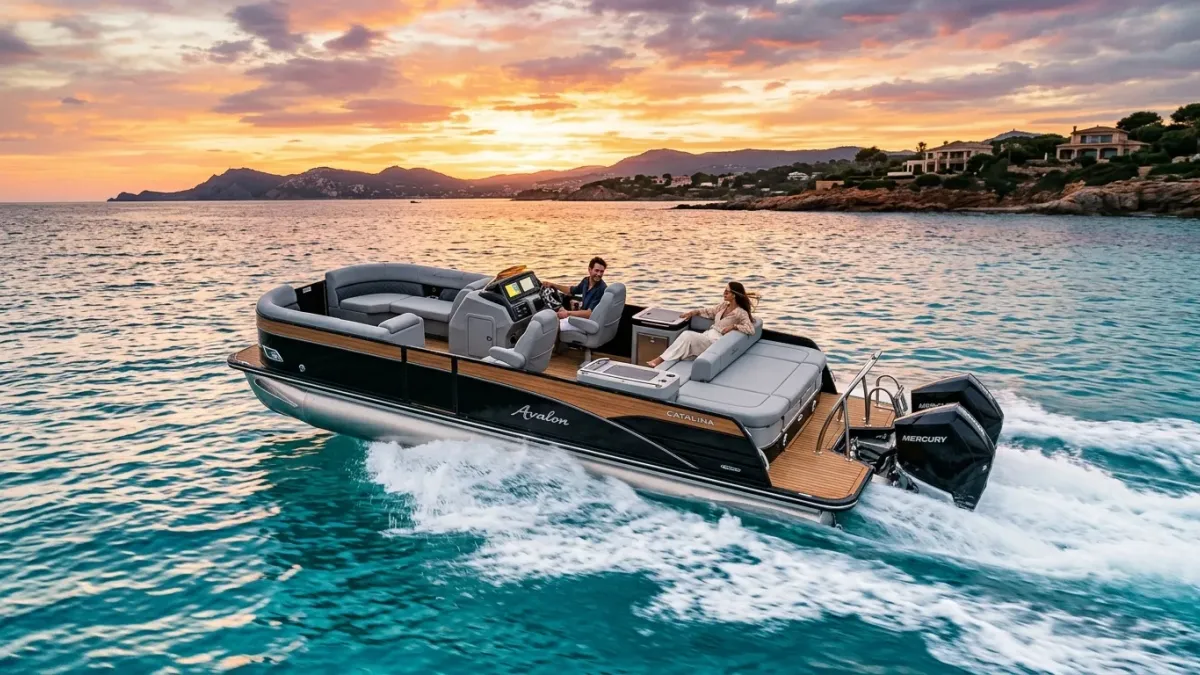
The top tier features luxury and custom powerhouses like Bennington, Premier, and Avalon. Bennington continues to dominate market share because of its relentless quality control, using heavy-duty M-brackets, thick 0.090 to 0.100-inch aluminum tubes, and cross-members spaced every 16 inches on center. Premier sets the pace for interior innovation, offering patented layout configurations and high-grade marine vinyl with multi-density foam that stands up to decades of UV exposure.
The mid-tier performance and versatile cruiser segment includes Crest, Manitou, and Berkshire. Manitou revolutionized the market with its patented V-Toon technology, dropping the center tube lower than the outer tubes to create authentic V-hull banking characteristics in tight turns. Meanwhile, value-driven manufacturers like Sun Tracker, Tahoe, and Sylvan provide accessible entry points into boater ownership without compromising essential safety features or structural integrity.
Detailed Comparison of Top Pontoon Manufacturers
When comparing manufacturers head-to-head, evaluating tube construction, standard outboard configurations, and deck design helps clarify why price points vary so significantly across brands.
Hydrodynamic Log Polish: Star brite Aluminum Restorer

| Brand | Primary Category | Tube Specs (Diameter/Thickness) | Max Horsepower Range | Best For |
|---|---|---|---|---|
| Bennington | Ultra-Luxury / Custom | 25" - 32" / up to 0.100" marine aluminum | 115 HP - 900 HP (Twin Outboards) | Unmatched fit and finish, resale value, luxury options |
| Manitou | Sport Performance | 23" x 27" V-Toon / 0.090" - 0.100" | 150 HP - 800 HP (Dual Engines) | Aggressive turns, high-speed watersports, modern design |
| Premier | Innovation & Luxury | 25" - 36" PTX Packages / 0.090" | 150 HP - 900 HP | Rough water handling, spacious layouts, massive center tubes |
| Crest | Performance cruising | 25" - 26" CP3 Performance / 0.090" | 115 HP - 400 HP | Structural frame strength, integrated electronics, sleek styling |
| Sun Tracker | Value & Family Fishing | 24" - 26" / 0.080" - 0.090" | 60 HP - 200 HP | Affordability, turn-key entry, integrated fishing stations |
Bennington Boats: The Gold Standard in Craftsmanship
Bennington consistently sets the standard for build quality across its flagship QX, R, and SV series. Their pontoon hulls feature heavy-duty cross-members that reduce deck flex in choppy waters, preventing squeaks and structural fatigue over time. The upholstery utilizes marine-grade vinyl with built-in mildew inhibitors, paired with stainless steel hardware throughout the deck rails and bimini tops.
Manitou Pontoons: Unrivaled Handling and Speed
For boaters transitioning from fiberglass runabouts or ski boats, traditional pontoons often feel flat and sluggish in turns. Manitou addresses this with its patented V-Toon hull design, which pairs a 27-inch center tube with 23-inch outer tubes. The center tube sits 5.25 inches deeper, letting the vessel bank smoothly into turns at speeds topping 50 MPH when powered by modern Mercury or Yamaha outboards.
On-the-water tip: When taking delivery or sea-trialling a performance tritoon with a 250+ HP outboard, pay close attention to engine trim at high speeds. Unlike traditional dual-tube pontoons that ride flat regardless of trim, a modern performance tritoon requires positive trim to lift the nose cones out of the water. Failing to trim up properly creates hydraulic drag on the forward underskinning, costing you up to 8 knots in top-end speed and causing severe bow-steering in cross-chop.
Understanding Pontoon Construction: What Makes a Brand Great?
Evaluating pontoon construction requires looking past comfortable upholstery to inspect the structural skeleton beneath the deck. A pontoon’s structural foundation consists of three primary components: aluminum logs (tubes), cross-members, and deck mounting hardware. High-end manufacturers utilize 5052 H34 aluminum alloy for their tubes, with wall thicknesses ranging from 0.080 inches for light-duty lake use to 0.100 inches for heavy rough-water tritoons.
Rail-Safe Docking Security: Extreme Max Pontoon Rail Cleat Kit

Look carefully at the spacing of the transverse cross-members beneath the marine plywood or composite deck. Entry-level brands space cross-members on 24-inch centers, whereas premium builders like Bennington and Premier space them on 16-inch centers—or even 12-inch centers in high-stress zones like the stern engine transom. Closer cross-member spacing drastically improves rigidity, eliminating structural deck twist when navigating heavy boat wakes or chop.
- Lifting Strakes: Aluminum angles welded to the lower sides of the pontoons that generate hydrodynamic lift, allowing the boat to plane faster and increase top speed.
- Underdeck Skinning: Aluminum shielding attached beneath the floor cross-members that prevents water from crashing into the exposed beams ("surging"), dramatically smoothing out the ride and reducing drag.
- Integrated Fuel Tanks: Built directly inside the center tube on tritoon packages to lower the boat’s center of gravity and optimize weight distribution.
Tritoon vs. Dual-Tube: Selecting the Right Hull Configuration
Choosing between a classic twin-tube pontoon and a triple-tube "tritoon" is one of the most critical decisions you will make during the purchasing process. A standard two-tube configuration works exceptionally well for small to medium inland lakes, quiet sandbars, and low-horsepower cruising under 115 HP. Twin-tube designs offer lower hull weight, minimal draft (often less than 12 to 16 inches), and easier trailering with mid-size tow vehicles.
Conversely, a tritoon configuration adds a full-length center pontoon, vastly increasing overall displacement, buoyancy, and structural capacity. With Length Overall (LOA) ranging from 22 to 30 feet, beams of 8.5 to 10 feet, and outboard engines rated up to 400 HP or dual 450 HP setups, tritoons can comfortably slice through open-water chop on large bodies of water like Lake Michigan or coastal bays. The third tube enables higher passenger capacities and supports heavy watersports equipment while maintaining level bow flotation.
Frequently Asked Questions
What is the difference between a pontoon and a tritoon?
All-Weather Deck Protection: Vortex Heavy-Duty Pontoon Cover

A standard pontoon uses two round aluminum tubes beneath the deck, best suited for calm waters and lower horsepower engines (up to 115 HP). A tritoon adds a third center tube, providing significantly higher weight capacity, increased stability in rough water, and support for higher-horsepower outboards (150 HP to 900 HP) with enhanced turning ability.
Which pontoon boat brand holds its value the best?
Bennington, Premier, and Crest consistently maintain the highest resale value on the used market. Their build construction, heavy aluminum gauges, sealed chamber pontoon designs, and transferable structural warranties help retain value over 5- to 10-year periods compared to budget-focused brands.
How much horsepower do I really need on a pontoon boat?
For basic cruising on small lakes with a twin-tube setup, 60 to 90 HP is sufficient for speeds around 18-22 MPH. If you plan to pull tubers or skiers on a twin-tube, aim for 115 HP. For performance tritoons carrying 8 or more passengers, a minimum of 150 HP is recommended, while 250 to 300 HP provides ideal performance for watersports and high-speed lake travel.
Before making your final deposit on a 2026 pontoon, inspect the underskinning, cross-member layout, and dealer support network in your local boating region. Choose a dual-tube 90 HP setup if you prefer calm-water cruising and easy trailering, or step up to a 250 HP performance tritoon with lifting strakes if you plan to navigate open lakes, pull watersports, and transport large groups of friends.
Sources
- Bennington Marine Official Site
- Manitou Pontoon Boats Official Site
- Premier Marine Official Site
- United States Coast Guard Boating Safety Division
Check Out Our Top Recommended Boat Gear on Amazon
Hand-picked sailing & boating essentials we actually recommend.
As an Amazon Associate, we earn from qualifying purchases.