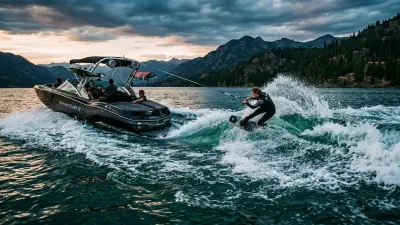
Steering into the specialized realm of towboats reveals a fascinating split in marine architecture. While a non-boater might view every sleek fiberglass vessel with a central tower as simply a "ski boat," any seasoned driver or skier knows that tournament ski boats and dedicated wakeboard vessels are built for completely opposing missions. One is engineered to slice through the lake with chirurgic precision to leave behind a mirror-flat wake, while the other is sculpted to sink heavy into the water column to throw massive, clean-lipped ramps and surfable rollers. Choosing between these two distinct classes requires a clear understanding of hull dynamics, propulsion layouts, ballast capabilities, and cockpit layout priorities.
Quick answer: Tournament ski boats utilize direct-drive mid-engine configurations and shallow-draft hulls to produce ultra-flat, soft wakes optimized for 30–36 mph slalom skiing, whereas wakeboard and wakesurf boats rely on rear-mounted V-drive engines, deep displacement hulls, and heavy ballast systems to sink the stern and shape high-air launch ramps. Selecting the right craft depends primarily on whether your priority is slalom cutting precision or high-capacity cruising, board riding, and wakesurfing.
Hull Architecture and Hydrodynamics: Flat Wakes vs. Massive Ramps
The foundational difference between a pure slalom ski boat and a wakeboard boat lies directly underwater. Hull shape dictates how much water the boat displaces as it moves forward at towing speed, which directly governs the height, steepness, and firmness of the wake trailing behind the transom. Ski boat naval architects design for minimal displacement, employing flat stern sections, minimal deadrise, and precise lifting strakes that keep the vessel skimming along the surface.
In contrast, wakeboard boat designers want the exact opposite reaction from the water. They construct deep-V hull bottoms with aggressive deadrise angles near the bow that transition into broader, displacement-friendly aft sections. Rather than riding high on top of the water, these hulls are shaped to push through it, churning up thousands of gallons of displaced water to create steep wake shoulders designed for boarders jumping across the wake or riders surfing without a rope.
The Flat-Bottom Precision of Tournament Ski Boats
A classic tournament ski boat, such as the MasterCraft ProStar or Nautique 200, typically measures between 19.5 and 20.5 feet in length overall (LOA) with a beam of roughly 85 to 96 inches. These compact dimensions keep the dry weight remarkably low, generally between 2,800 and 3,300 pounds. With a draft of only 20 to 22 inches, the flat aft section creates almost zero transom drag at standard slalom speeds of 32 to 36 mph.
This light displacement ensures that when a slalom skier cuts aggressively across the wakes, the boat holds a rock-solid track without getting yanked sideways. Dual tracking fins along the keel act as underwater rails, keeping the hull tracking straight on three-event tournament courses certified by organizations like USA Water Ski & Wake Sports. The resulting wake is short, table-flat, and soft enough for a skier to cross smoothly at speed.
Deep-V Displacement and Ballast in Wakeboard Vessels
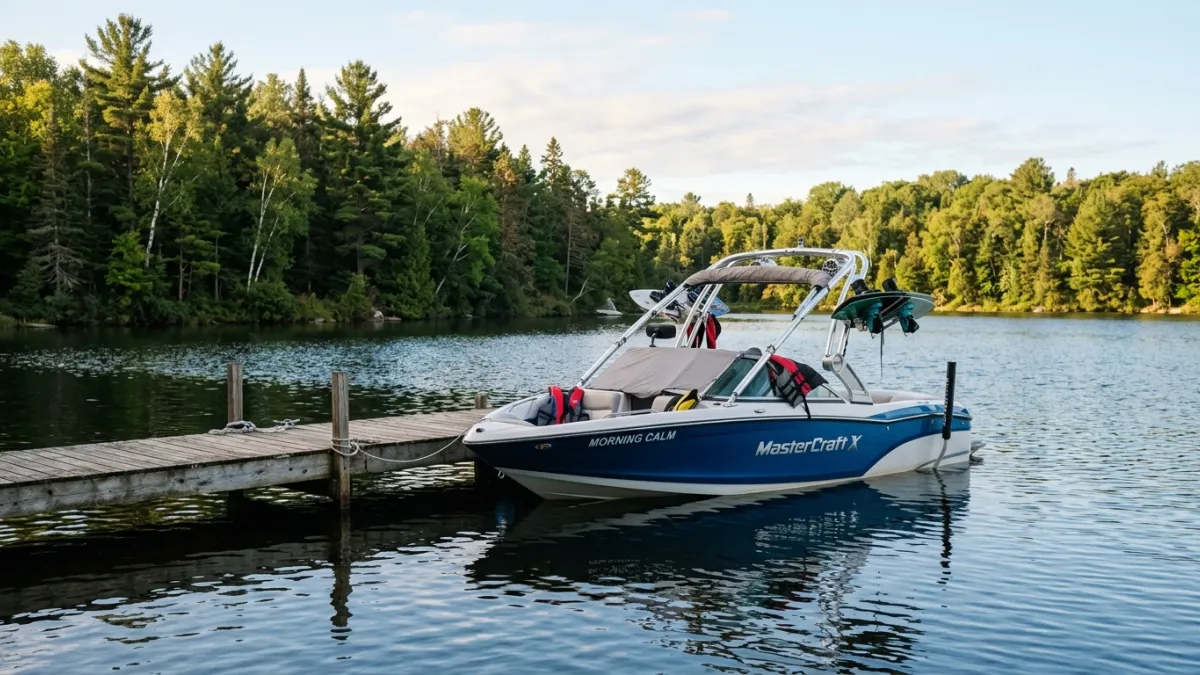
Wakeboard and wakesurf boats operate on a much grander scale. Modern models like the Malibu Wakesetter, MasterCraft X24, or Nautique Paragon stretch from 21 to 26 feet in length overall with wide 102-inch beams. Their dry weights start around 4,500 pounds and can exceed 6,800 pounds before adding liquid ballast or fuel. Draft depth often exceeds 28 to 36 inches under load.
To magnify the wake even further, these vessels feature integrated internal ballast systems consisting of hard plastic tanks and flexible bladder bags hidden beneath the floorboards. Pressing a switch activates high-flow ballast pumps capable of filling or emptying 3,000 to 5,000 pounds of water within minutes. Plowing this immense weight through the lake at typical wakeboarding speeds of 18 to 23 mph generates a tall, crisp wake table with maximum pop.
Engine Placement & Drivetrain: Direct-Drive vs. V-Drive Configurations
The mechanical heart of any towboat dictates both its handling characteristics on the water and the living space available inside the cockpit. Engine placement is the key structural divider between classic tournament ski craft and modern multi-sport wakeboard vessels.
Engine manufacturers such as PCM, Indmar, and Ilmor build high-torque V8 powerplants ranging from 350 hp naturally aspirated engines up to 600+ hp supercharged units to power these hulls. However, the orientation of the engine block and propeller shaft completely alters how that horsepower transfers to the water.
Direct-Drive Systems: Mid-Engine Balance and Throttle Response
Direct-drive propulsion is the time-tested gold standard for pure tournament ski boats. In a direct-drive arrangement, the V8 engine sits right in the center of the boat inside an insulated motor box, commonly called the dog house. A straight stainless steel drive shaft passes down through the bottom of the hull at a shallow angle between 7 and 12 degrees to turn a bronze three- or four-blade propeller.
Centering the engine puts the heaviest mechanical component directly over the boat's center of gravity. This balanced weight distribution prevents the stern from squatting, maintaining a level running attitude that keeps wake height to an absolute minimum. Drivers benefit from instant throttle response, razor-sharp turning radii, and precise tracking, though passengers must navigate around the central engine box occupying the mid-cockpit floor.
On-the-water tip: When maneuvering a direct-drive ski boat in tight marina slips, remember that the prop-wash hits the rudder directly beneath the boat's center. Unlike an outboard or stern-drive boat that steers by vectoring thrust, a direct-drive turns exceptionally sharp under forward power but offers very little steering control in reverse due to prop-walk. Always approach the dock slowly and use brief forward bumps of the throttle to swing the stern into place.
V-Drive Systems: Rear-Engine Displacement and Interior Ergonomics
V-drive propulsion flipped towboat design on its head in the late 1990s and quickly became the dominant configuration for wakeboard and surf boats. In a V-drive setup, the engine is mounted all the way in the stern under the aft sun pads, facing backward with the flywheel pointing toward the bow. The driveshaft runs forward into a specialized V-drive transmission, which loops the torque back down and rearward at an angle through the hull to the propeller.
Concentrating engine weight in the stern helps sink the rear of the hull deeper into the water column, aiding wake creation without requiring extra ballast. Mechanically, modern V-drive units engineered by PCM and Ilmor are exceptionally robust, though they involve secondary gearsets that require routine fluid checks during annual servicing. Moving the powerplant aft completely frees up the cockpit layout, opening the floorplan for plush, wraparound seating lounges.
Wake Shaping Technologies and Hull Hardware
Beyond hull shape and engine placement, hardware mounted to the transom allows captains to fine-tune wake dynamics for different riders and skill levels. Ski boats and wakeboard boats rely on vastly different underwater control systems to achieve their specific wake goals.
Slalom ski boats use minimal trim hardware to keep the hull running flat and level. Mechanical trim plates or small center tabs, like the Nautique Hydro-Gate or MasterCraft attitude adjustment plate, allow the driver to fine-tune the bow down attitude based on fuel load and passenger weight, ensuring the wake remains as flat as possible regardless of speed.
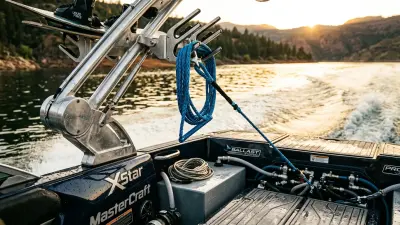
Wakeboard and wakesurf boats, on the other hand, feature highly complex electronic wake-shaping systems. Hydraulic tabs, surf gates, and vertical deployment blades (such as Malibu Surf Gate, Nautique Surf System, or MasterCraft SurfStar) extend outward or downward from the transom sides. Deploying these tabs creates asymmetrical drag, delaying wake convergence on one side to produce a smooth, clean surfing wave with plenty of push—all controlled via touchscreen helm displays integrated with GPS speed control systems like Zero Off or PerfectPass.
Direct Comparison & Specifications Overview
Comparing the design parameters of dedicated slalom ski boats against modern wakeboard and wakesurf vessels highlights how specialized each class has become. The table below outlines key mechanical, structural, and performance metrics across both boat styles:
| Specification / Feature | Tournament Ski Boat | Wakeboard & Wakesurf Boat |
|---|---|---|
| Drivetrain Layout | Direct-Drive (Mid-Engine) | V-Drive (Rear-Engine) |
| Typical Length Overall (LOA) | 19.5 ft – 20.5 ft | 21.0 ft – 26.0 ft |
| Beam Width | 85 in – 96 in | 100 in – 102 in |
| Dry Weight Range | 2,800 lbs – 3,300 lbs | 4,500 lbs – 6,800 lbs |
| Ballast Capacity | 0 lbs – 300 lbs (Optional) | 2,500 lbs – 5,000+ lbs |
| Passenger Capacity | 6 – 7 Passengers | 12 – 18 Passengers |
| Tow Point Height | Low Midship Pylon (Floor Level) | High Aluminum Wake Tower |
| Optimal Tow Speed | 30 mph – 36 mph (Slalom) | 10.5–11.5 mph (Surf) / 18–22 mph (Wake) |
| Average Fuel Consumption | 5 – 8 GPH | 8 – 15+ GPH (Fully Ballasted) |
Buying Guide: Key Decision Factors for Your Water Sports Style
Selecting the right boat comes down to an honest assessment of how your family and crew spend time on the water. While a tournament ski boat offers unrivaled slalom performance, its cozy seating layout and lower freeboard make it less suitable for large social gatherings on choppy, open lakes. Conversely, a heavy V-drive wakeboard boat excels at entertaining large groups and pulling wakesurfers, but its sizable wake table can frustrate serious slalom skiers seeking smooth water cuts.
If your main goal is logging early morning slalom runs through an anchor-down course, prioritizing quick acceleration, flat wakes, and precise tracking makes a direct-drive ski boat the logical choice. Models like the Malibu Response TXi or Correct Craft Ski Nautique offer championship-grade pulls with unbeatable fuel efficiency, consuming as little as 5 to 7 gallons per hour during typical ski runs.
If your weekend routine centers around towing teenagers on wakeboards, wakesurfing with friends, or spending all day anchor-cruising with a crew of 10 or more people, a V-drive wake boat is worth the higher investment. The elevated wake tower provides high tow points that give wakeboarders extra lift and airtime, while the spacious open-bow seating lounge and massive ballast tanks deliver effortless wakesurfing setups at the touch of a screen button.
Evaluating Crew Size, Layout, and Storage Needs
Interior layout should play a major role in your purchasing decision. Direct-drive ski boats split the cockpit in half with the mid-ship engine dog house, leaving narrow walkways to step between the bow and the stern bench. Storage space is limited to gunwale ski racks and small rear trunk lockers, requiring gear like life jackets, ropes, and slalom skis to share space on the floor.
V-drive towboats utilize a wide-open lounge configuration, featuring U-shaped or J-shaped bench seating that spans the entire perimeter of the cockpit. Moving the engine beneath the aft sun pad creates deep storage compartments on either side of the motor box, perfectly sized for storing multiple wakeboards, wakesurf boards, inflatable tubes, and Coast Guard-required safety equipment out of sight.
Fuel Efficiency, Maintenance, and Resale Considerations
Operating costs differ notably between these two categories. Lightweight direct-drive ski boats powered by 350 to 400 hp engines place very little hydrodynamic drag on the motor, allowing them to burn significantly less fuel over a weekend on the lake. Maintenance is straightforward, with direct access to spark plugs, oil filters, and raw water impellers right under the hinged mid-ship engine cover.
V-drive wakeboard boats carry heavy hull displacements and pump thousands of pounds of ballast on board, requiring larger displacement V8 engines (5.3L, 6.2L, or supercharged 6.2L) working under high load conditions. Running at 3,500 to 4,500 RPM while fully ballasted increases fuel burn to 10–15+ gallons per hour. Winterization and transmission servicing also require extra care due to the secondary V-drive gearbox and complex plumbing for ballast pumps, trim actuators, and surf gates.
If you primarily ski on calm, sheltered private lakes or quiet river stretches and prefer precise slalom runs, invest in a low-hour direct-drive tournament ski boat. However, if you plan to navigate larger public reservoirs with chop and wish to board, surf, and host large groups, choose a modern 22- to 24-foot V-drive wakeboard boat equipped with factory ballast and integrated wake-shaping controls.
Frequently Asked Questions
Can you wakesurf behind a direct-drive ski boat?
Wakesurfing behind a traditional direct-drive ski boat is generally not recommended or effective. Direct-drive hulls are engineered to run flat and minimize displacement, making it difficult to build a wave tall enough or long enough to surf without a rope. Additionally, adding heavy portable ballast bags to a low-freeboard ski boat reduces swamping safety margins without matching the surf wave quality of a V-drive hull.
Why are wakeboard towers mounted higher than ski pylons?
Wakeboard towers stand 6 to 7 feet above the floor to give boarders upward tow angle leverage, helping them launch higher off the wake into aerial tricks and land safely. In contrast, slalom ski pylons are mounted low near floor level mid-ship to keep tow rope tension aligned with the boat's center of gravity, preventing the skier from pulling the boat's stern off course during aggressive cuts.
Are V-drive wakeboard boats harder to dock than direct-drive ski boats?
Both direct-drive and V-drive inboards steer differently than outboard or stern-drive boats because they rely on a fixed shaft and underwater rudder. However, modern V-drive wakeboard boats are frequently equipped with factory stern thrusters or dual-rudder systems, making low-speed maneuvering, docking, and pickup around swimmers remarkably simple despite their larger size and weight.
What is the average lifespan of a V8 inboard towboat engine?
With proper winterization, routine oil changes, and regular raw water impeller replacement, modern marine V8 engines from manufacturers like PCM, Indmar, and Ilmor routinely reach 1,500 to 2,500 operating hours before requiring major overhauls. Fresh-water operation significantly extends engine block and manifold lifespan compared to salt-water use.
Sources
- USA Water Ski & Wake Sports Governing Body
- MasterCraft Boat Company Official Specifications
- Nautique Boat Company Technical Guides
- United States Coast Guard Boating Safety Division