Quick answer: Choosing between a power and sailing catamaran comes down to speed and ocean range versus quiet efficiency and long-distance independence. A power cat delivers higher cruising speeds (15–22 knots) and massive flybridge living space, making it ideal for tight vacation schedules, whereas a sailing cat offers virtually unlimited offshore range under wind power with vastly lower fuel costs.
Propulsion, Speed, and Range Dynamics
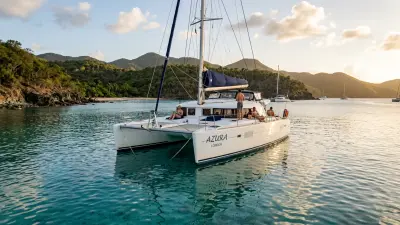
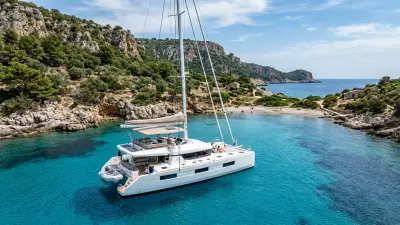
The core distinction between these two vessels begins right at the waterline and dictates how far you can travel in a single day. A typical 45-foot sailing catamaran, such as a Lagoon 46 or Fountaine Pajot Elba 45, relies primarily on a sloop rig with roughly 1,300 to 1,500 square feet (120–140 m²) of total sail area. Under wind power alone, cruising speeds average between 7 and 9 knots in a moderate 15-knot breeze. When the wind dies, small auxiliary diesels—typically twin 45 hp to 57 hp Yanmar or Volvo Penta inboards—push the boat at 6 to 7.5 knots, consuming around 1.5 to 2 gallons of diesel per hour total. This setup provides an incredible endurance range, as a 120-gallon fuel tank can easily stretch for over 400 nautical miles under motor, or infinitely while under sail.
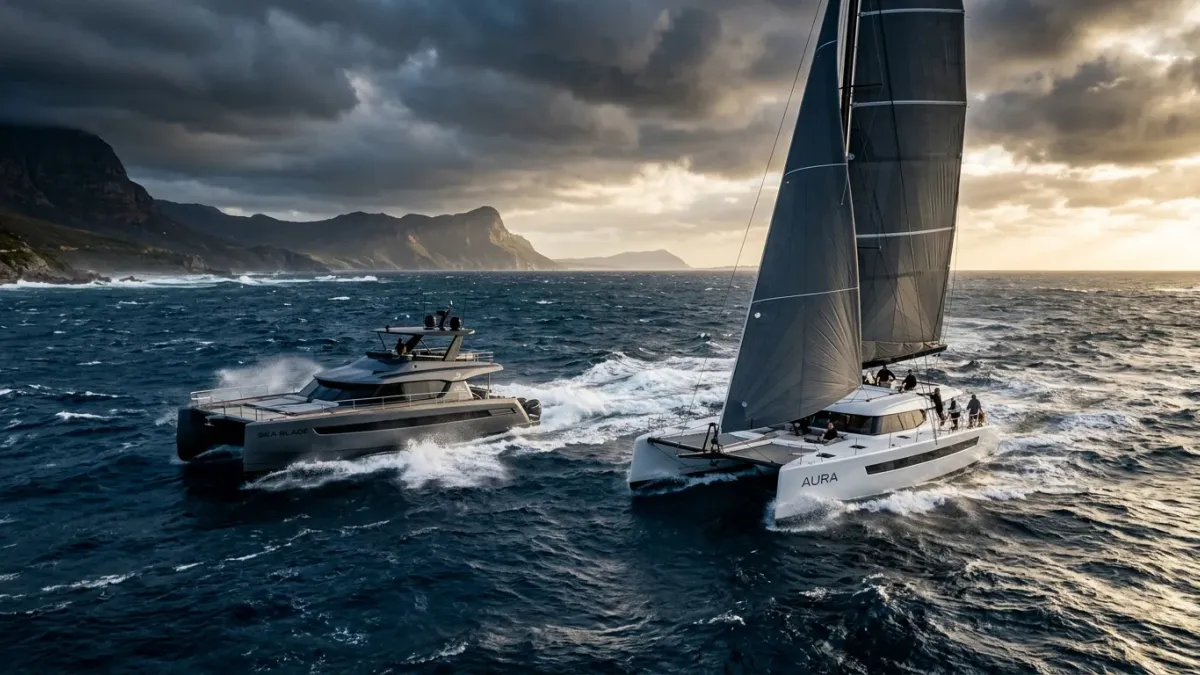
power catamarans, on the other hand, discard the mast, standing rigging, and heavy keel structures in favor of dedicated powerplants and optimized displacement or semi-displacement hull shapes. A power cat like the Aquila 44 or Horizon PC52 is driven by twin inboards ranging from 225 hp up to 550 hp each, or high-output Mercury/Yamaha outboards on smaller models. This allows power cats to comfortably cruise at 15 to 22 knots, with top speeds exceeding 25 knots depending on the hull design. While you can cover 200 nautical miles in a daylight run rather than taking two full days, fuel burn increases exponentially, often reaching 15 to 30 gallons per hour at fast cruise speeds.
Understanding this trade-off is critical for realistic voyage planning. Sailboats require patient passage-making and a constant awareness of weather windows, trade winds, and tacking angles. Power cats give owners the freedom to outrun local weather patterns and quickly jump between island chains on a rigid weekend schedule, provided the fuel budget supports it.
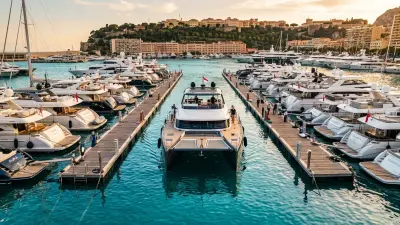
On-the-water tip: When maneuvering either vessel in a crowded marina with strong crosswinds, remember that power catamarans lack the underwater lateral plane provided by a sail cat's low-profile keels or daggerboards. Because power cats have high topsides and shallow draft, they catch the wind like a sail; use your twin engines independently—one in forward, one in reverse—to pivot the boat around its center axis rather than relying heavily on the rudder.
Interior Layout, Deck Space, and Accommodation Features
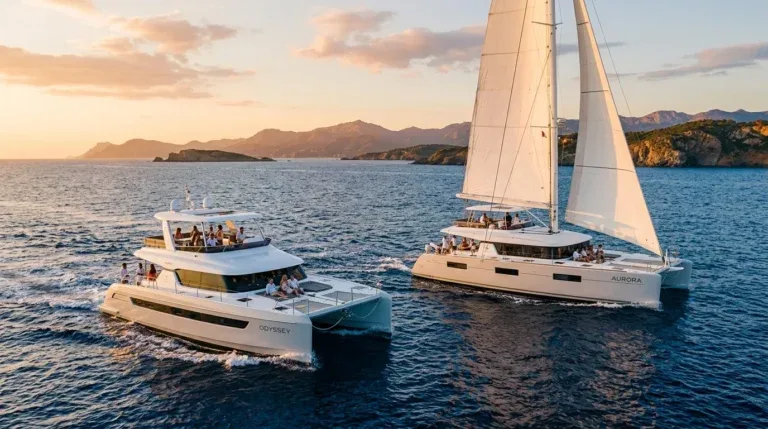
Both types of multihulls benefit from a wide beam—often reaching 22 to 26 feet (6.7 to 7.9 meters) on a 45-foot hull—which eliminates the steep heel angles common to monohulls. However, removing the rig completely changes how naval architects utilize deck space. Without the structural requirement for a mast compression post, chainplates, or running rigging led back to a cockpit, a power catamaran can extend its main saloon forward and carry a massive, full-beam flybridge across the entire upper level.
Sailing catamarans must balance living space with working sail controls. Winches, clutches, and sheet tracks occupy prime real estate around the helm station and aft cockpit. Forward, sailing cats feature trampolines made of woven mesh to reduce bow weight and prevent hydraulic slamming when plunging into head seas. While these trampolines are iconic lounging spots, they are wet deck areas when under way in rough water.
Power catamarans replace forward trampolines with solid fiberglass foredecks, sunbeds, or even forward cockpits accessible directly through a door in the main saloon. Furthermore, the elevated flybridge on a power cat serves as a second full-sized salon, complete with wet bars, outdoor grills, and steering stations that offer uncompromised 360-degree visibility. If maximizing air-conditioned interior volume and entertainer-friendly outdoor lounge space is your top priority, a power catamaran delivers significantly more square footage per foot of length overall (LOA).
Technical Comparison and Specifications
To evaluate how these multihull platforms differ in technical build, operational specs, and physical dimensions, consider the typical metrics for mid-sized cruising models:
| Specification / Feature | Sailing Catamaran (45 ft) | Power Catamaran (44–45 ft) |
|---|---|---|
| Length Overall (LOA) | 45 ft (13.7 m) | 44 ft 11 in (13.7 m) |
| Beam (Width) | 25 ft 10 in (7.87 m) | 21 ft 6 in – 23 ft (6.55 – 7.0 m) |
| Draft | 4 ft 3 in – 4 ft 9 in (1.3 m) | 3 ft 3 in – 3 ft 8 in (1.0 m) |
| Displacement (Light) | ~32,000 lbs (14,500 kg) | ~35,000 – 42,000 lbs (16,000 – 19,000 kg) |
| Primary Engines | Twin 45–57 hp Inboard Diesels | Twin 225–480 hp Inboard/Outboard |
| Cruising Speed | 7 – 9 knots (Sail / Motor-sail) | 14 – 20 knots (Motor) |
| Fuel Capacity | 120 – 200 gal (450 – 750 L) | 350 – 600 gal (1,300 – 2,250 L) |
| Rig & Sail Area | Sloop rig / ~1,400 sq ft (130 m²) | N/A (No mast or standing rigging) |
Cost of Ownership, Maintenance, and Rigging Expenses
The upfront purchase price of new and brokerage catamarans can be surprisingly similar between sail and power, but their ongoing operating budgets diverge rapidly over a 5-to-10-year ownership cycle. Owning a sailing catamaran involves specialized systems maintenance unique to wind propulsion. Stainless steel standing rigging (shrouds, forestay) must be inspected continuously and fully replaced every 10 years to satisfy marine insurance underwriters, a job that easily costs $10,000 to $20,000. Sails degrade under UV exposure and mechanical stress; replacing a main sail, genoa, and code zero every 5 to 7 years costs between $12,000 and $25,000.
Conversely, a power catamaran eliminates sail inventories, mast step loads, winches, and rigging costs entirely, but transfers those expenses directly into mechanical systems and fuel consumption. Large diesel propulsion engines require meticulous service schedules, including heat exchanger flushings, turbocharger checks, transmission fluid changes, and frequent fuel filter replacements. Running high-horsepower engines consumes significantly more oil and mechanical spares over time.
Dockage and haul-out logistics are practically identical for both types due to their wide beams. Finding a boatyard equipped with a travelift wide enough (often requiring a 26-plus-foot bay) is a shared consideration for all multihull owners. However, a power cat's shallower draft—often under 3.5 feet due to the lack of deep keels—makes it slightly easier to navigate thin waters in regions like the Bahamas or the Florida Keys, expanding your options for shallow anchorages.
Selecting the Ideal Cruiser for Your Lifestyle
Determining which boat deserves your investment comes down to a clear assessment of your crew, timeline, and cruising philosophy. If your dream involves long ocean passages, living off-grid for months at a time, and enjoying the tranquil process of harnessing the wind without generator or engine noise, the sailing catamaran is unmatched. It rewards seamanship, self-reliance, and slow travel, making it the premier choice for circumnavigators and blue-water cruisers.
If you have limited time away from work, prefer straightforward mechanical operation, want maximum entertaining space, or frequently cruise coastal waters with family members who prioritize speed and flat-water comfort, a power catamaran is the superior fit. You gain rapid transit speeds, simplified dockside operation, and luxuriously spacious upper-deck living quarters that rival coastal holiday homes.
Frequently Asked Questions
Do power catamarans burn too much fuel for long-distance cruising?
While power catamarans burn significantly more fuel at fast cruising speeds (15–20 knots), most modern displacement power cats can be dialed back to 7 or 8 knots to achieve impressive fuel efficiency. At displacement speeds, fuel consumption drops dramatically, allowing power cats to achieve trans-oceanic ranges of 1,000 to 1,500 nautical miles on a single tank.
Is a sailing catamaran harder to operate shorthanded than a power cat?
Modern sailing catamarans are fitted with electric winches, furling headsails, lazy jacks, and self-tacking jibs that allow a couple or single-hander to trim sails easily from the helm. However, power catamarans remain fundamentally simpler to control, as they require no physical line handling or sail trimming when changing course.
Which catamaran holds its resale value better?
Both power and sailing catamarans retain exceptionally high resale value compared to monohulls due to high market demand. Sailing catamarans from established builders like Lagoon, Bali, and Fountaine Pajot have a massive global buyer pool, while power catamarans from brands like Aquila and Nautitech are experiencing the fastest percentage demand growth in today's brokerages.
Sources
- United States Coast Guard Auxiliary Safety Guidelines
- American Boat and Yacht Council (ABYC) Standards
- Wikipedia: Catamaran Design Principles