
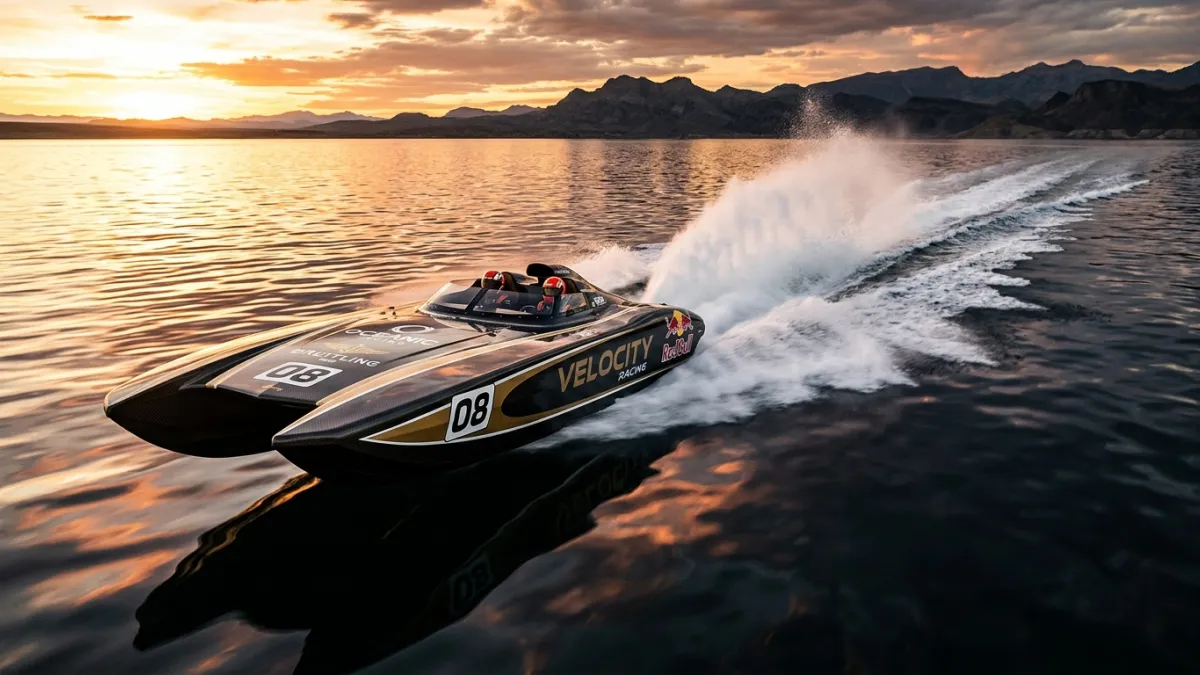
Boats designed for racing span high-speed offshore powerboats hitting speeds over 180 mph (290 km/h), ultra-light performance sailboats reaching 30+ knots on hydrofoils, and specialized tournament vessels. Selecting the ideal racing boat depends entirely on the racing discipline—whether offshore powerboat circuits, regatta keelboat classes, hydroplane drag races, or high-speed freshwater tournaments—alongside structural factors like hull deadrise, carbon fiber construction, and power-to-weight ratios.
Primary Categories of Racing Boats
Competitive marine racing is broadly divided between motorized powerboat disciplines and wind-driven sailing divisions. Each category employs distinct engineering principles to maximize velocity and reduce hydrodynamic drag.
1. Offshore Powerboats and Catamarans
Offshore racing powerboats are built to handle rough ocean waters at extreme speeds. Modern Class 1 and Super Cat racing catamarans frequently utilize twin turbocharged engines producing up to 1,100 horsepower each, driving twin-screw surface drives. These hulls feature deep air tunnels that generate aerodynamic lift, lifting the boat out of the water to minimize friction. Deep-V monohull powerboats, often featuring a 24-degree transom deadrise, provide superior directional stability in heavy swell conditions.
2. Circuit Hydroplanes and Drag Boats
Hydroplanes operate on flat water, utilizing stepped hull designs and sponsons to ride on a cushion of air. Unlimited Hydroplanes, powered by turbine engines generating over 3,000 horsepower, routinely reach speeds exceeding 200 mph (320 km/h) on oval racecourses. Drag boats focus purely on short-distance acceleration over a quarter-mile, achieving 0-to-250 mph in under four seconds.
3. Sport and Tournament Racing Vessels
Not all competitive boating takes place on offshore circuits. Freshwater tournament racing—such as competitive bass fishing runs—demands rapid speeds to reach fishing grounds first. Anglers often seek out modified high-performance bass hulls, ranging from lightweight welded aluminum vessels like alweld boats to fiberglass models equipped with 250 to 300 HP outboard motors achieving speeds over 70 mph. Buyers searching for budget-friendly entries frequently explore market listings for cheap bass boats for sale to modify for local club competitions.
Additionally, sport-oriented hulls like axopar boats and paragon boats have redefined high-speed open-water cruising and tow-sport competitions, using stepped hulls to optimize fuel efficiency and acceleration. For entry-level recreational racing and watersport events, family sport hulls such as tahoe boats offer accessible platforms for local club slalom and wake competitions.
4. Performance Racing Sailboats
Sailboat racing ranges from single-handed dinghy classes (like the ILCA/Laser) to grand-prix ocean racers (TP52, IMOCA 60) and foiling catamarans (AC75). Modern sailboat racing heavily relies on carbon-fiber construction, rotating wing masts, and underwater hydrofoils that lift the hull entirely clear of the water, allowing speeds greater than three times the true wind speed.
Comparing Popular Racing Boat Types
The table below breaks down technical specifications, top speeds, and structural materials across major racing categories:
| Category | Typical Speed Range | Hull Material | Power Source | Primary Environment |
|---|---|---|---|---|
| Offshore Catamaran | 120 – 180+ mph | Carbon Fiber / Epoxy | Twin 750–1100 HP Engines | Open Ocean / Coastal |
| Unlimited Hydroplane | 150 – 200+ mph | Honeycomb Composite | Turbine Engine (3000 HP) | Inland Lakes / Rivers |
| Tournament Bass Boat | 60 – 80 mph | Fiberglass / Aluminum | 200–300 HP Outboard | Freshwater Lakes |
| Grand Prix Racing Sailboat | 20 – 35+ knots | Pre-preg Carbon Fiber | Wind (Hydrofoil / Sails) | Inshore / Offshore Ocean |
Key Design Factors That Drive Speed
Engine output alone does not make a race-winning vessel. Marine engineers focus on three core principles to maximize speed and control:
- Hydrodynamic Drag Reduction: Stepped hulls introduce air under the running surface to break water suction. Hydrofoils replace hull displacement entirely by flying above the surface.
- Power-to-Weight Ratio: Vacuum-infused carbon fiber, Kevlar matrix resins, and structural foam cores drastically decrease weight while maintaining structural integrity against impact forces.
- Propulsion Efficiency: Surface-piercing propellers on powerboats operate half-submerged, reducing lower-unit drag. High-aspect ratio carbon sails on sailboats capture wind energy with minimal aerodynamic turbulence.
To learn more about structural hull variations and how hull shapes impact performance, read our detailed guide on boat hull types and performance characteristics.
Pros and Cons of Dedicated Race Boats
Pros
- Exceptional top-end speed and rapid acceleration.
- State-of-the-art composite engineering and advanced aerodynamics.
- High resale value within specialized racing circuits and enthusiast communities.
Cons
- High maintenance costs due to extreme thermal and mechanical stress on engines and rigging.
- Rigid design compromises comfort; minimal amenities compared to cruising yachts.
- Requires specialized driver training and strict safety equipment (capsule suits, head and neck restraints).
Frequently Asked Questions
What safety gear is mandatory for high-speed powerboat racing?
According to safety guidelines set by governing bodies like the Union Internationale Motonautique (UIM) and APBA, racers must use impact-resistant life jackets rated for high speeds, reinforced safety capsules with life support air systems, wireless engine kill switches, and certified helmet restraint systems.
Can recreational boats be retrofitted for local racing?
Yes. Many entry-level racing leagues feature stock classes where factory runabouts, aluminum utility boats, and standard outboard hulls can compete. Modifications usually focus on propeller pitching, weight minimization, fine-tuning fuel delivery, and installing essential safety kill-switches.
What is the difference between displacement hull racing and foiling?
Displacement hulls push through water, limiting top speed based on waterline length. Foiling boats use underwater wings to generate hydrodynamic lift, raising the hull out of the water to eliminate displacement drag entirely, allowing significantly higher speeds.